By clicking “Accept All Cookies” you agree to the storing of cookies on your device
to enhance site navigation, analyze site usage, and assist in our marketing efforts.
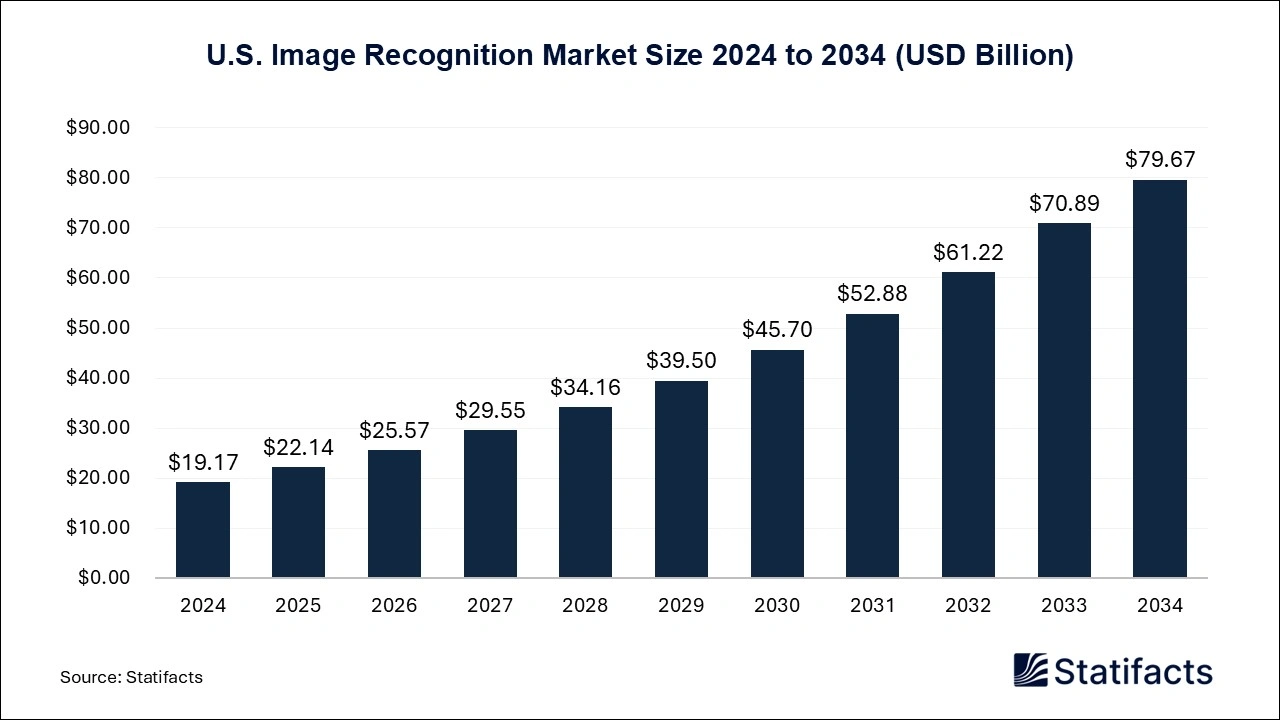
The U.S. image recognition market size was estimated at USD 19.17 billion in 2024 and is projected to be worth around USD 79.67 billion by 2034, growing at a CAGR of 15.31% from 2025 to 2034.
Highlights of the U.S. Image Recognition Market
By technique, the facial recognition segment held a dominant presence in the market in 2024.
By technique, the pattern recognition segment is expected to expand at the fastest CAGR over the projected period.
By application, the marketing and advertising segment accounted for a considerable share of the market in 2024.
By application, the augmented reality segment is projected to experience the highest growth rate in the market between 2025 and 2034.
By component, the service segment maintained a leading position in the market in 2024.
By component, the software segment is projected to expand rapidly in the market in the coming years.
By deployment mode, the cloud segment dominated the market in 2024.
By deployment mode, the on-premises segment is expected to grow at the fastest CAGR in the market during the forecast period of 2025 to 2034.
Industry Valuation and Growth Rate Projection
Industry Worth
Details
Market Size in 2025
USD 22.14 Billion
Market Size by 2034
USD 79.67 Billion
Market Growth Rate from 2025 to 2034
CAGR of 15.31%
The U.S. image recognition market is greatly concerned with advanced machine learning and DL methods to perceive, analyze, and interpret visual data from either images or video frames. It acts similarly to human vision, allowing machines to make decisions based on their visual input. Image analysis is being integrated with AI so that systems can achieve higher accuracy and is being used in many industries. The major adopters include healthcare, automotive, retail, and security services that use image recognition for diagnostics, surveillance, and navigation. With fast advancements of neural networks in terms of computational power and real-time processing, image recognition has now been brought to the forefront of applications supporting augmented and virtual realities, public safety, and autonomous driving.
What are the Market Trends in the U.S. Image Recognition Market?
The market trends in the U.S. image recognition market are defined by AI-powered image recognition, cloud-based solutions, and industry-specific applications.
AI-Driven Advancements: These advancements help increase the level of accuracy in the analysis of images across the deep learning and convolutional neural network (CNN) domains at large.
Cloud-Based Image Recognition: Scalable and cost-effective cloud solutions are driving the growth of e-commerce, retail, and remote applications.
Multi-Modal AI Integration: Advances combining image, text, and audio analyses reach better contextual understandings and use cases across industries.
Generative AI for Synthetic Training Data: Generative models create synthetic datasets to alleviate the scarcity of data and to improve training efficiency.
Industry-Specific Expansion: Image recognition is reaching industries such as healthcare, automotive, and security for their application combinations much faster now.
What are the Major Market Restraints in the U.S. Image Recognition Market?
The growth of the U.S. image recognition market is restrained by factors such as high cost, data concerns, and lack of awareness.
Privacy and Security Concerns: With the rising apprehension over facial recognition and image data misuse, the regulatory terrain faces certain hurdles.
High Implementation Costs: High costs of hardware, software, and AI training hinder adoption, particularly among SMEs.
Data Theft Risks: A Higher risk of cyber-threats and unlawful breaches occurs with image data collection and outsourcing.
Low-Resolution Limitations: Subpar image quality and storage constraints hamper the performance of recognition algorithms.
What are the Market Opportunities in the U.S. Image Recognition Market?
The opportunities in the U.S. image recognition market are associated with automated visual analysis, integration of AI capabilities, and technological advancement.
Healthcare Imaging: AI image recognition will bring a revolution to diagnosis, radiology, and the early detection of disease.
Autonomous Vehicles & ADAS: Navigation, object detection, and safety features inside vehicles are very big growing factors for development.
Retail & E-Commerce Innovation: Visual search, product recognition-aided AR shopping experiences are some of the possibilities to enhance consumer interaction.
Security & Surveillance: Real-time facial and behavior recognition in public and private areas is increasing in demand.
Recent Developments in the Image Recognition Market:
In September 2024, NEC Corporation introduces a biometric system that uses facial recognition to authenticate individuals in crowded areas, processing up to 100 individuals per minute, reducing congestion and waiting times.
U.S. Image Recognition Market Revenue, By Technique, 2024 to 2034 (USD Million)
Subsegment
2024
2025
2026
2027
2028
2029
2030
2031
2032
2033
2034
QR/Barcode Recognition
4,373.20
4,881.50
5,444.40
6,066.70
6,753.60
7,510.10
8,341.30
9,252.30
10,247.60
11,331.40
12,356.20
Object Recognition
5,018.90
6,007.50
7,184.00
8,583.50
10,247.70
12,226.00
14,576.90
17,369.60
20,686.60
24,625.20
28,149.40
Facial Recognition
3,813.70
4,417.80
5,119.40
5,934.30
6,881.10
7,981.70
9,261.30
10,749.60
12,481.20
14,496.60
16,322.80
Pattern Recognition
2,160.40
2,469.90
2,824.50
3,230.70
3,696.40
4,230.20
4,842.30
5,544.30
6,349.60
7,273.60
8,118.50
Optical Character Recognition
1,851.30
2,093.70
2,367.60
2,677.00
3,026.60
3,421.40
3,867.10
4,370.00
4,937.30
5,577.10
6,168.60
Last Updated: 17 Jun 2025
Source: Statifacts

References
Primary Research Interviews
Market Research Firms: Organizations like Market Research Future (MRFR) and Verified Market Research conduct in-depth interviews with industry experts, stakeholders, and key players to gather firsthand insights into market trends and forecasts.
Industry Conferences: Events such as the Computer Vision and Pattern Recognition (CVPR) conference provide opportunities for direct interactions with professionals and researchers in the field.
Stakeholders
Technology Providers: Companies like IBM, Google, Amazon Web Services, and Microsoft are pivotal in developing and deploying image recognition technologies.
End Users: Industries such as healthcare, retail, automotive, and security leverage image recognition for various applications, including diagnostics, customer service, and surveillance.
Regulatory Bodies: Organizations like the National Institute of Standards and Technology (NIST) play a role in setting standards and benchmarks for image recognition technologies.
Databases
ImageNet: A large visual database designed for use in visual object recognition software research, containing over 14 million images hand-annotated to indicate what objects are pictured.
FERET Database: A government-sponsored project that aimed to create a large, automatic face-recognition system for intelligence, security, and law enforcement purposes.
Chronicling America: A database of digitized historic American newspapers, which can be useful for analyzing the historical context and evolution of image recognition technologies.
Magazines
Wired: Covers the intersection of technology, culture, and business, often featuring articles on advancements in image recognition and artificial intelligence.
MIT Technology Review: Publishes in-depth articles on emerging technologies, including developments in image recognition and computer vision.
IEEE Spectrum: The flagship magazine of the IEEE, covering a wide range of engineering and applied sciences topics, including image recognition technologies.
Journals
IEEE Transactions on Pattern Analysis and Machine Intelligence (TPAMI): A leading journal in the field of computer vision and image recognition.
Journal of Machine Learning Research (JMLR): Publishes research on machine learning, including algorithms and applications in image recognition.
Computer Vision and Image Understanding (CVIU): Focuses on the development and application of computer vision techniques, including image recognition.
Newspapers
The New York Times: Covers a wide range of topics, including technology and its impact on society, often featuring articles on advancements in image recognition.
The Wall Street Journal: Provides coverage on business and technology, including developments in the image recognition market.
USA Today: Offers articles on technology trends, including the adoption and impact of image recognition technologies.
Associations
IEEE Computer Society: A professional organization for computing professionals, offering resources and conferences related to image recognition and computer vision.
Association for Computing Machinery (ACM): Provides a platform for computing professionals, including those working in image recognition, to share research and developments.
Computer Vision Foundation (CVF): Supports the computer vision community through conferences and publications, including the CVPR conference.
Public Domain Sources
Library of Congress: Offers free-to-use digital collections, including books, newspapers, and photographs, which can be valuable for historical research on image recognition.
National Institutes of Health (NIH) Image Gallery: Provides access to a vast collection of medical images that can be used for research and development in image recognition applications.
U.S. Government Open Data: Various federal agencies provide open access to datasets that can be utilized for training and testing image recognition algorithms.
Proprietary Elements
Proprietary Datasets: Companies like Google and Amazon maintain proprietary datasets that are used to train and improve their image recognition models.
Proprietary Algorithms: Organizations develop proprietary algorithms and models for image recognition, which are central to their competitive advantage.
Patents: Companies file patents related to image recognition technologies, protecting their innovations and methodologies.
U.S.
Market Statistics
U.S. Image Recognition Market Revenue, By Technique 2024 to 2034 (USD Billion)