Last Updated: 17 Jun 2025
Source: Statifacts


Share



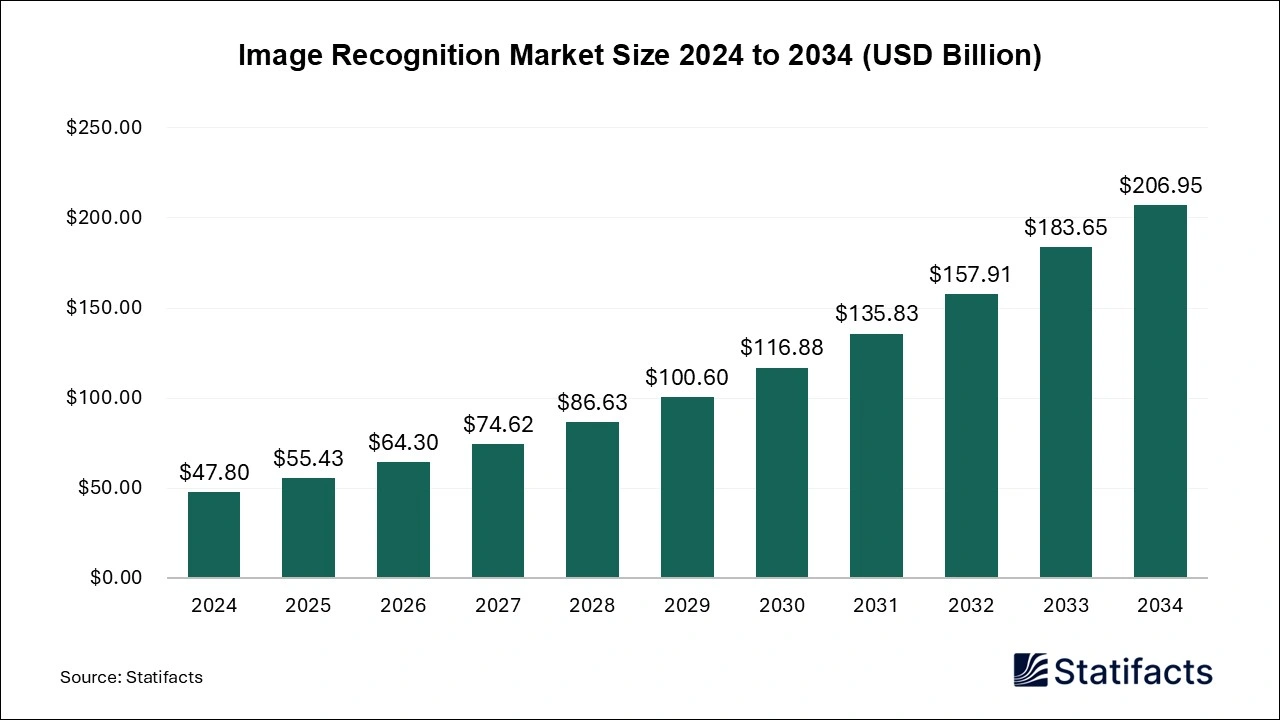
The global image recognition market size surpassed USD 47.8 billion in 2024 and is predicted to reach around USD 206.95 billion by 2034, registering a CAGR of 15.78% from 2025 to 2034.
| Industry Worth | Details |
| Market Size in 2025 | USD 55.43 Billion |
| Market Size by 2034 | USD 206.95 Billion |
| Market Growth Rate from 2025 to 2034 | CAGR of 15.78% |
The image recognition market deals with an object image classification marketplace that incorporates a number of technologies that enable machines to see and interpret visual information much like the human eye. Artificial intelligence (AI), machine learning, and pattern recognition are the elements that allow these systems to identify objects, people, and scenes in images or video streams and take action from that visual data. This spectacular technology goes to different industries like retail, healthcare, automotive, security, surveillance, and immersive technologies. It also enables real-time interaction of AR and VR applications with the physical environment. As AI and DL evolve, we push the limits of image recognition to the more smart, faster, and accurate ones. Industry digitalization plays as the main background that supports automation, efficiency, and innovation through image recognition.
“In the coming weeks, public figures in the UK will start seeing in-app notifications letting them know they can now opt in to receive the celeb-bait protection with facial recognition technology.”
North America
North America dominated the market in 2024. An advanced tech base, excited early adopters, and an end-user community willing to engage in technological upgrades collectively place North America at the helm of the global image recognition market in 2024.
Asia-Pacific
Asia-Pacific is expected to see the fastest CAR during the forecast period. Asia-Pacific region grows due to digitization and AI applications in retail and healthcare mature at a rapid pace, coupled with facilitated e-commerce activities. India and China remain the focus of adoption, as both develop economically and infrastructurally.
Europe
Europe grows slowly yet steadily, considering more industries that are initiating image recognition and secure, on-premise solutions amid strict data security regulations. The said region's alpine hikes on AI integration, plus the needs in retail, automotive, and urban security, increasingly assert the rank that the region holds in the global image recognition market.
The market is moderately fragmented with local players like Google LLC, IBM Corporation, Amazon Web Services, Inc., NVIDIA Corporation, Cognex Corporation, Honeywell International Inc., Intel Corporation, Catchoom Technologies S.L., LTU Technologies (A Dassault Systèmes Company), Microsoft Corporation, Slyce Inc., Qualcomm Technologies, Inc., NEC Corporation, Toshiba Corporation, Zebra Medical Vision Ltd. etc. wishing to take the time to edge their presence through investments, partnerships, acquisitions, and mergers. They also invest in product development and competitive pricing. These strategies will promote market growth and lucrative opportunities for market players
NVIDIA's annual revenue for fiscal year 2025 (ending January 26, 2025) was a record $130.5 billion, a 114% increase compared to the previous year.
Amazon Web Services (AWS) annual revenue for 2024 was $107.6 billion, a 19% increase year-over-year.
In 2024, Google's parent company, Alphabet, reported a total revenue of $350.018 billion.
Published by Yogesh Kulkarni





