



Aviation-grade Aluminum Market (By Type: Plate, Rod, Tube, and Others; By Application: Military Aviation and Civil Aviation; By Region: North America, Europe, Asia Pacific, and LAMEA) Industry Size, Share, Growth, Trends 2026 to 2035

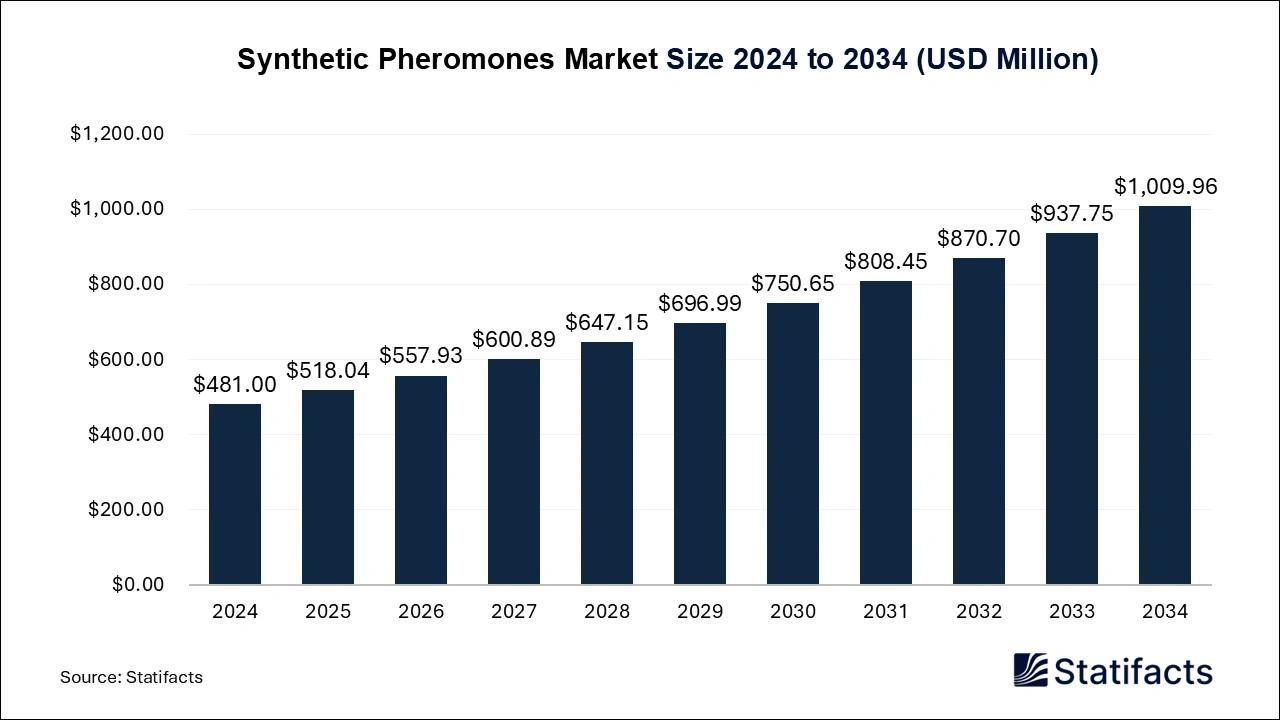
The global synthetic pheromones market size was valued at USD 518.04 million in 2025, is projected to reach approximately USD 1078.73 million by 2035. This growth, driven by expanding use in pest control and agricultural productivity enhancement, is expected at a CAGR of 7.7%.
| Reports Attributes | Statistics |
| Market Size in 2025 | USD 518.04 Million |
| Market Size in 2026 | USD 557.93 Million |
| Market Size in 2032 | USD 870.7 Million |
| Market Size by 2035 | USD 1078.73 Million |
| CAGR 2026 to 2035 | 7.61% |
| Base Year | 2025 |
| Forecast Period | 2026 to 2035 |
The synthetic pheromones market is growing rapidly, and the agricultural sector is moving towards bio-based pest control to address environmental and health problems. The growing regulatory restrictions on harmful pesticides and the need to sustainably improve farm productivity are driving the rapid adoption of pheromonal-based monitoring and control systems. These pheromones can also mimic natural insect signals to disorient mating, providing an effective, non-toxic means of pest control that protects crops without affecting the ecological balance. The technology is becoming popular in fruit, vegetable, and grain crops, forestry, and storage facilities. The issues of high production costs, poor pheromone stability, and limited availability of species-specific formulations may, however, act as impediments to large-scale implementation, especially in emerging economies.
Controlled-release pheromones, nanotechnology-based pheromone carriers, and digital pest-monitoring systems are likely to drive the synthetic pheromones market forward. Food companies that invest in artificial intelligence AI- and internet of things IoT-based pheromone detectors are improving real-time data collection and pest population analytics to enhance precision agriculture. Additionally, partnerships between agrochemical companies, universities, and biotechnology start-ups will be an anticipated move to hasten the development and commercialization of products.
| Regions | Shares (%) |
| North America | 47.40% |
| Asia Pacific | 19.43% |
| Europe | 21.24% |
| LAMEA | 11.93% |
| Segments | Shares (%) |
| Sex Pheromones | 29.85% |
| Aggregation Pheromones | 58.14% |
| Others | 12.01% |
| Segments | Shares (%) |
| Fruits and Vegetables | 26.79% |
| Field Crops | 46.44% |
| Others | 26.76% |
Published by Saurabh Bidwai





