



Yarn Break Sensor Market (By Type: Photoelectric, Capacitive, and Others; By Application: Apparel Manufacturing, Industrial Textiles, Medical Textiles, and Others; By Region: North America, Europe, Asia Pacific, Latin America, and Middle East & Africa) Industry Size, Share, Growth, Trends 2026 to 2035.

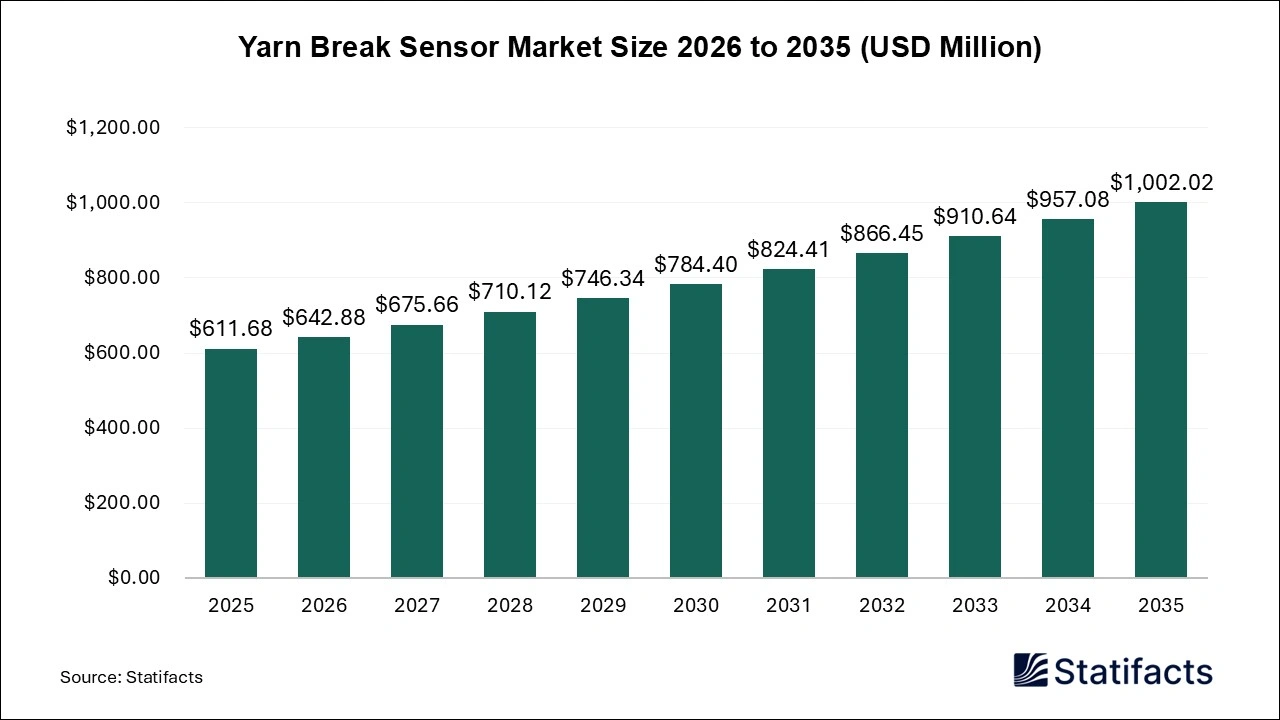
The global yarn break sensor market was valued at USD 611.68 million in 2025 and is projected to reach USD 1002.02 million by 2035, growing at a CAGR of 5.06%. This growth is driven by increasing automation in textile manufacturing and the demand for improved production efficiency and quality control.
| Reports Attributes | Statistics |
| Market Size in 2025 | USD 611.68 Million |
| Market Size in 2026 | USD 642.88 Million |
| Market Size in 2032 | USD 866.45 Million |
| Market Size by 2035 | USD 1002.02 Million |
| CAGR 2026 to 2035 | 5.06% |
| Base Year | 2025 |
| Forecast Period | 2026 to 2035 |
The yarn break sensor market refers to the global industry focused on the development, manufacturing, and sale of sensors designed to detect yarn breakage during textile production. These sensors are essential components in modern textile machinery, enabling real-time monitoring of yarn tension and continuity to prevent defects, production delays, and material wastage. By quickly detecting yarn breaks in processes such as weaving, knitting, and embroidery, these sensors help improve manufacturing efficiency, maintain product quality, and reduce operational costs.
Yarn break sensors are commonly classified by type, including photoelectric, capacitive, and other advanced sensing technologies, and are utilized across diverse applications such as apparel manufacturing, industrial textiles, and medical textiles, among others. The market is driven by increasing automation in textile production, rising demand for high-quality fabrics, and technological advancements in sensor accuracy and integration.
| Segments | Shares (%) |
| North America | 40% |
| Europe | 30% |
| Asia Pacific | 20% |
| LAMEA | 10% |
| Segments | Shares (%) |
| Photoelectric | 40% |
| Capacitive | 35% |
| Others | 25% |
| Segments | Shares (%) |
| Apparel Manufacturing | 50% |
| Industrial Textiles | 30% |
| Medical Textiles | 10% |
| Others | 10% |





