

Share


Vertical Iron Roller Rice Mill Market (By Type: Processing Capacity: 0-5 tons per hour, 5-10 tons per hour, and over 10 tons per hour; By Application: Factory and Home Workshop; By Region: North America, Europe, Asia Pacific, Latin America, and Middle East & Africa) Industry Size, Share, Growth, Trends 2026 to 2035

The global vertical iron roller rice mill market exceeded USD 435.94 million in 2025 and is projected to reach USD 727.63 million by 2035, growing at a CAGR of 5.26%. Market growth is driven by increasing automation in manufacturing, rising adoption of robotics for precision operations, and the need to enhance productivity and efficiency.
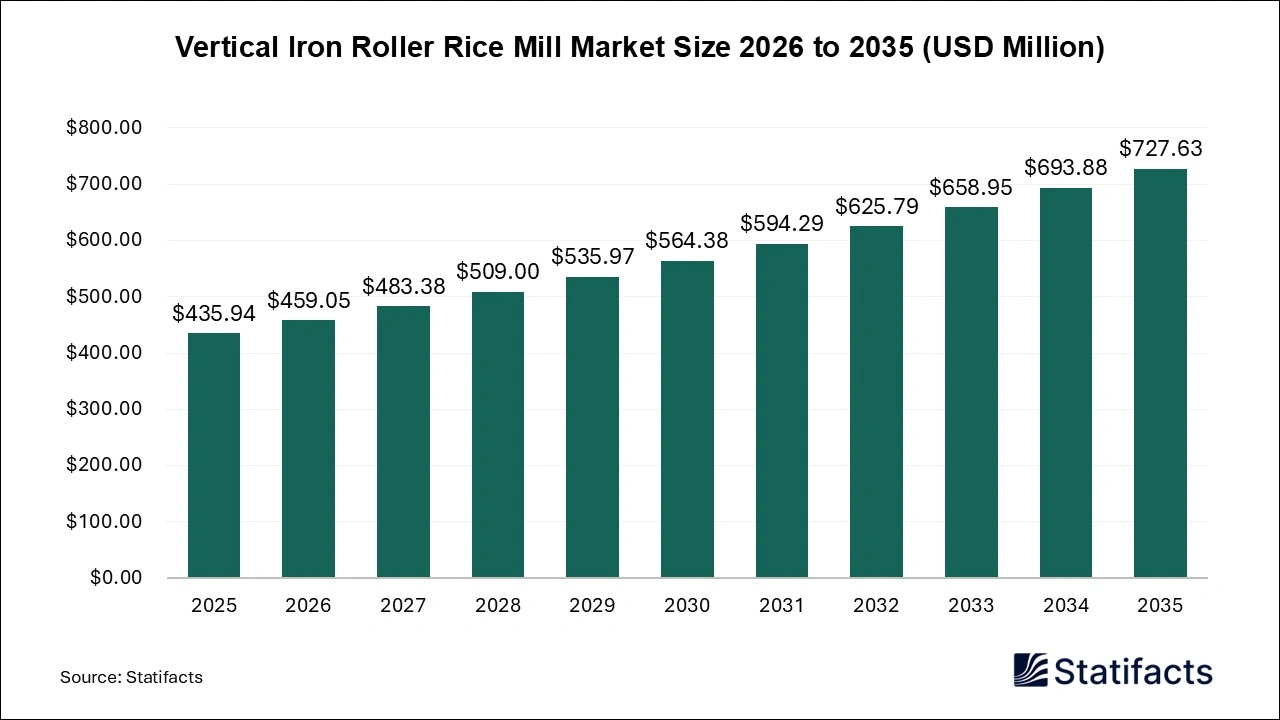
| Reports Attributes | Statistics |
| Market Size in 2025 | USD 435.94 Million |
| Market Size in 2026 | USD 459.05 Million |
| Market Size in 2032 | USD 625.79 Million |
| Market Size by 2035 | USD 727.63 Million |
| CAGR 2026 to 2035 | 5.26% |
| Base Year | 2025 |
| Forecast Period | 2026 to 2035 |
The vertical iron roller rice mill market refers to the global industry involved in the manufacturing, distribution, and sale of vertical iron roller rice milling machines. These machines are designed to process paddy (unmilled rice) into polished white rice by employing a vertical roller mechanism that efficiently removes husk and bran layers while minimizing grain breakage. Unlike traditional horizontal or stone mills, vertical iron roller rice mills offer improved efficiency, higher output, reduced energy consumption, and better rice quality, making them a preferred choice for both commercial rice milling facilities and small-scale operations.
The market encompasses various types of vertical iron roller rice mills, segmented by processing capacity, application, and region. Key applications include industrial rice processing factories and smaller home or workshop setups. The market growth is driven by increasing demand for rice in Asia and other regions, modernization of rice milling technology, and rising awareness about higher efficiency and reduced wastage in rice processing.
| Segments | Shares (%) |
| North America | 9.84% |
| Europe | 3.32% |
| Asia Pacific | 16.17% |
| LAMEA | 20.67% |
| Segments | Shares (%) |
| Processing Capacity: 0-5 tons per hour | 40% |
| Processing Capacity: 5-10 tons per hour | 33.44% |
| Processing Capacity: Over 10 tons per hour | 26.56% |
| Segments | Shares (%) |
| Factory | 45.79% |
| Home Workshop | 54.21% |





