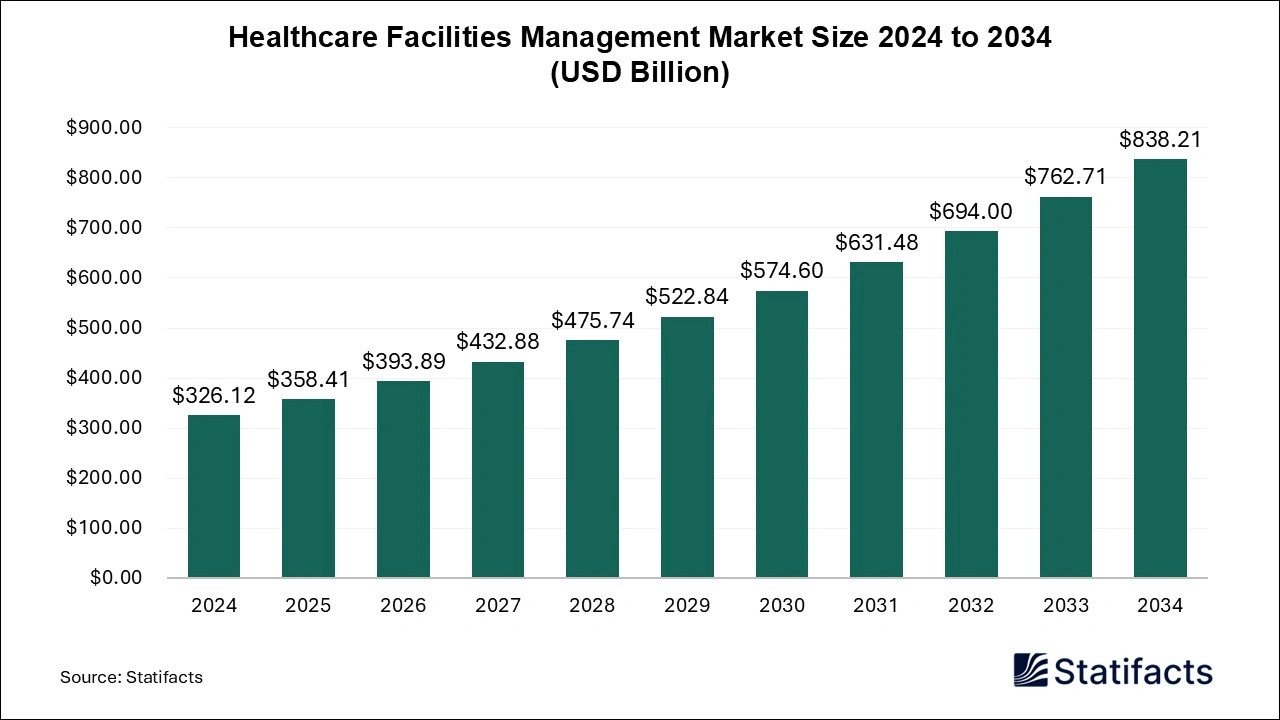
The global healthcare facilities management market size was calculated at USD 326.12 billion in 2024 and is predicted to attain around USD 838.21 billion by 2034, expanding at a CAGR of 9.9% from 2025 to 2034.
Highlights of the Healthcare Facilities Management Market
- North America dominated the global healthcare facilities management market in 2024.
- Asia Pacific is anticipated to grow at the fastest rate in the market during the forecast period.
- By service type, the hard services segment held a dominant presence in the healthcare facilities management market in 2024.
- By service type, the soft services segment is expected to grow at the fastest rate in the market during the forecast period of 2025 to 2034.
- By end user, the hospitals & clinics segment accounted for a considerable share of the healthcare facilities management market in 2024.
- By end user, the long-term healthcare facilities segment is projected to experience the highest growth rate in the market between 2025 and 2034.
Industry Valuation and Growth Rate Projection
| Industry Worth |
Details |
| Market Size in 2025 |
USD 358.41 Billion |
| Market Size by 2034 |
USD 838.21 Billion |
| Market Growth Rate from 2025 to 2034 |
CAGR of 9.9% |
The healthcare facilities management market refers to the maintenance and administration of a healthcare facility’s maintenance, development, operations, and security. These management systems come with the benefits of minimizing energy expenses, employee health and wellness, occupant safety, security, improving space utilization, enhancing patient experience, predictive maintenance, ensuring regulatory compliance, cost control, asset management, energy management, and overall upkeep.
These healthcare facilities are needed to treat and prevent illnesses across large populations. Healthcare facilities like blood banks, ambulance services, laboratories for testing, hospitals, and health centers can provide essential care and services to patients. In October 2024, the Health Facility Solar Electrification (HFSE) initiative to improve primary healthcare services was launched by Ethiopia, the Ministry of Health, Gavi, UNICEF, and WHO. Over 300 remote healthcare facilities across Ethiopia are powered with solar energy and serve an estimated 6.7 million people.
Healthcare Facilities Management Market: Stats and Figures
- According to the World Health Organization (WHO), in June 2023, nearly 118.54 million blood donations were collected worldwide. Approximately 40% of these are collected in high-income countries, which are home to 16% of the world’s population. Almost 13300 blood centers in 169 countries report collecting a total of 106 million donations.
- According to a report published in July 2024, state-run medical transport services or ambulance services recorded the fastest response time across 12 different states, averaging 7.3 minutes.
- In March 2025, a report published by the World Health Organization (WHO), over 1 billion people worldwide are at risk of falling into poverty because of poor health spending of 10% or more of their household budget.
- Improving primary healthcare (PHC) interventions among low and middle-income countries can save 60 million lives and improve average life expectancy by 3.7 years by
- 2030. Across the world, investments in PHC enhance access and equity, accountability of health systems, healthcare performance, and health outcomes.
Industry Leader Announcements
- Tim Dismond was appointed to Chief Operations Officer (COO) and Marjorie McCarthy to Chief Marketing Officer (CMO)
In October 2024, two senior leaders were appointed to the leadership team of North American business, including Tim Dismond as Chief Operations Officer (COO) and Marjorie McCarthy as Chief Marketing Officer (CMO), who were appointed by a leading global workplace experience, corporate dining, and facility management company, ISS.
- Dexter Devid, Senior Vice President, Human Resources, Diversity, Equity & Inclusion
Dexter Devid, Senior Vice President, Human Resources, Diversity, Equity & Inclusion, said, “Through allyship and advocacy, we strive to create an engaging and inclusive workplace where all associates are allowed to perform at their best.” “It’s time to take steps and build on the momentum to ensure each associate at Ecolab has the opportunities they deserve.”
How AI Has Benefitted the Market
- AI has revolutionized the healthcare facilities management market by improving patient experience, population health management, and aiding in research. While not currently being directly involved with patient care, AI can help to analyze usage patterns, schedule maintenance, and predict failures.
- Reduces downtime: AI reduces downtime, improves user experience in buildings, and enhances reliability.
- Emergency management: AI algorithms improve risk prediction for hurricanes, tornadoes, wildfires, and other risks.
- Remote Monitoring: AI can help in remote health monitoring by digitizing healthcare routines and switching to remote care models with telehealth apps. This helps to handle more patients in a day.
- Lowers healthcare costs: AI helps to reduce healthcare costs for both patients and providers by improving processes, facilitating preventive care, and improving processes.
Recent Developments:
- In April 2025, a new product ‘SIMPPLE Vision”, an end-to-end Vision as a service (VaaS) video content analytics, that secures a paid pilot with a national healthcare institution in Singapore, was launched by a leading technology provider and innovators in the facilities management (FM) sector, SIMPPLE Ltd.
- In February 2025, a Healthcare Technology Management (HTM) facility at Sector V in Kolkata was introduced by a sustainable food services and valued experiences company, Sodexo India.
Geographical Insights
North America dominated the global healthcare facilities management market in 2024, while Asia Pacific is anticipated to grow at the fastest rate in the market during the forecast period.
North America
North America dominated the global healthcare facilities management market in 2024. The presence of innovative technologies and strong healthcare organizations is driving the growth of the market in this region.
- In August 2024, a programme supporting water and sanitation standardization and training for health workers, supported by the Republic of Korea, was developed by coordinating with the Palestinian Ministry of Health, UNICEF.
Asia Pacific
Asia Pacific is anticipated to grow at the fastest rate in the healthcare facilities management market during the forecast period. India and China are the leading countries for the growth of the market in the Asia Pacific region.
- In October 2024, India’s first free air ambulance service or helicopter emergency medical service (HEMS) at AIIMS Rishikesh, aimed at providing quick medical care to remote areas during the ‘golden hour’, was launched by Prime Minister Narendra Modi.
- In August 2024, a report was published on co-designing interventions to strengthen the primary healthcare system for the management of type 2 diabetes and hypertension in China.
Competitive Landscape
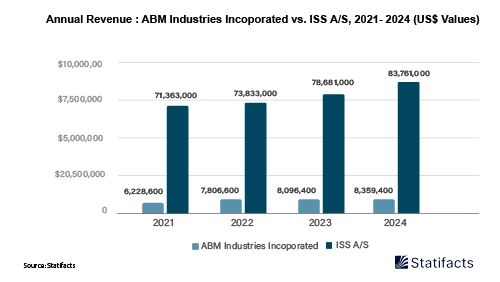
The healthcare facilities management market is highly competitive, with leading companies like ABM Industries Inc. and ISS World Services A/S holding the highest market share.
- Company Name: ABM Industries Inc.
- Year of Incorporation: 1985
- Headquarters: New York, New York, United States.
ABM reported first-quarter fiscal 2025 results, with revenue up 2.2% to $2.1 billion, including organic growth of 1.6%. Net income of $43.6 million, and earnings per diluted share of $0.69, versus $44.7 million and $0.70 in the prior year, respectively.
- Company Name: ISS A/S
- Year of Incorporation: 1901
- Headquarters: Copenhagen, Denmark.
ISS A/S is a multi-national company operating in a number of European nations such as the United Kingdom, Ireland, Germany, Switzerland, Spain, Turkey, and Denmark. The company also has roots in North America, operating in both the United States and Canada, with an Oceania presence in New Zealand and Australia. ISS A/S has a diverse portfolio, operating in manufacturing, transportation, hospitality, security, and emergency management services. The company also extends administrative support and management services, with investments in energy management, asset management, building structure and fabric, property maintenance, and waste management services.