By clicking “Accept All Cookies” you agree to the storing of cookies on your device
to enhance site navigation, analyze site usage, and assist in our marketing efforts.
The U.S. military displays market size was evaluated at USD 349.1 million in 2024 and is expected to grow around USD 615.1 million by 2034, registering a CAGR of 5.82% from 2025 to 2034.
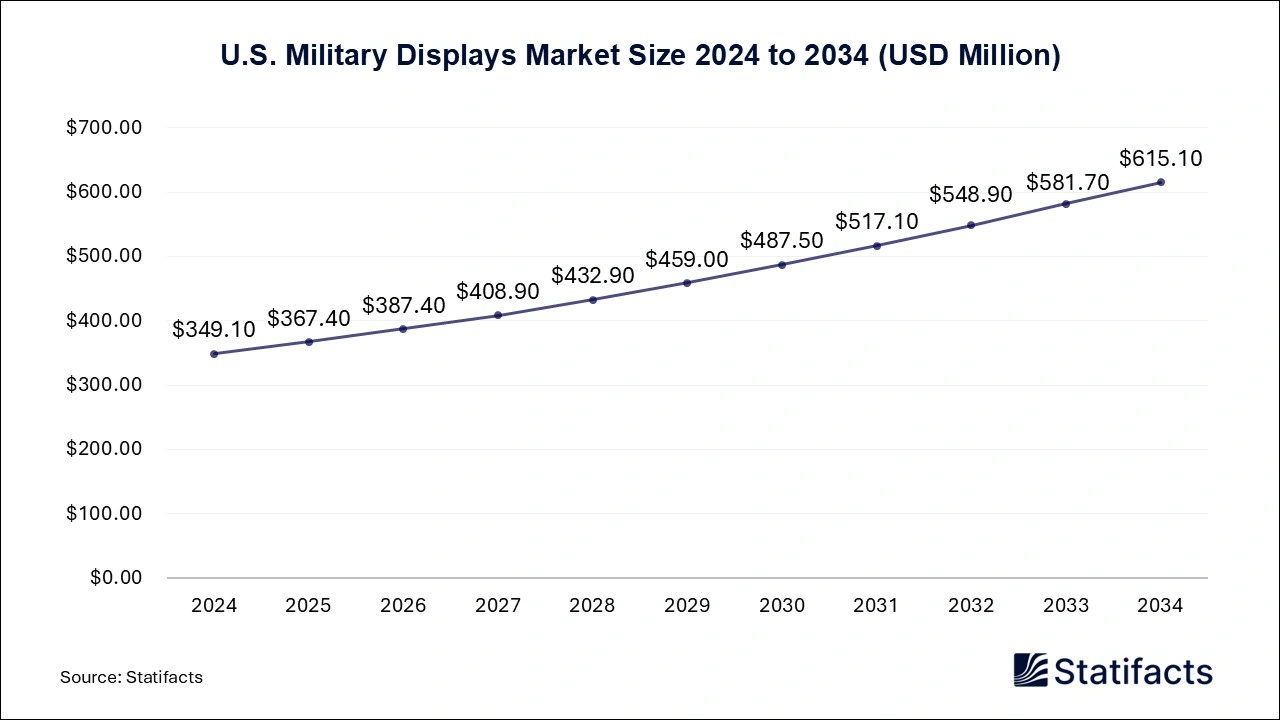
Highlights of the U.S. Military Displays Market
By product, the computer displays segment held a dominant presence in the market in 2024.
By product, the handheld segment is expected to grow at the fastest rate in the market during the forecast period of 2025 to 2034.
By technology, the liquid crystal display (LCD) segment accounted for a considerable share of the market in 2024.
By technology, the OLED segment is projected to experience the highest growth rate in the market between 2025 and 2034.
By end use, the land segment led the U.S. military displays market.
By end use, the airborne segment is set to experience the fastest rate of market growth from 2025 to 2034.
Industry Valuation and Growth Rate Projection
Industry Worth
Details
Market Size in 2025
USD 367.4 Million
Market Size by 2034
USD 615.1 Million
Market Growth Rate from 2025 to 2034
CAGR of 5.82%
Owing to demand for high-tech weaponry, the U.S. military displays market has been significantly expanding in the past few years. Screens inside tanks, planes, ships, and command posts give troops crucially important intel about enemy positions, weather, and mission statuses. These specialized screens provide a visual interface to convert raw data into images that allow the troops to make independent decisions on the field in both a quick and wise fashion. These also tend to have features such as anti-reflective coatings and feature high brightness levels, allowing for easier use in harsh environments and combat zones.
Developments in display technology, increased defense budgets, and the thirst for sharper situational awareness keep driving the growth of the market. Manufacturers are investing in versatile hardware solutions that are durable across several missions, enabled by simple software upgrades. They are now making rugged, high-resolution panels that stand the test of heat, cold, or shock. Touch capability and night-vision modes are quickly becoming standard. Moving forward, with the army leaning toward networked combat and cyberspace, special display demand shall culture further, giving an expansive shape to the market.
What Are the Market Trends in the U.S. Military Displays Market?
The market trends in the U.S. military displays market are driven by growth in training for soldiers in the use of AR and VR displays, touchscreen display installations, and adoption of smaller portable military displays on the battlefield.
The use of AR and VR displays is growing for training soldiers in virtual environments safely and at lower costs.
Touchscreen displays are being installed in fighter jets and command centers for fast control and data access. From tanks to submarines and outdoor adventures, ruggedized waterproof displays continue to be found useful.
In the field, smaller portable military displays are used by troops to acquire real-time battlefield data.
What Are the Restraints in the U.S. Military Displays Market?
The U.S. military displays market experiences growth restraints due to factors such as long test periods for test and evaluation, older systems might not support the new and advanced technology, and delays in the supply chain.
Extended periods for tests and evaluation really can slow down the introduction of fresh display technology.
Some of the older defense systems may simply not support the latest digital displays without substantial modification.
The production with screen parts in the U.S. can be held back by delays in the supply chain.
What Are the Opportunities in the U.S. Military Displays Market?
Key opportunities in the U.S. military displays market are driven by increasing defense budget, expansion of homeland security operations, utilization of AI technology in military screens, and government partnerships with private defense companies.
The increasing defense budget in the United States of America enables higher financial resources to develop modern military presentation systems.
The expansion of homeland security operations and border patrol responsibilities requires advanced mobile display technology with intelligent features.
Military screens utilizing AI technology need more research to enable intelligent tracking capabilities and accelerate decision-making processes.
Government partnerships with private defense companies enable improved production of local display technology and drive innovation in this sector.
Recent Developments in the U.S. Military Displays Market
In March 2024, EIZO rolled out the Talon RGD2443W, a 24-inch rugged 4K UHD screen built with SWaP-C in mind, for naval consoles and airborne ISR work. It boasts MIL-STD toughness, optional E-LFC flicker control, and seals against water, vibration, and severe heat or cold.
Key trends include the growing use of AR and VR for training, the adoption of touchscreen displays in various military applications, and the increasing demand for portable, rugged displays in the field. These trends are driven by the need for enhanced situational awareness and more efficient operations.
The market is fueled by increasing defense budgets, a shift towards networked combat, and a demand for high-resolution, durable displays capable of operating in extreme conditions. The push for smarter, AI-powered displays also contributes to market growth.
Challenges include long test and evaluation periods, difficulty integrating new technologies into older systems, and supply chain delays that can hinder the timely deployment of advanced displays.
Opportunities arise from higher defense spending, the expansion of homeland security operations, the integration of AI into displays for better decision-making, and government partnerships with private companies for innovation.
The market is highly competitive, with major players like Lockheed Martin and Raytheon Technologies leading innovation in rugged, high-resolution displays. The rise of AI and networked combat strategies will intensify competition among companies.
The market is expected to grow significantly, reaching USD 615.1 million by 2034. Key factors driving growth include advancements in display technology, increasing defense budgets, and the need for smarter, networked military systems.
Proceed to Buy
Looking for a Customized Solution?
50% customization is on us! Shape the insights, trends and strategic planning your way.
Asia Pacific Digital Health Market - (By Component: Software, Hardware, Services; By Technology: Telehealthcare, mHealth, Digital Health Systems, Heal...





