By clicking “Accept All Cookies” you agree to the storing of cookies on your device
to enhance site navigation, analyze site usage, and assist in our marketing efforts.
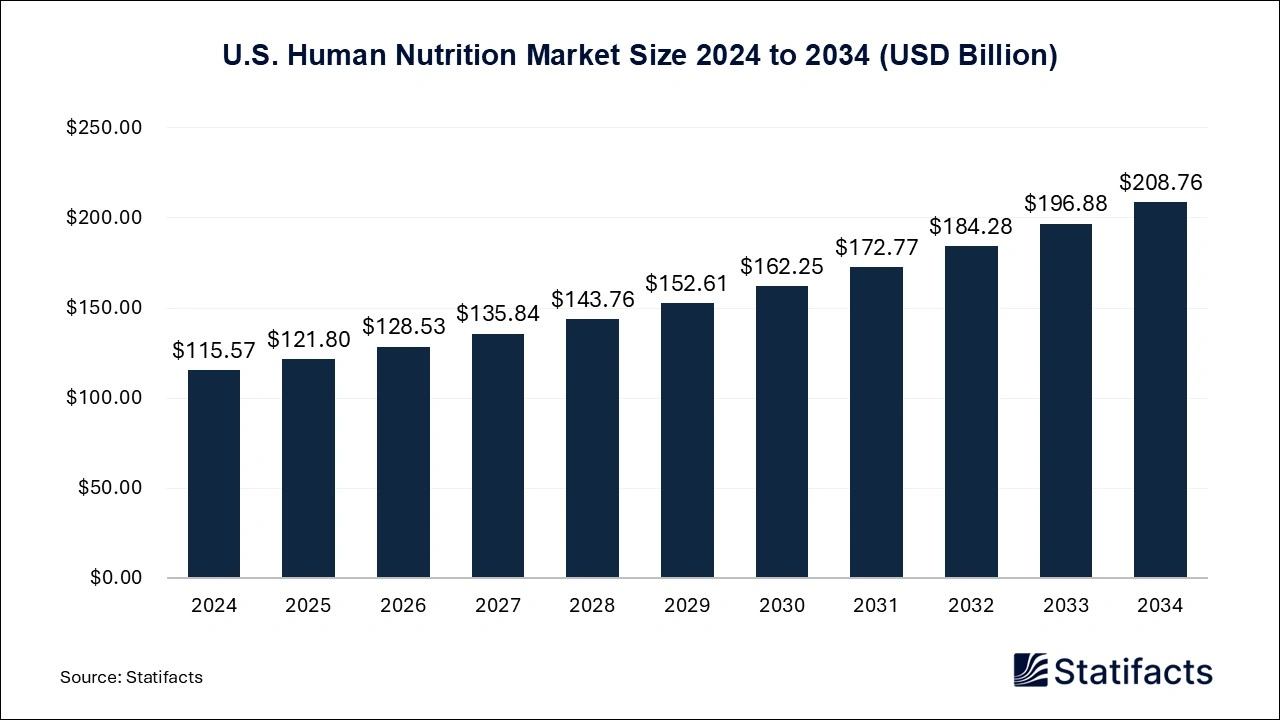
The U.S. human nutrition market size surpassed USD 115.57 billion in 2024 and is predicted to reach around USD 208.76 billion by 2034, registering a CAGR of 6.09% from 2025 to 2034.
Highlights of the U.S. Human Nutrition Market
By type, the probiotics segment held a dominant presence in the market in 2024.
By type, the vitamins segment is expected to grow at the fastest rate in the market during the forecast period of 2025 to 2034.
By distribution channel, the OTC segment accounted for a considerable share of the market in 2024.
By distribution channel, the prescribed segment is projected to experience the highest growth rate in the market between 2025 and 2034.
By application, the dietary supplement segment led the market.
By application, the infant nutrition segment is set to experience the fastest rate of market growth from 2025 to 2034.
Industry Valuation and Growth Rate Projection
Industry Worth
Details
Market Size in 2025
USD 121.8 Billion
Market Size by 2034
USD 208.76 Billion
Market Growth Rate from 2025 to 2034
CAGR of 6.09%
The U.S. human nutrition market is growing fast because more people want to stay healthy and live longer. This market includes vitamins, minerals, supplements, proteins, and healthy food products. Many Americans are now eating better, exercising more, and choosing natural or plant-based products. The rise in health problems like obesity, heart disease, and diabetes is also pushing people to focus more on nutrition. Companies are making new and better products to meet this demand. They use science and research to create food that helps the body work better. The U.S. human nutrition market is expected to grow even more in the future, as people of all ages look for ways to improve their health and wellness through what they eat.
What are the Market Trends in the U.S. Human Nutrition Market?
The market trends in the U.S. human nutrition market are the rising demand for plant-based products, the growth of personalized nutrition, the popularity of clean-label products, and the increase in sports and fitness supplements.
More Americans are choosing vegan or plant-based foods for better health and the environment.
People want vitamins and diet plans made just for their body and health needs.
Consumers prefer foods with simple, natural ingredients and no harmful chemicals.
More people are using protein powders and energy drinks to stay fit and build muscle, thus increasing the demand for sports and fitness supplements.
What are the Restraints in the U.S. Human Nutrition Markett?
The market restraints in the U.S. human nutrition market are the high cost of quality nutrition products, lack of clear regulations, misinformation among the public and false claims by the nutrition companies, and low awareness in rural areas.
Organic and personalized supplements are often too expensive for many people.
Some supplements are sold without proper checks, making safety a concern.
Many products make health promises that are not true, confusing consumers.
People in small towns may not know about good nutrition or have access to it.
What are the Opportunities in the U.S. Human Nutrition Market?
The opportunities in the U.S. human nutrition market lie in the rising interest in immune-boosting products, more older adults demand for special nutrition, growth in e-commerce sales.
Since COVID-19, more people are buying vitamins like C and D to stay healthy, and the use of immune-boosting products is also increasing.
Seniors in the U.S. need easy-to-digest foods and supplements to stay strong.
Online stores make it easier for people to buy healthy food and supplements.
Recent Developments in the U.S. Human Nutrition Market:
In January 2025, researchers explored the sustainability impacts of substituting pork for beef, seafood, poultry, eggs, or legumes among U.S. adults. In their model, they reported reductions in land use and greenhouse gas emissions of between 11% - 35% for substituting beef for pork, and that substituting seafood reduced energy demand and costs.
U.S. Human Nutrition Market Revenue, By Application, 2024 to 2034 (USD Billion)
Subsegment
2024
2025
2026
2027
2028
2029
2030
2031
2032
2033
2034
Functional Nutrients
5.37
5.71
6.07
6.47
6.90
7.39
7.92
8.50
9.14
9.84
10.51
Dietary Supplements
48.74
52.46
56.51
60.94
65.79
71.07
76.85
83.17
90.12
97.71
104.88
Medical Nutrition
33.64
34.84
36.14
37.53
39.04
40.73
42.56
44.54
46.69
49.02
51.24
Infant Nutrition
23.00
23.64
24.33
25.07
25.88
26.79
27.78
28.85
30.01
31.26
32.46
Food & Beverages
5.53
5.99
6.44
6.87
7.29
7.71
8.10
8.46
8.77
9.04
9.34
Last Updated: 18 Jun 2025
Source: Statifacts

References
Primary Research Interviews
Nutritionists: Registered dietitians and clinical nutritionists.
Healthcare Providers: Physicians and specialists in nutrition-related fields.
Industry Experts: Executives from food and supplement companies.
Consumers: Individuals participating in dietary studies or surveys.
Stakeholders
Academy of Nutrition and Dietetics: The largest organization of food and nutrition professionals in the U.S., with over 112,000 members.
Council for Responsible Nutrition (CRN): A trade association representing over 180 companies in the dietary supplement industry.
American Nutrition Association (ANA): A non-profit organization dedicated to the scientific investigation of nutrition and metabolism.
Databases
USDA FoodData Central: An integrated data system providing information on food and nutrient profiles, including the National Nutrient Database for Standard Reference.
PubAg and PubMed: Databases offering access to a wide range of nutrition-related research publications.
Nutrition Science Data and Biospecimen Resources Portal: A portal providing access to publicly available datasets, biospecimens, and data analysis tools for nutrition science research.
Magazines
Journal of the Academy of Nutrition and Dietetics: A monthly peer-reviewed scientific journal covering research in nutritional science and dietetics.
Journal of Human Nutrition and Dietetics: A bimonthly peer-reviewed medical journal covering nutrition science as it relates to humans.
Journals
Journal of the Academy of Nutrition and Dietetics: As mentioned above.
Journal of Human Nutrition and Dietetics: As mentioned above.
Journal of Nutrition: A peer-reviewed journal publishing research in the field of nutrition.
Newspapers
The New York Times: Regularly features articles on nutrition and health.
USA Today: Covers topics related to nutrition and wellness.
Los Angeles Times: Publishes articles on food and nutrition topics.
Associations
Academy of Nutrition and Dietetics: As mentioned above.
Council for Responsible Nutrition (CRN): As mentioned above.
American Nutrition Association (ANA): As mentioned above.
Public Domain Sources
USDA FoodData Central: Provides public domain data on food and nutrient profiles.
Data.gov: The U.S. government's open data site, offering access to a vast array of datasets, including those related to nutrition.
Proprietary Elements
Market Research Reports: Commercial reports from firms like Statifacts, Precedence Research, and Market Research Future, offering proprietary insights into market size, trends, and forecasts.
Industry Surveys and Consumer Panels: Conducted by market research firms to gather proprietary data on consumer preferences and behaviors.
U.S.
Market Statistics
U.S. Human Nutrition Market Revenue, By Application 2024 to 2034 (USD Billion)
The U.S. human nutrition market is being propelled by a convergence of health-conscious consumer behavior, aging demographics, and increasing awareness of preventive healthcare. Rising incidences of chronic diseases such as obesity, diabetes, and cardiovascular conditions have prompted consumers to proactively seek nutritional solutions. Furthermore, the COVID-19 pandemic acted as a catalyst, increasing demand for immune-supporting supplements like vitamin C, D, and zinc. Technology-led innovation in personalized nutrition and widespread e-commerce adoption also fuel market growth by improving access and customization.
The most promising investment opportunities lie in the vitamins, personalized nutrition, and infant nutrition segments. Vitamins are forecasted to grow at the fastest pace through 2034 due to increased consumer interest in targeted health outcomes. Meanwhile, personalized nutrition, powered by biotech startups and AI-driven platforms, attracts both VC and strategic investments for its scalability and direct-to-consumer model. Infant nutrition, with its demand fueled by growing awareness among millennial parents and evolving clinical formulations, presents long-term recurring revenue potential.
Technological disruptions are reshaping the industry through AI-based personalized diet plans, DNA-based nutritional profiling, and advanced ingredient delivery systems like microencapsulation. Emerging platforms like Viome and Care/of are leveraging machine learning and microbiome testing to offer customized nutrition. Blockchain is also gaining ground in ensuring ingredient traceability and clean-label compliance, while biotech advances are pushing boundaries in alternative proteins and functional foods.
Regulatory clarity remains a double-edged sword both a challenge and an opportunity. Currently, the market suffers from fragmented oversight, especially concerning supplements and functional foods, which allows for false claims and consumer misinformation. However, impending FDA moves toward stricter labeling standards and supplement validation could enhance consumer trust and level the competitive playing field. Companies aligning early with transparency and compliance will gain a competitive edge.
The market is moderately consolidated with multinational corporations such as Nestlé S.A., Abbott Laboratories, Danone S.A., and PepsiCo dominating due to their deep R&D, global sourcing, and distribution capabilities. However, niche players like Care/of, Viome, and Impossible Foods are rapidly gaining traction by targeting specialized health concerns with innovative solutions. Strategic partnerships, M&A, and DTC expansions are shaping the future competitive battleground.
Proceed to Buy
Looking for a Customized Solution?
50% customization is on us! Shape the insights, trends and strategic planning your way.