By clicking “Accept All Cookies” you agree to the storing of cookies on your device
to enhance site navigation, analyze site usage, and assist in our marketing efforts.
The U.S. gastroenterology market size surpassed USD 12.56 billion in 2024 and is predicted to reach around USD 22.25 billion by 2034, registering a CAGR of 5.88% from 2025 to 2034.
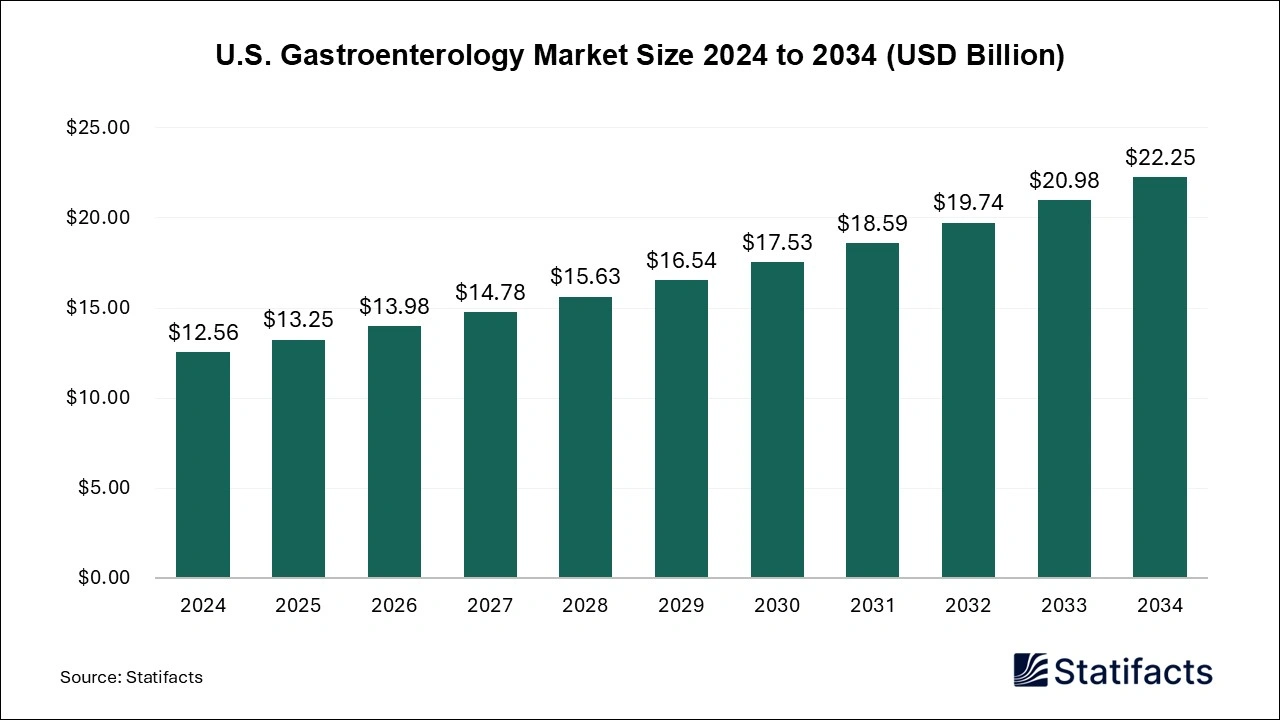
Highlights of the U.S. Gastroenterology Market
By type, the branded segment held a dominant presence in the market in 2024.
By type, the generics segment is expected to grow at the fastest rate in the market during the forecast period of 2025 to 2034.
By distribution channel, the retail pharmacies segment led the U.S. gatroenterology market.
By distribution channel, the online pharmacies segment is anticipated to grow with the highest CAGR in the market during the studied years.
By application, the Crohn’s Disease segment registered its dominance over the market in 2024.
By application, the ulcerative colitis segment is expected to see notable performance in growth between 2025–2034.
By route of administration, the injectable segment captured a significant portion of the market in 2024.
By route of administration, the oral & others segment is predicted to witness significant growth in the market over the forecast period.
Industry Valuation and Growth Rate Projection
Industry Worth
Details
Market Size in 2025
USD 13.25 Billion
Market Size by 2034
USD 22.25 Billion
Market Growth Rate from 2025 to 2034
CAGR of 5.88%
The U.S. gastroenterology market is booming as a result of an increasing population suffering from digestive diseases including irritable bowel syndrome (IBS), Crohn's disease, and acid reflux disease. There are many contributing factors such as poor eating habits, increased stress levels, and alcohol use; and the gastrointestinal diseases/death rates in the United States are significantly higher than most countries. The term “gastroenterology” can include a wide variety of medical devices, diagnostic testing, and medications that are used to treat many conditions in the stomach, intestines, and liver as well as the pancreas.
The U.S. hospitals and clinics seek effective equipment for procedures and the growing prevalence of endoscopy equipment and non-invasive Gastrointestinal procedures improves care and accessibility to the population. The aging population has prompted many healthcare systems to rethink their current processes for traditional providers; this has led to positive changes as older patients generally suffer from more digestive problems. In addition, many healthcare companies in the US use established research funding to expand present capabilities or develop new devices and this has facilitated continuing research and innovation; this makes gastroenterologist an essential key in their present and future healthcare ecosystem.
What are the Market Trends for the U.S. Gastroenterology Market?
More Digestive Disorders: The U.S. population is experiencing a rise in the number of people suffering with IBS, GERD and liver disease, thus boosting the gastroenterology market.
Telehealth: The market is booming due to the increase in gastroenterology care now done through online consultancies, video calls, and remote checks.
Demand for less invasive tools: The rise in patient demand for the less invasive tools in the U.S. boosts the market for quick and non-invasive endoscopy.
What are the Restraints for the U.S. Gastroenterology Market?
High procedure costs: Endoscopy is expensive due to which not all patients are able to afford such therapies even with insurance.
Shortage of specialists: Gastro specialists are in shortage in the U.S. especially in the less developed or rural regions, which is also a reason for the expensive procedure of endoscopy.
Invasive technique fear: Endoscopy is invasive, and many patients avoid it due to the discomfort and pain it causes them.
What are the Opportunities for the U.S. Gastroenterology Market?
Rising digestive issues: The rising number of patients with digestive issues due to changing lifestyles and decreasing fiber quantities being consumed creates an opportunity for the market to expand further.
AI-assisted diagnosis: The U.S. clinics and hospitals are increasingly adopting the use of AI tools to enhance the detection and diagnosis.
Digital health platforms: Telehealth and mobile apps for gastro care are being increasingly used to ensure regular health checks due to the increasing awareness among people about digestive issues.
What are the Recent Developments in the U.S. Gastroenterology Market?
In March 2025, Xeris Biopharma Holdings, Inc. announced that it has received the U.S Food and Drug Administration (FDA) approval for its supplemental new drug application (sNDA) of Gvoke VialDx™. The drug is approved for use as a diagnostic aid during radiologic examinations to temporarily inhibit movement of the gastrointestinal tract in adults.





