




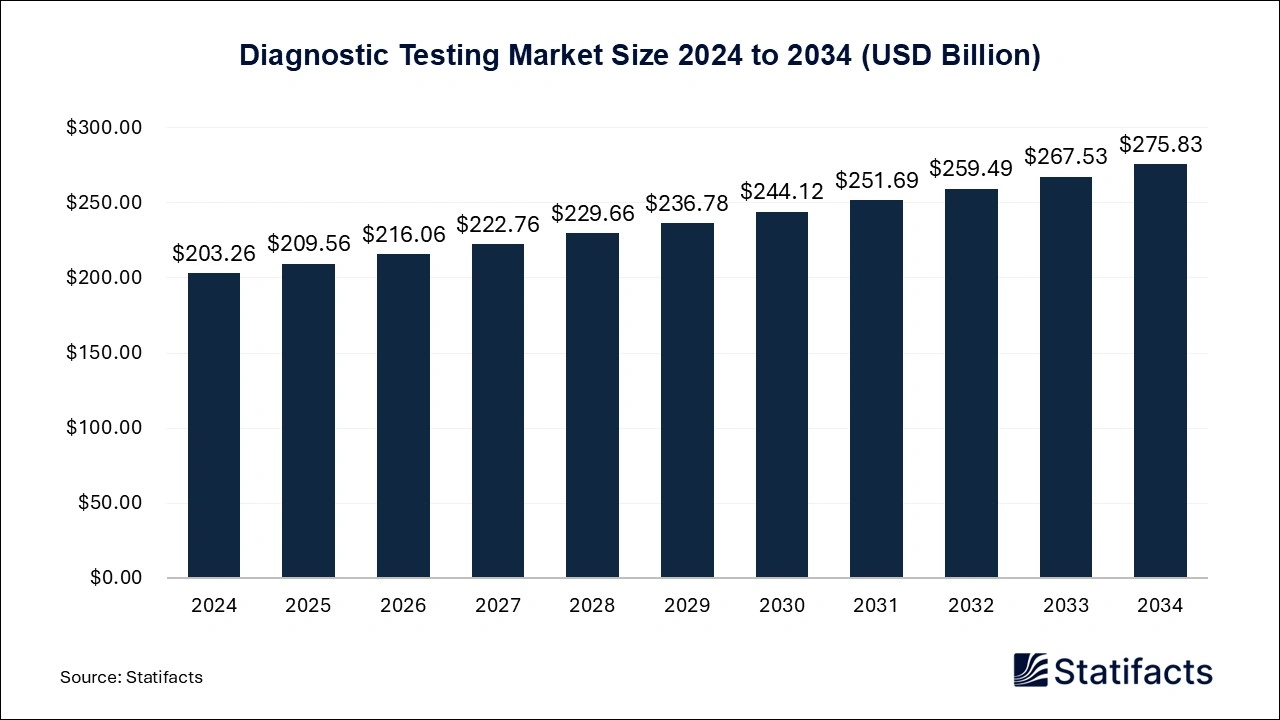
The global diagnostic testing market size was estimated at USD 203.26 billion in 2024 and is projected to be worth around USD 275.83 billion by 2034, growing at a CAGR of 3.1% from 2025 to 2034.
| Industry Worth | Details |
| Market Size in 2025 | USD 209.56 Billion |
| Market Size by 2034 | USD 275.83 Billion |
| Market Growth Rate from 2025 to 2034 | CAGR of 3.1% |
Healthcare begins with and relies on diagnostics, whether it’s diabetes, cancer, infectious disorders, or significant health threats, diagnostics are at the fore and centre. Diagnostics authorize physicians and clinicians to collect precise data to assist in the early detection, prevention, and understanding of diseases. Diagnostics is essential because it can aid patients to live prolonged and healthier lives when disorder progression is halted or delayed, or patients recover via early and timely diagnosis, and subsequently early execution of treatment plans. However, diagnostics offer data that can highly advantage the patient as healthcare providers can select the relevant preventative interventions as well as offer vital prognostic information that permits the improvement of care pathways and management.
The World Health Organization (WHO) has recorded the first mpox in vitro diagnostic (IVD) under its Emergency Use Listing (EUL) processes, an essential step in enhancing access to mpox testing worldwide. The acceptance of emergency usage of the Alinity m MPXV assay, produced by Abbott Molecular Inc., will be crucial in expanding diagnostic volume in countries facing mpox outbreaks, where the demand for quick and exact testing has risen intensely. Early discovery of mpox permits timely treatment, care, and management of the virus.
“Siemens Healthineers seeks to benefit from market opportunities in the diagnostics market through the introduction of the Atellica solution,” says Michael Reitermann, chief operating officer at Siemens Healthineers. “Deepak Nath’s exceptional leadership experience and deep industry knowledge will greatly benefit us as we look to expand the early success of Atellica solution and drive wide adoption in the diagnostics market.”
"We look forward to working with Seegene to provide needed diagnostic testing products to U.S. markets," said Dara Wright, Bio-Rad EVP and President, Clinical Diagnostics. "Seegene’s unique assay design, chemistries, and high-level multiplexing can detect multiple infectious disease targets simultaneously, making the assays well-suited for syndromic testing," she said.
The diagnostic testing market is experiencing significant growth, with North America maintaining its position as the dominant region while Europe emerges as the rapidly growing market. The Asia Pacific region is projected to be the fastest-growing in the market during the forecast period.
North America
North America dominated the global market in 2024. With a target on customized diagnostics, precision medicine, and a broader array of testing services, the North American diagnostic laboratory incorporates the leading edge of innovation in healthcare diagnostics. North America participates in a high volume of diagnostic testing.
Europe
Europe is experiencing rapid growth in the diagnostic testing market during the forecast period. Clinical diagnostics is a discipline of medicine that includes the use of laboratory tests and other diagnostic methods to evaluate a patient's health in Europe and discover the existence of disorders or diseases. These tests, which can be determined on blood, tissue samples, urine, or other physiological fluids, can provide information on various factors, including genetic, biochemical, and immunological indicators.
APAC and China
Asia Pacific (APAC) is projected to be the fastest-growing in the market during the forecast period. With a vast and densely dispersed population, China has generated a national SARS-CoV-2 nucleic acid testing method that has played a vital role in containing COVID-19. This strategy included border entry screening, rapid screening in fever clinics, and inpatient screening.
Companies are investing heavily in R&D to generate advanced diagnostic tools like next-generation sequencing, molecular diagnostics, and AI-derived platforms. These innovations improve speed, accuracy, and reliability in disorder detection. Besides, working with hospitals, academic institutions, and research organizations helps firms speed up product development and widen their reach. Partnerships with telemedicine professionals are also permitting the implementation of diagnostics with remote healthcare services.
Siemens Healthineers AG, a subsidiary of Siemens AG, is a medical technology firm. The firm designs, produces, develops, and distributes diagnostic and therapeutic goods, including in vitro diagnostics, imaging systems, and advanced therapies. The firm serves many consumers, including laboratories, hospitals, clinics, hospital systems, public health agencies, physicians, universities, pharmaceutical firms, state-run and private health insurers, and clinical research institutes.
PerkinElmer functions as a manufacturer of medical equipment and contributes to the healthcare industry. PerkinElmer has received an undisclosed quantity of funding. The firm has 162 active competitors, as well as seven funded and 14 that have existed.
EKF Diagnostics Holdings Plc is an in vitro diagnostics firm that develops, designs, manufactures, and central laboratory goods. Its goods find application in general surgeries, blood banks, pharmacies, diabetes clinics, hospitals, and laboratories.
Annual Revenue: Siemens Healthineers AG vs PerkinElmer Inc vs EKF Diagnostics Holdings plc 2022-24 (Millions of US$)
| Year | Siemens Healthineers AG | PerkinElmer Inc | EKF Diagnostics Holdings plc |
| 2024 | 22,363,000 | 2,755,026 | 52,611 |
| 2023 | 21,680,000 | 2,750,571 | 66,635 |
| 2022 | 21,714,000 | 3,311,822 | 81,836 |
Published by Rohan Patil





