By clicking “Accept All Cookies” you agree to the storing of cookies on your device
to enhance site navigation, analyze site usage, and assist in our marketing efforts.
The U.S. biological buffers market size was calculated at USD 4.49 billion in 2024 and is predicted to attain around USD 10.44 billion by 2034, expanding at a CAGR of 8.8% from 2025 to 2034.
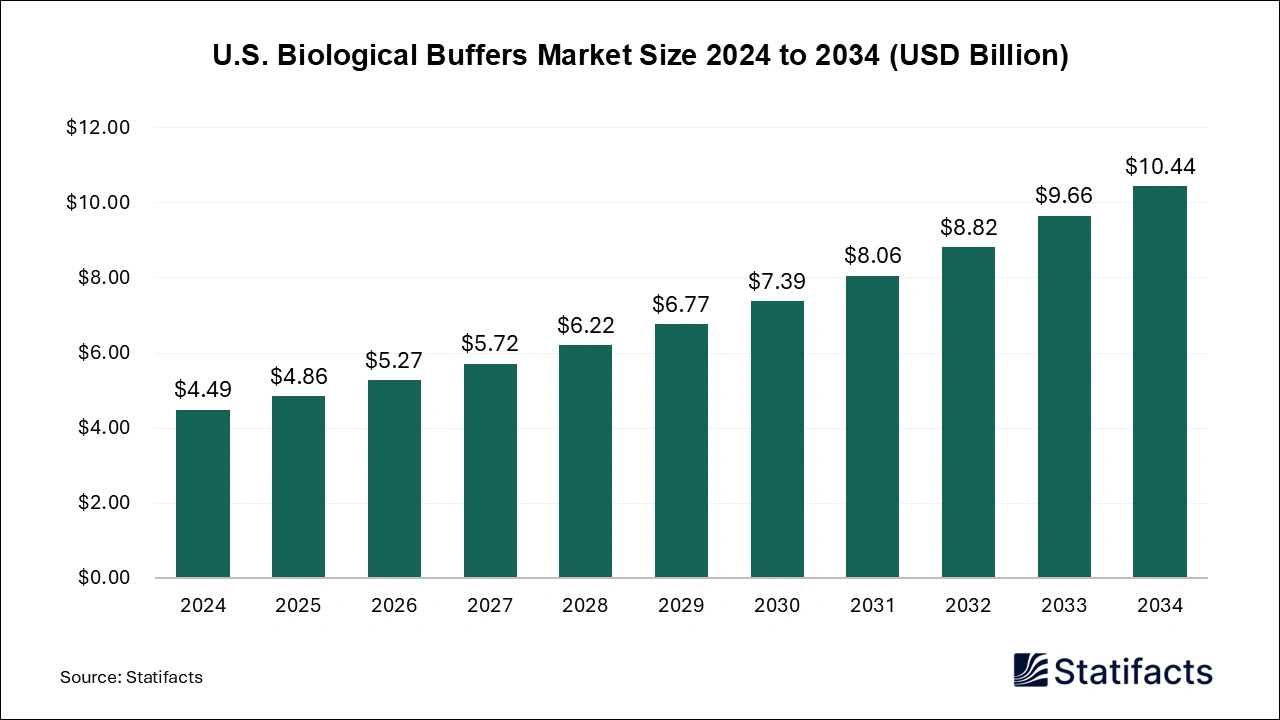
Highlights of the U.S. Biological Buffers Market
By form, the powder media segment held a dominant presence in the market in 2024.
By form, the liquid media segment is expected to grow at the fastest rate in the market during the forecast period of 2025 to 2034.
By end-user, the pharmaceutical and biotechnology companies segment accounted for a considerable share of the market in 2024.
By end-user, the clinical and diagnostic laboratories segment is projected to experience the highest growth rate in the market between 2025 and 2034.
By application, the biopharmaceutical production segment captured a significant portion of the peer-to-peer lending market in 2024.
By application, the cell and gene therapy segment is projected to expand rapidly in the market in the coming years.
Industry Valuation and Growth Rate Projection
Industry Worth
Details
Market Size in 2025
USD 4.86 Billion
Market Size by 2034
USD 10.44 Billion
Market Growth Rate from 2025 to 2034
CAGR of 8.8%
A growing U.S. biological buffers market is being driven by increased science and medicine research and development. Biological buffers help maintain a consistent pH in laboratories, and lab tests and experiments rely on it. Biological buffers are used in many very important fields such as biotechnology, pharmaceuticals, and other life science research. As more researchers go into studying diseases and developing new medicines, researchers need biological buffers that are used in testing and sampling applications to be of high quality. U.S. manufacturers are developing higher-quality and safer biological buffers to address customer demand. Emerging technologies, laboratory supplies, laboratory equipment, and testing technology as a whole are greatly contributing to advances in biological buffers. The U.S. will continue to grow as a leading market for biological buffers due to its strong healthcare system and research part of the healthcare system.
What are the Market Trends in the U.S. Biological Buffers Market?
The market trends in the U.S. biological buffers market are the rising biomedical research, growth in pharmaceutical R&D, increasing number of biotechnology companies, and rise in adoption of good manufacturing practices (GMP).
More universities and labs in the U.S. are using buffers for cancer and genetic studies. This boosts demand.
Pharma companies are increasing drug testing, and buffers are key in making stable test conditions.
Startups in gene therapy and cell culture are growing, needing high-quality biological buffers.
Companies are using better processes to make buffers safer and more reliable for research use.
What are the Restraints in the U.S. Biological Buffers Market?
The market restraints in the U.S. biological buffers market are high production cost, strict government regulations, storage and handling problems, and a shortage of skilled labor.
It is complex and costly to make pure and stable buffers because it requires expensive technology to do so.
The FDA and other U.S. regulatory agencies have high standards for the use of chemicals, which adds time to to approval process.
Buffers need to be handled and stored in special environments, which adds cost to logistics.
Some labs can't find skilled workers trained to make or use buffers correctly.
What are the Opportunities in the U.S. Biological Buffers Market?
The opportunities in the U.S. biological buffers market lie in the personalized medicine demands, government funding for research, exportation of high-quality buffers, and utilization of buffers in advanced therapies.
New emerging therapies designed specifically for a single individual require extensive assessment, where buffers play a key role.
While health and science have always been funded by U.S. government initiatives, growing requirements for buffers in and out of academic laboratories will expand as the available funding is increasing.
U.S. companies have the opportunity to provide safe, high-quality buffers for the needs of other countries requiring quality tools.
Buffers play a pivotal role in the development of both cell and gene therapy, which have the potential to grow substantially in the U.S. market.
Recent Developments in the U.S. Biological Buffers Market:
In August 2024, after higher temperatures melted sea-ice buffers, Antarctic ecosystems were at risk, scientists observed. A simulation revealed rubbish, invasive animals, plants, and pathogens drifting from Africa, Australia, South America, or New Zealand towards Antarctica every year. The melted ice may allow these organisms to survive and disrupt native species.





