By clicking “Accept All Cookies” you agree to the storing of cookies on your device
to enhance site navigation, analyze site usage, and assist in our marketing efforts.
The global U.S. bioethanol market size was evaluated at USD 25.38 billion in 2024 and is expected to grow around USD 36.09 billion by 2034, registering a CAGR of 3.58% from 2025 to 2034.
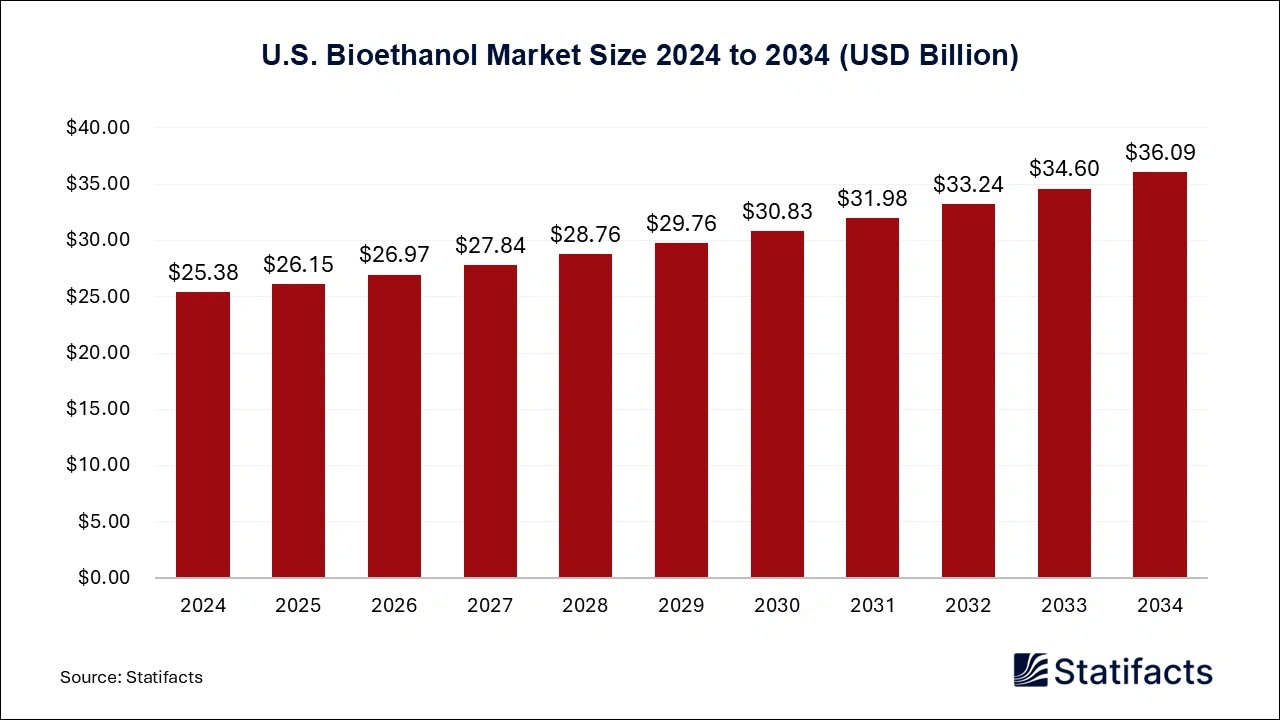
Highlights of the U.S. Bioethanol Market
By application insight, the transport segment held a dominant presence in the market in 2024 and is expected to grow at the fastest rate in the market during the forecast period of 2025 to 2034.
By feedstock, the starch based segment accounted for a considerable share of the market in 2024.
By feedstock, the cellulose-based segment is projected to experience the highest growth rate in the market between 2025 and 2034.
By fuel generation, the first generation segment led the market.
By fuel generation, the second generation segment is set to experience the fastest rate of market growth from 2025 to 2034.
By blend insight, the E-10 segment accounted for a considerable share of the market in 2024.
By blend insight, the E15 to E70 segment is projected to experience the highest growth rate in the market between 2025 and 2034.
Industry Valuation and Growth Rate Projection
Industry Worth
Details
Market Size in 2025
USD 26.15 Billion
Market Size by 2034
USD 36.09 Billion
Market Growth Rate from 2025 to 2034
CAGR of 3.58%
In the U.S. bioethanol market, a worldwide trade and innovation cluster for the fuel from organic and renewable raw materials exists. During enzymatic fermentation, bioethanol is prepared from the fermentation of sugars, which are extracted from crops and agricultural waste. It acts as an alternative to petroleum fuels, which are pollutants and environmentally unfriendly. It promotes sustainable energy use and carbon emission reduction, and also supports rural economies. Countries wanting to reduce their dependence on fossil fuel aim at giving diversity to their energy matrix, which, in turn, drives demand for this market. Since the fuel is environmentally friendly, it is being increasingly used for power generation, transport, and industrial applications, alongside government subsidies and awareness among consumers.
What Are the Market Trends in the U.S. Bioethanol Market?
The market trends in the U.S. bioethanol market are defined by rising demand for renewable fuel, increased consumption of fuel, and environmental awareness.
Renewable fuels address environmental concerns while governments impose blending mandates.
Hence, diversification of feedstock from food-based crops to second and third-generation crops.
Technological development in production, thereby improving efficiency, and hence reducing cost.
Application of bioethanol in personal care, pharmaceuticals, and bio-based chemicals.
Use of smart technologies for the automation of production processes and supply chain management.
What Are the Major Market Restraints in the U.S. Bioethanol Market?
The growth of the U.S. bioethanol market is restrained by factors such as compatibility issues, rising EV adoption, and strict government policies
The Renewed Growth of Electric Vehicles limits the forecasting of bioethanol demand for transportation.
Vehicle Incompatibility Issues depreciate the sales of E85 and other bioethanol fuels to consumers.
The Uncertainty of Policies is not supporting long-term investments in bioethanol infrastructure.
Resource and Environmental Concerns are holding back the bioethanol production.
Volatile Feedstock and Oil Price fluctuations bring insecurity to cost competitiveness.
What Are the Market Opportunities in the U.S. Bioethanol Market?
The opportunities in the U.S. bioethanol market are associated with rising demand for fuel, advanced technology, and integration of bio-chemicals Transportation Sector Expansion.
Advanced Bioethanol Development with sustainability growth avenues.
Integration with Bio-Based Chemicals for additional industrial relevance.
AI and Digital Optimization for improvement in production efficiency.
Government Sustainability Targets opening bioethanol to energy and environmental policy advantages.
Recent Developments in the U.S. Bioethanol Market:
In May 2024, Verbio plans to convert its South Bend ethanol plant into a second integrated biorefinery in North America, incorporating renewable natural gas and bioethanol production using innovative methods.
In March 2024, Nissan is launching trials at its Tochigi Plant in Japan for a stationary bio-ethanol-fuelled system, aiming to improve power generation capacity by 2030.
The market is driven by rising demand for renewable fuels, government blending mandates like E10 and E15, and a shift toward second-generation feedstocks such as cellulosic biomass. Smart technologies and bioethanol’s expansion into pharmaceuticals and chemicals are also shaping the landscape.
Growth is fueled by blending mandates, sustainability targets, rising fuel demand, rural economic benefits, and advancements in fermentation technology that boost production efficiency and reduce costs.
With a projected CAGR of 3.58% and a market value expected to reach USD 36.09 billion by 2034, the market offers moderate but stable growth. Investment prospects are strongest in second-generation ethanol, integrated biorefineries, and bio-based chemicals.
Disruptive changes include AI-driven production optimization, advanced enzyme technologies, and integration of bioethanol with other bio-products like RNG. These innovations enhance scalability and sustainability.
Regulatory support such as the Renewable Fuel Standard and Inflation Reduction Act drives demand, though inconsistent policy updates and EV promotion create uncertainty for long-term planning.
Leaders like POET, ADM, Valero, and Green Plains are focusing on second-generation biofuels, diversification, and multi-product facilities to enhance value and reduce carbon intensity.
Opportunities lie in scaling cellulosic ethanol, integrating ethanol in bio-based chemicals, leveraging AI for efficiency, and meeting rising demand in industrial and power generation sectors.
Proceed to Buy
Looking for a Customized Solution?
50% customization is on us! Shape the insights, trends and strategic planning your way.
Digital Geophone Market (By Type: Low Frequency, Mid Frequency, and High Frequency; By Application: Oil and Gas Exploration, Seismic Monitoring, Geote...





