



Sunflower Seed Dehuller Market (By Type: Processing Capacity ≤ 1 ton/hour, Processing Capacity > 1 ton/hour; By Application: Factory, Home Workshop; By Region: North America, Europe, Asia-Pacific, Latin America, Middle East and Africa) Industry Size, Share, Growth, Trends 2026 to 2035.

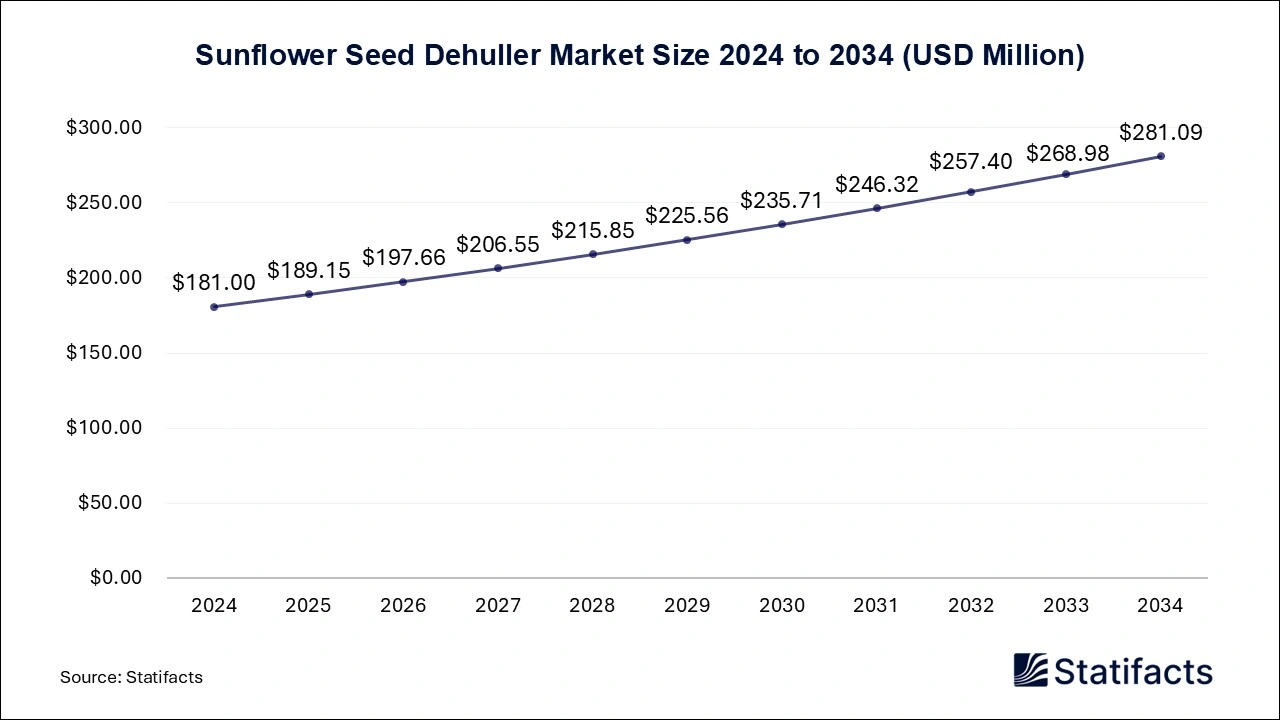
The global sunflower seed dehuller market, valued at USD 189.15 million in 2025, is projected to reach USD 292.85 million by 2035, growing at a CAGR of 4.47% driven by increasing demand for efficient seed processing in the food and agricultural industries.
| Reports Attributes | Statistics |
| Market Size in 2025 | USD 189.15 Million |
| Market Size in 2026 | USD 197.66 Million |
| Market Size in 2032 | USD 257.4 Million |
| Market Size by 2035 | USD 292.85 Million |
| CAGR 2026 to 2035 | 4.47% |
| Base Year | 2025 |
| Forecast Period | 2026 to 2035 |
The market for sunflower seed dehullers, a crucial component of the broader seed processing and agricultural sectors, is experiencing significant growth driven by several factors. A key growth factor is the rising worldwide demand for healthy, plant-based items, with sunflower seeds becoming more popular as nutritious snacks, premium edible oil, and components in baked goods and sweets. This health awareness, driven by consumers, drives the demand for effective dehulling machinery to prepare seeds for food uses.
In addition, the growing animal feed sector significantly enhances resources, as dehulled sunflower meal serves as a protein-dense, low-fiber additive for both livestock and aquaculture. The marketplace offers many chances for growth and creativity. For example, creating personalized dehulling systems tailored to specific seed types and user needs, ranging from large oil mills to smaller food manufacturers, can attract niche markets. Volatile raw material prices, influenced by weather changes and geopolitical events, can lead to significant market fluctuations and impact the profitability of dehulling operators.
Artificial intelligence is poised to revolutionize the entire dehulling value chain, transforming it from a conventional mechanical process into an intelligent, data-driven operation. Computer vision and machine learning, powered by AI, can be incorporated into dehullers to automatically identify, categorize, and separate seeds according to quality, size, and type with unmatched precision, thereby reducing damage and enhancing output. Predictive analytics, by leveraging real-time sensor information from the dehulling machinery, can anticipate maintenance requirements, identify potential failures before they occur, and optimize process variables such as impeller speed and feed ratetherebyus increasing uptime and reducing operational expenses. AI algorithms can analyze seed quality data, such as moisture and lipid levels, to adapt dehulling processes in real-time, ensuring maximum efficiency and uniform product qualitywhich is crucial for food safety adherence to rigorous industry regulations.
| Regions | Shares (%) |
| North America | 32% |
| Asia Pacific | 27% |
| Europe | 29% |
| LAMEA | 12% |
| Segments | Shares (%) |
| Processing Capacity ≤ 1 ton/hour | 57% |
| Processing Capacity > 1 ton/hour | 43% |
| Segments | Shares (%) |
| Factory | 68% |
| Home Workshop | 32% |





