



Steady-state Porometer Market (By Type: Manual and Automatic; By Application: Botanical Research Institute, Agricultural Company, University, and Others; By Region: North America, Europe, Asia Pacific, Latin America, and Middle East & Africa) Industry Size, Share, Growth, Trends 2026 to 2035.

The global steady-state porometer market, valued at USD 214.83 million in 2025, is projected to reach approximately USD 480.91 million by 2035. This significant growth, driven by advancements in filtration and material testing, is expected at a CAGR of 8.39%.
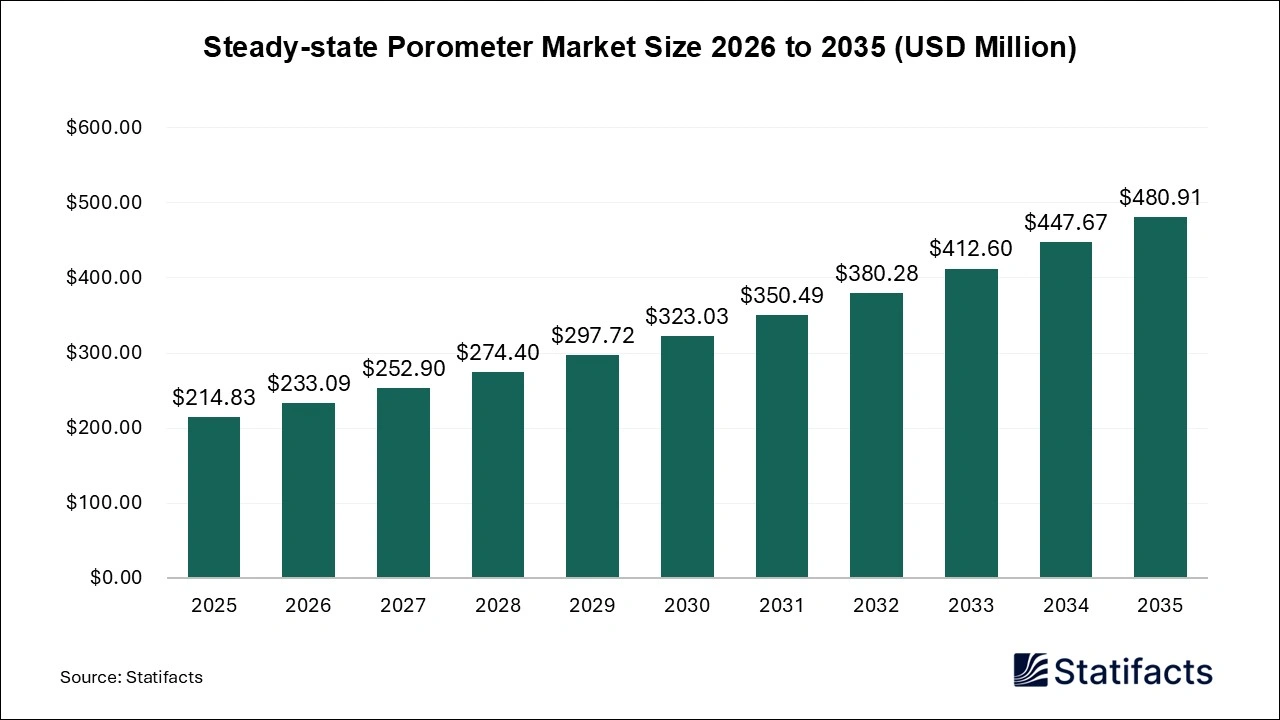
| Reports Attributes | Statistics |
| Market Size in 2025 | USD 214.83 Million |
| Market Size in 2026 | USD 233.09 Million |
| Market Size in 2032 | USD 380.28 Million |
| Market Size by 2035 | USD 480.91 Million |
| CAGR 2026 to 2035 | 8.39% |
| Base Year | 2025 |
| Forecast Period | 2026 to 2035 |
Growth is being driven by the rising adoption of precision agriculture technologies, increased investment in crop physiology research, and growing awareness of plant water management amid global climate challenges. Expanding use in universities, agricultural research institutes, and crop breeding programs further supports demand. Additionally, technological advances, such as portable porometers with digital sensors, automated calibration, and data integration capabilities, are enhancing measurement accuracy and convenience.
However, high instrument costs, limited operational expertise in developing regions, and the need for regular calibration act as restraints on market expansion. The small scale of end-users and budget constraints in academic research settings can also slow adoption. Opportunities lie in developing cost-effective, compact, and cloud-connected porometers that enable remote monitoring and real-time data sharing. Integrating these devices with broader precision agriculture systems, such as soil moisture sensors and climate monitoring tools, presents strong potential for cross-functional growth.
Artificial intelligence AI is expected to transform the steady-state porometer market by enabling intelligent data analysis and modeling of plant physiological responses. Machine learning algorithms can interpret porometer readings in combination with environmental data to predict crop stress or optimize irrigation strategies. AI integration also enhances calibration accuracy, automates data validation, and supports large-scale phenotyping applications, helping researchers and growers make faster, data-driven decisions for improved yield and sustainability.
| Regions | Shares (%) |
| North America | 35% |
| Asia Pacific | 25% |
| Europe | 30% |
| LAMEA | 10% |
| Segments | Shares (%) |
| Manual | 45% |
| Automatic | 55% |
| Segments | Shares (%) |
| Botanical Research Institute | 25% |
| Agricultural Company | 40% |
| University | 20% |
| Others | 15% |





