



Software Bill of Materials Market (By Type: SPDX, CycloneDX, and Others; By Application: Retail and E-commerce, Financial Services, Transportation and Logistics, Government, Manufacturing, Healthcare, and Aerospace & Defense; By Region: North America, Europe, Asia Pacific, Latin America, and Middle East & Africa) Industry Size, Share, Growth, Trends 2026 to 2035.

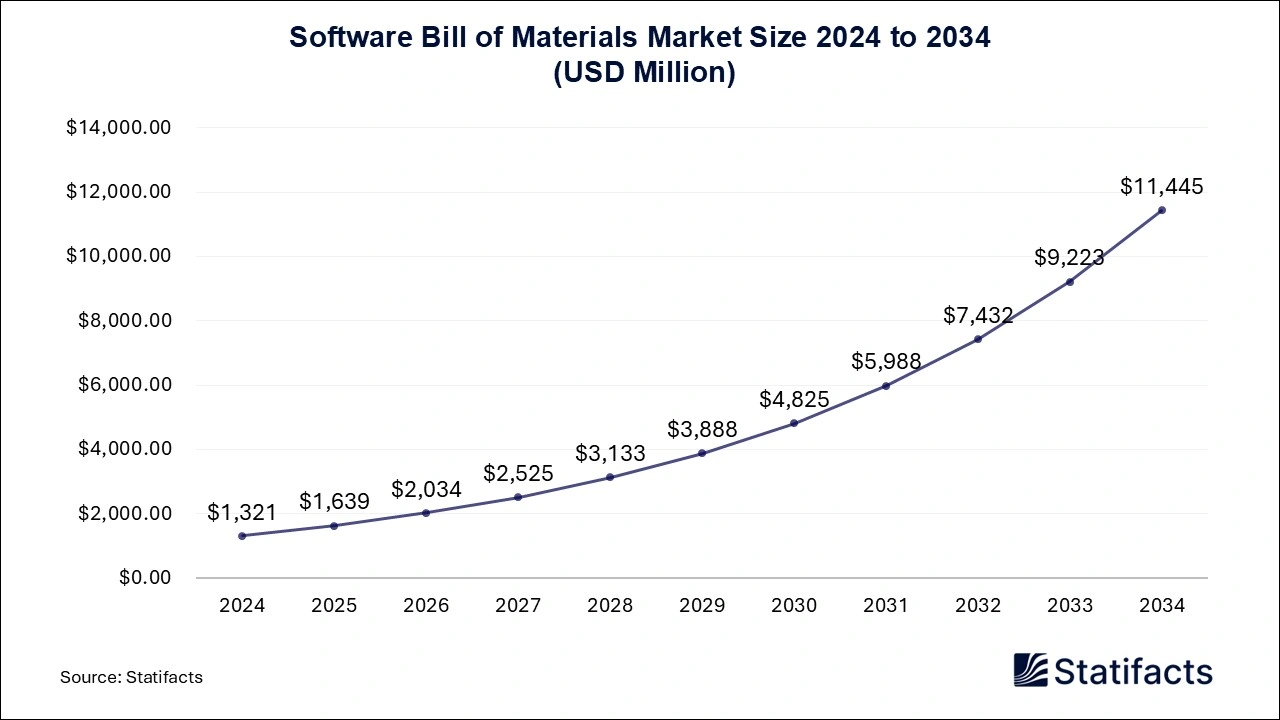
The global software bill of materials (SBOM) market, valued at USD 1,639 million in 2025, is projected to reach approximately USD 13,380 million by 2035. This robust growth, driven by increasing cybersecurity needs and software transparency regulations, is expected at a CAGR of 23.36%.
| Reports Attributes | Statistics |
| Market Size in 2025 | USD 1,639 Million |
| Market Size in 2026 | USD 2,034 Million |
| Market Size in 2032 | USD 7,432 Million |
| Market Size by 2035 | USD 13,380 Million |
| CAGR 2026 to 2035 | 23.36% |
| Base Year | 2025 |
| Forecast Period | 2026 to 2035 |
Market growth is being driven by rising cyber security threats, increasing regulatory mandates for software transparency, and the expanding use of open-source software in enterprise development. Governments and industry bodies are requiring SBOM adoption as part of secure software development frameworks, most notably in critical infrastructure, healthcare, and defense. The rapid digital transformation of industries and the surge in software supply chain attacks have made SBOM solutions a core element of DevSecOps practices.
Key restraints include a lack of standardization across SBOM formats, integration challenges with existing development pipelines, and limited awareness among smaller software vendors. The complexity of maintaining accurate, continuously updated SBOMs in large-scale applications can also hinder adoption. Opportunities lie in developing interoperable SBOM management platforms that integrate seamlessly with CI/CD pipelines, as well as automation-driven tools that continuously detect and remediate vulnerabilities.
Artificial intelligence AI is poised to play a pivotal role in the SBOM market by automating component identification, license detection, and vulnerability prioritization. Machine learning algorithms can analyze vast repositories of code to detect hidden dependencies or security flaws in real time. AI-driven SBOM analytics can also predict potential exploit pathways and optimize patch management, enabling proactive software risk mitigation.
| Regions | Shares (%) |
| North America | 33% |
| Asia Pacific | 26% |
| Europe | 28% |
| LAMEA | 13% |
| Segments | Shares (%) |
| SPDX | 40% |
| CycloneDX | 35% |
| Others | 25% |
| Segments | Shares (%) |
| Retail and E commerce | 20% |
| Financial Services | 14% |
| Transportation and Logistics | 12% |
| Government | 8% |
| Manufacturing | 16% |
| Healthcare | 18% |
| Aerospace Defense | 12% |
Published by Yogesh Kulkarni





