

Share


Self-Propelled Mast Vertical Lifts Market (By Type: Max Working Height 10–15m, Max Working Height 5–15m, and Others; By Application: Equipment Maintenance, Logistics, Electricity, Construction, Retail, and Others; By Region: North America, Europe, Asia Pacific, Latin America, and Middle East & Africa) Industry Size, Share, Growth, Trends 2026 to 2035

The global self-propelled mast vertical lifts market was valued at USD 956 million in 2025 and is projected to reach USD 1453 million by 2035, registering a CAGR of 4.27%. The market growth is driven by increasing automation in warehouses, rising demand for efficient material handling solutions, and the adoption of compact lifting equipment for indoor and outdoor industrial operations.
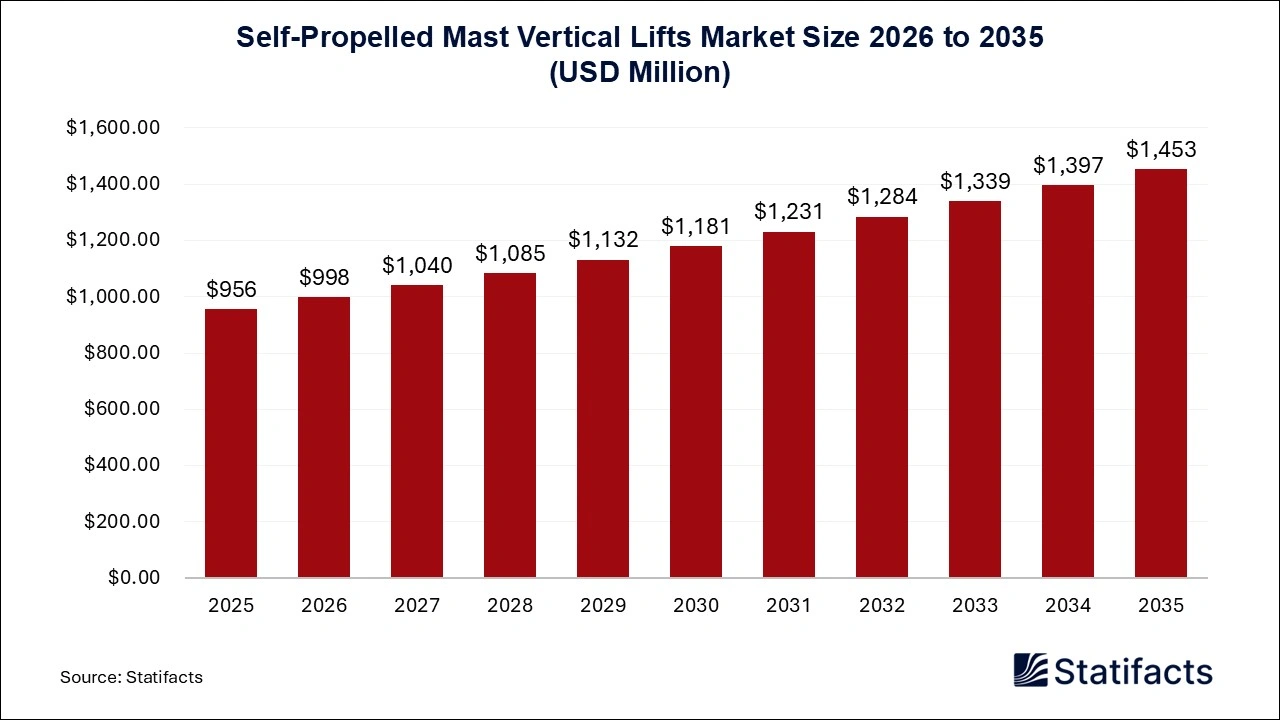
| Reports Attributes | Statistics |
| Market Size in 2025 | USD 956 Million |
| Market Size in 2026 | USD 998 Million |
| Market Size in 2032 | USD 1284 Million |
| Market Size by 2035 | USD 1453 Million |
| CAGR 2026 to 2036 | 4.27% |
| Base Year | 2025 |
| Forecast Period | 2026 to 2035 |
The Self-Propelled Mast Vertical Lifts (SPMVL) Market refers to the global industry involved in the manufacturing, sales, and deployment of vertical lift equipment that is designed to elevate personnel, tools, and materials to elevated work areas while being self-propelled, meaning it can move independently without the need for external towing or pushing. These lifts are primarily used in industrial, construction, warehousing, maintenance, and logistics operations where access to heights is required safely and efficiently.
Self-propelled mast vertical lifts are characterized by compact designs, maneuverability in tight spaces, and enhanced safety features such as guardrails, emergency stop systems, and tilt sensors. They are increasingly favored over traditional scaffolding or ladders due to their ability to increase productivity, reduce manual labor, and minimize workplace accidents.
| Segments | Shares (%) |
| North America | 30% |
| Europe | 25% |
| Asia Pacific | 35% |
| LAMEA | 10% |
| Segments | Shares (%) |
| Max Working Height 10-15m | 40% |
| Max Working Height 5-10m | 35% |
| Others | 25% |
| Segments | Shares (%) |
| Equipment Maintenance | 25% |
| Logistics | 30% |
| Electricity | 20% |
| Construction | 15% |
| Retail | 5% |
| Others | 5% |





