

Share


Seeded Gel Abrasive Market (By Type: Alumina-Seeded Gel Abrasive, Zirconia-Seeded Gel Abrasive, and Mixed-Seed Gel Abrasive; By Application: Automotive, Aerospace, Metal Fabrication, Industrial Equipment, Construction, and Others; By Region: North America, Asia Pacific, Europe, Latin America, and Middle East & Africa) Industry Size, Share, Growth, Trends 2026 to 2035

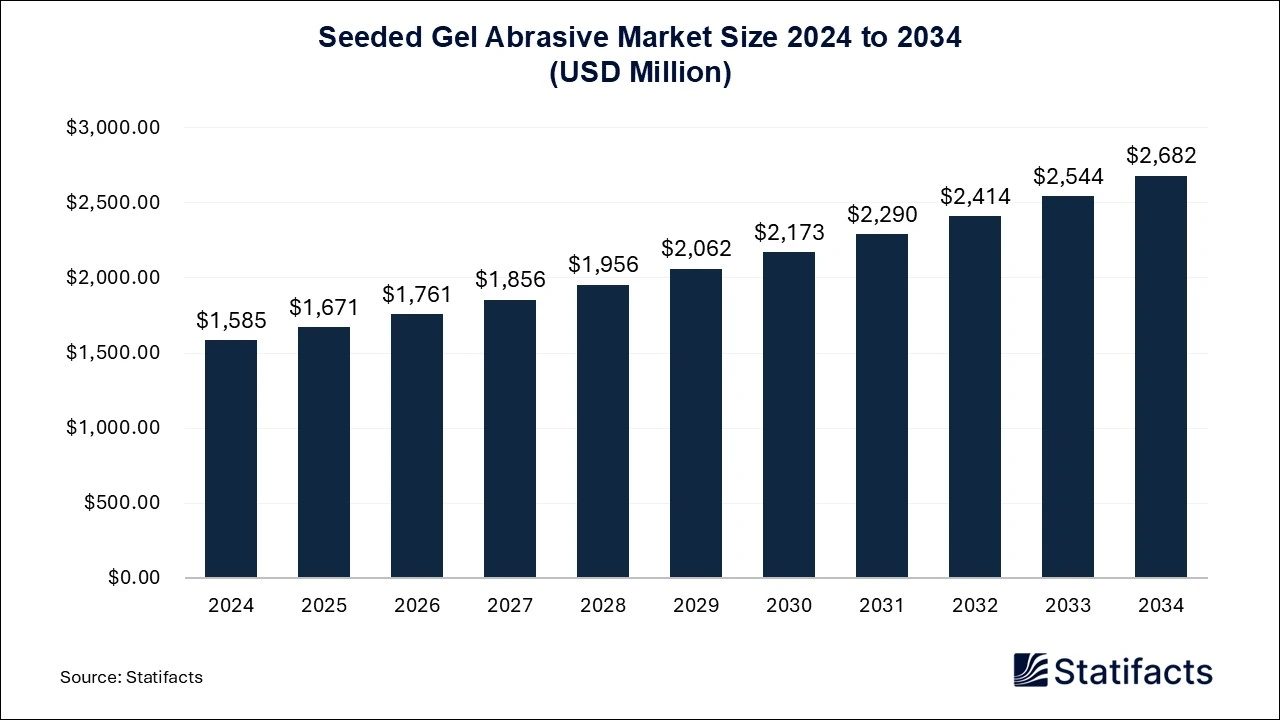
The global seeded gel abrasive market, valued at USD 1,671 million in 2025, is expected to reach approximately USD 2,815 million by 2035. This growth, fueled by its expanding applications in polishing and precision manufacturing, is projected at a CAGR of 5.35%.
| Reports Attributes | Statistics |
| Market Size in 2025 | USD 1,671 Million |
| Market Size in 2026 | USD 1,761 Million |
| Market Size in 2032 | USD 2,414 Million |
| Market Size by 2035 | USD 2,815 Million |
| CAGR 2026 to 2035 | 5.35% |
| Base Year | 2025 |
| Forecast Period | 2026 to 2035 |
The seeded gel abrasive market is growing at a lucrative pace, driven by the rising demand for enhanced surface finishing in sectors like electronics, automotive, and aerospace. The use of these gel abrasives provides longevity compared to traditional ones, leading to increased production investments from companies. However, these abrasives are more expensive than traditional ones because they use high-quality polymers and grains. This may limit its adoption in applications where companies consider the upfront costs.
The seeded gel abrasive market is expected to gain momentum as specific industries focus on manufacturing precise abrasives tailored to their needs. This is fostering more customization and material innovation among the players, as well as creating more opportunities. The industry players are adopting artificial intelligence AI and machine learning ML, which is helping them optimize performance by analyzing abrasive grain dispersion, binder composition, and other tasks.
| Regions | Shares (%) |
| North America | 35% |
| Asia Pacific | 25% |
| Europe | 30% |
| LAMEA | 10% |
| Segments | Shares (%) |
| Alumina-Seeded Gel Abrasive | 40% |
| Zirconia-Seeded Gel Abrasive | 35% |
| Mixed-Seed Gel Abrasive | 25% |
| Segments | Shares (%) |
| Automotive | 30% |
| Aerospace | 25% |
| Metal Fabrication | 20% |
| Industrial Equipment | 15% |
| Construction | 5% |
| Others | 5% |
Published by Saurabh Bidwai





