

Share


Robotic 3D Laser Cutting Machine Market (By Type: 5 Axis, 6 Axis, 7 Axis, Others; By Application: Automotive, Machinery Manufacturing, Metal Processing, Ships, Others; By Region: North America, Europe, Asia-Pacific, Latin America, Middle East and Africa) Industry Size, Share, Growth, Trends 2026 to 2035.

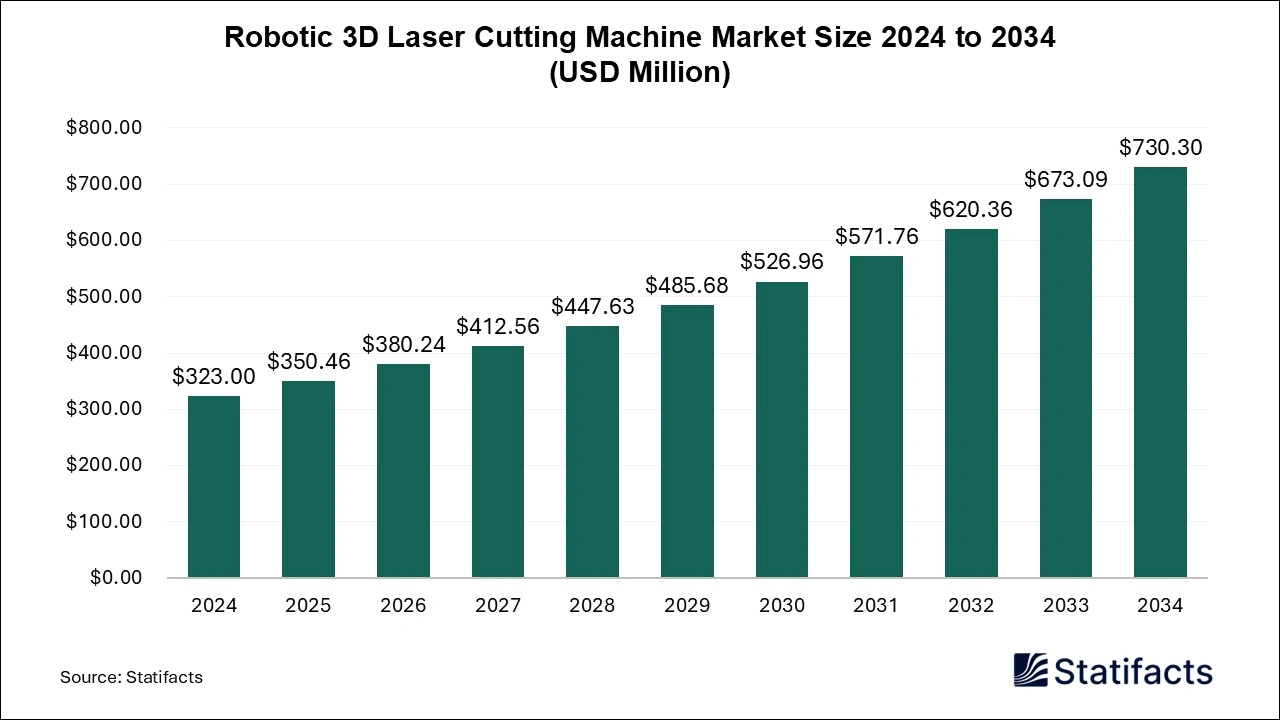
The global robotic 3D laser cutting machine market, valued at USD 350.46 million in 2025, is projected to reach USD 784.52 million by 2035, growing at a CAGR of 8.39% driven by increasing demand for precision manufacturing and automation in industries like automotive and aerospace.
| Reports Attributes | Statistics |
| Market Size in 2025 | USD 350.46 Million |
| Market Size in 2026 | USD 380.24 Million |
| Market Size in 2032 | USD 620.36 Million |
| Market Size by 2035 | USD 784.52 Million |
| CAGR 2026 to 2035 | 8.39% |
| Base Year | 2025 |
| Forecast Period | 2026 to 2035 |
The robotic 3D laser cutting machine market is growing rapidly due to the increasing demand to cut, automate, and enhance productivity in the manufacturing sectors. The robotic 3D laser cutting systems are also penetrating industries such as the automotive, aerospace, shipbuilding, and heavy machinery, among others, to create complex geometries, increase cutting speed, and minimize human interference. The quality and flexibility assurance, along with the reduction of production downtimes, are guaranteed by the introduction of robotics and high-power laser technology. Besides, the move towards smart manufacturing and Industry 4.0 is also contributing to adoption, as companies seek to streamline operations by automating processes using data and controlling them in real-time. The installation and maintenance costs are, however, very high and may restrict penetration into small and medium-sized enterprises.
The robotic 3D laser cutting machine market is going to grow exponentially as AI and motion control system technologies enhance the robots' intelligence and flexibility. Calibration and path optimization through artificial intelligence AI are making it possible to cut more accurately and use less energy, with minimal or no material wastage. Also, emerging opportunities in automated fabrication and smart factories in the Asia-Pacific and Europe are generating new openings for manufacturers. This shift to digital and autonomous production spaces makes robotic 3D laser cutting the key element of the next-generation industrial automation.
| Regions | Shares (%) |
| North America | 28% |
| Asia Pacific | 33% |
| Europe | 27% |
| LAMEA | 12% |
| Segments | Shares (%) |
| 5 Axis | 30% |
| 6 Axis | 35% |
| 7 Axis | 20% |
| Others | 15% |
| Segments | Shares (%) |
| Automotive | 25% |
| Machinery Manufacturing | 20% |
| Metal Processing | 22% |
| Ships | 18% |
| Others | 15% |





