

Share


Revenue Operations Market (By Component: Software and Services; By Deployment Mode: Cloud and On-Premises; By Enterprise Size: Large Enterprises and SMEs; By Application: Sales Operations, Marketing Operations, Customer Success Operations, Finance & Revenue Analytics, and Forecasting & Planning; By End Use: BFSI, IT & Telecom, Healthcare & Life Sciences, Retail & E-commerce, Manufacturing, Media & Entertainment, and Others; By Region: North America, Europe, Asia Pacific, and LAMEA) Industry Size, Share, Growth, Trends 2025 to 2034

The global revenue operations market, valued at USD 4.41 billion in 2024, is projected to reach nearly USD 20.66 billion by 2034.This rapid expansion, driven by rising demand for integrated sales, marketing, and customer success optimization, is expected at a CAGR of 16.7%. Driven by the increasing need for unified business strategies across sales, marketing, and customer success functions, along with the growing adoption of automation, analytics, and customer lifecycle management tools. As companies prioritize operational efficiency and data-driven decision-making, revenue operations are becoming an essential framework for achieving predictable and scalable business growth.
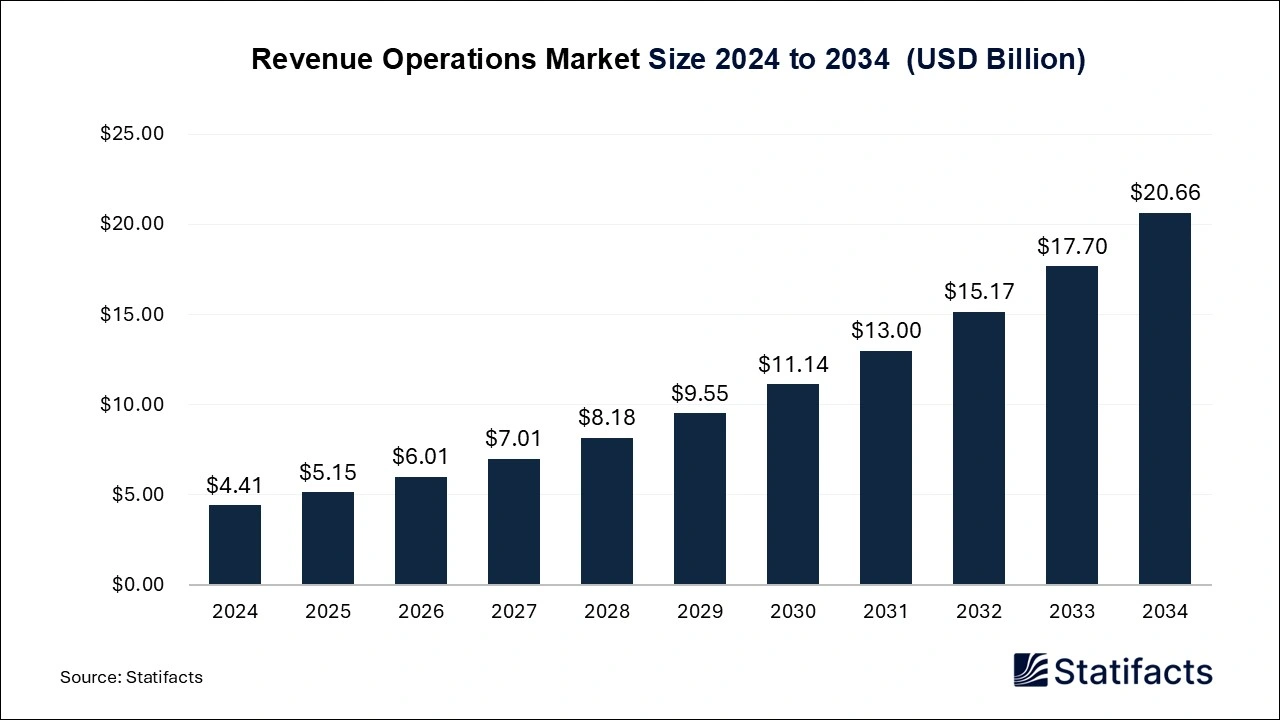
| Reports Attributes | Statistics |
| Market Size in 2024 | USD 4.41 Billion |
| Market Size in 2025 | USD 5.15 Billion |
| Market Size in 2031 | USD 13 Billion |
| Market Size by 2034 | USD 20.66 Billion |
| CAGR 2025 to 2034 | 16.7% |
| Base Year | 2024 |
| Forecast Period | 2025 to 2034 |
The revenue operations market is expanding as businesses recognize the importance of aligning traditionally siloed departments such as sales, marketing, and customer support under a single revenue-focused strategy. Organizations are moving away from fragmented systems toward integrated workflows that provide a 360-degree view of the customer journey. This alignment helps eliminate inefficiencies, reduce operational friction, and enhance revenue predictability.
A growing reliance on digital channels and subscription-based business models has also increased the demand for consistent customer engagement. Companies are leveraging revenue operations to synchronize customer data, streamline lead management, and improve cross-departmental communication. The trend is particularly strong in SaaS, technology, telecommunications, and professional services sectors, where recurring revenue models and customer retention are key performance indicators.
The use of analytics and key performance metrics is central to this market’s growth. Enterprises are using revenue operations software and tools to consolidate insights across the pipeline, enabling leadership teams to make data-backed decisions. The rise of remote and hybrid work models has further underscored the need for centralized platforms that unify performance tracking and real-time communication.
Technological innovation is at the heart of revenue operations transformation. Artificial intelligence, predictive analytics, and automation are being integrated into platforms to enhance forecasting, lead scoring, and process optimization. AI-powered tools can detect trends and anomalies in revenue data, helping businesses identify bottlenecks and new opportunities faster. Machine learning algorithms also assist in pipeline management, improving conversion rates and overall efficiency.
Cloud-based RevOps solutions are also driving market expansion by enabling scalability and real-time access to insights. These platforms integrate seamlessly with customer relationship management (CRM), enterprise resource planning (ERP), and marketing automation systems. As data volumes grow, cloud adoption ensures greater flexibility and security while lowering operational costs for businesses of all sizes.
While adoption is growing, there are notable challenges. Many organizations struggle with change management when shifting to a revenue operations framework, particularly in aligning multiple teams with different goals and processes. Legacy infrastructure, inconsistent data quality, and limited analytics maturity can slow implementation. Additionally, the lack of standardized metrics and performance benchmarks across industries can make it difficult to measure success uniformly.
Data security and compliance remain other key concerns. As revenue operations relies heavily on unified data from multiple systems, safeguarding customer information against breaches and ensuring compliance with privacy laws like GDPR and CCPA are critical.
There is significant potential for vendors offering comprehensive, all-in-one revenue operations platforms that combine analytics, collaboration, and workflow automation. Small and mid-sized enterprises are increasingly seeking affordable, scalable solutions to improve their revenue performance without heavy customization. Consulting and managed service providers also have opportunities to support businesses with implementation, training, and performance analytics.
As organizations continue to invest in digital transformation, RevOps adoption is expected to expand into new sectors such as healthcare, finance, and manufacturing. Integrating revenue operations with customer success management and financial analytics will help enterprises maximize profitability while maintaining customer satisfaction.
Artificial intelligence is transforming the way revenue operations function by automating repetitive processes, enhancing forecasting, and improving decision accuracy. AI can analyze sales trends, detect customer churn signals, and provide recommendations for resource allocation and pricing adjustments. Natural language processing is being used in conversational analytics to interpret sales calls and customer feedback, providing actionable insights for improvement.
AI is also improving predictive revenue modeling, allowing teams to forecast with greater accuracy by analyzing large datasets in real time. With automation handling much of the manual workload, human teams can focus more on strategy and relationship building, resulting in higher productivity and reduced costs.
| Regions | Shares (%) |
| North America | 40% |
| Asia Pacific | 26% |
| Europe | 27% |
| LAMEA | 7% |
| Segments | Shares (%) |
| Software | 70% |
| Services | 30% |
| Segments | Shares (%) |
| Cloud | 78% |
| On-Premises | 22% |
| Segments | Shares (%) |
| Large Enterprises | 55% |
| SMEs | 45% |
| Segments | Shares (%) |
| Sales Operations | 32% |
| Marketing Operations | 20% |
| Customer Success Operations | 18% |
| Finance & Revenue Analytics | 18% |
| Forecasting & Planning | 12% |
| Segments | Shares (%) |
| BFSI | 18% |
| IT & Telecom | 24% |
| Healthcare & Life Sciences | 12% |
| Retail & E-commerce | 16% |
| Manufacturing | 10% |
| Media & Entertainment | 10% |
| Others | 10% |
Published by Yogesh Kulkarni





