

Share


Automotive Battery X-Ray Imaging Inspection Market (By Type: Online Devices, Offline Devices; By Application: Lithium Iron Phosphate Battery, Lithium Manganese Oxide Battery, Ternary Polymer Lithium Battery, Other; By Region: North America, Asia-Pacific, Europe, Latin America, Middle East & Africa) Industry Size, Share, Growth, Trends 2026 to 2035.

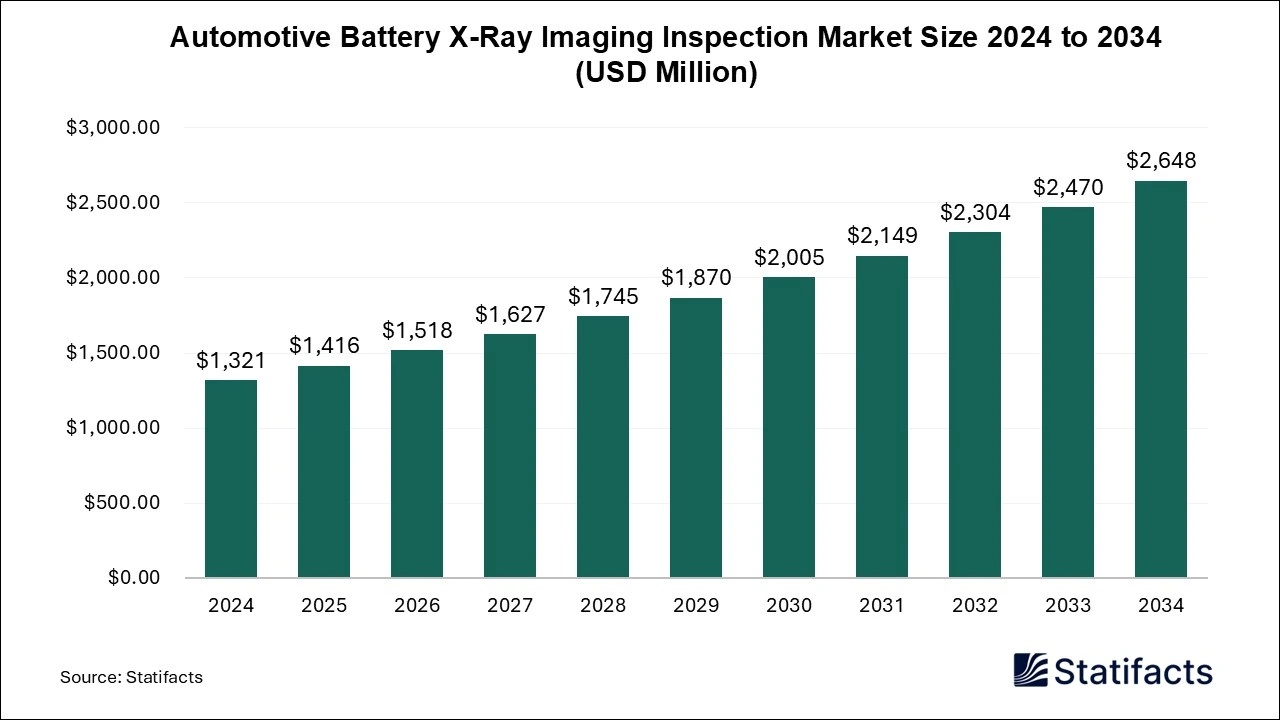
The global automotive battery X-ray imaging inspection market, valued at USD 1,416 million in 2025, is projected to reach USD 2,818 million by 2035, growing at a CAGR of 7.12% driven by increasing demand for advanced safety and quality control in automotive battery manufacturing.
| Reports Attributes | Statistics |
| Market Size in 2025 | USD 1,416 Million |
| Market Size in 2026 | USD 1,518 Million |
| Market Size in 2032 | USD 2,304 Million |
| Market Size by 2035 | USD 2,818 Million |
| CAGR 2026 to 2035 | 7.12% |
| Base Year | 2025 |
| Forecast Period | 2026 to 2035 |
The trend of increasing EV production, building gigafactories, and maintaining high-performing safety standards is a key reason why advanced inspection technologies using imaging are being adopted by the automotive industry. As the trend of global electric vehicles becomes more rapid, the integrity, performance, and safety of lithium-ion batteries have become a priority for automobile manufacturers and battery manufacturers. X-ray imaging inspection systems enable the detection of internal defects, electrode misalignment, and material inconsistencies that may lead to a loss of battery reliability or cause safety issues, such as overheating and short-circuiting.
The automotive battery X-ray imaging inspection market will grow faster as manufacturers adopt AI-driven inspections to improve accuracy, speed, and automation. Through the application of artificial intelligence AI-based analytics, these systems can automatically detect defects, anticipate performance problems, and streamline the imaging process, making it more accurate and consistent. It minimizes operational expenses and decreases production cycles. Also, EV infrastructure development, including machine vision and digital inspection technologies, is opening enormous opportunities for innovation.
| Regions | Shares (%) |
| North America | 23% |
| Asia Pacific | 35% |
| Europe | 18% |
| LAMEA | 24% |
| Segments | Shares (%) |
| Online Devices | 55% |
| Offline Devices | 45% |
| Segments | Shares (%) |
| Lithium Iron Phosphate Battery | 30% |
| Lithium Manganese Oxide Battery | 22% |
| Ternary Polymer Lithium Battery | 20% |
| Other | 28% |
Published by Yogesh Kulkarni





