



Recycled Thermoplastic Elastomers Market (By Type: <55% and ≥55%; By Application: Automotive Interior & Exterior Trims, Consumer Goods, Construction Material, Wire & Cable, and Others; By Region: North America, Europe, Asia Pacific, Latin America, and Middle East & Africa) Industry Size, Share, Growth, Trends 2026 to 2035.

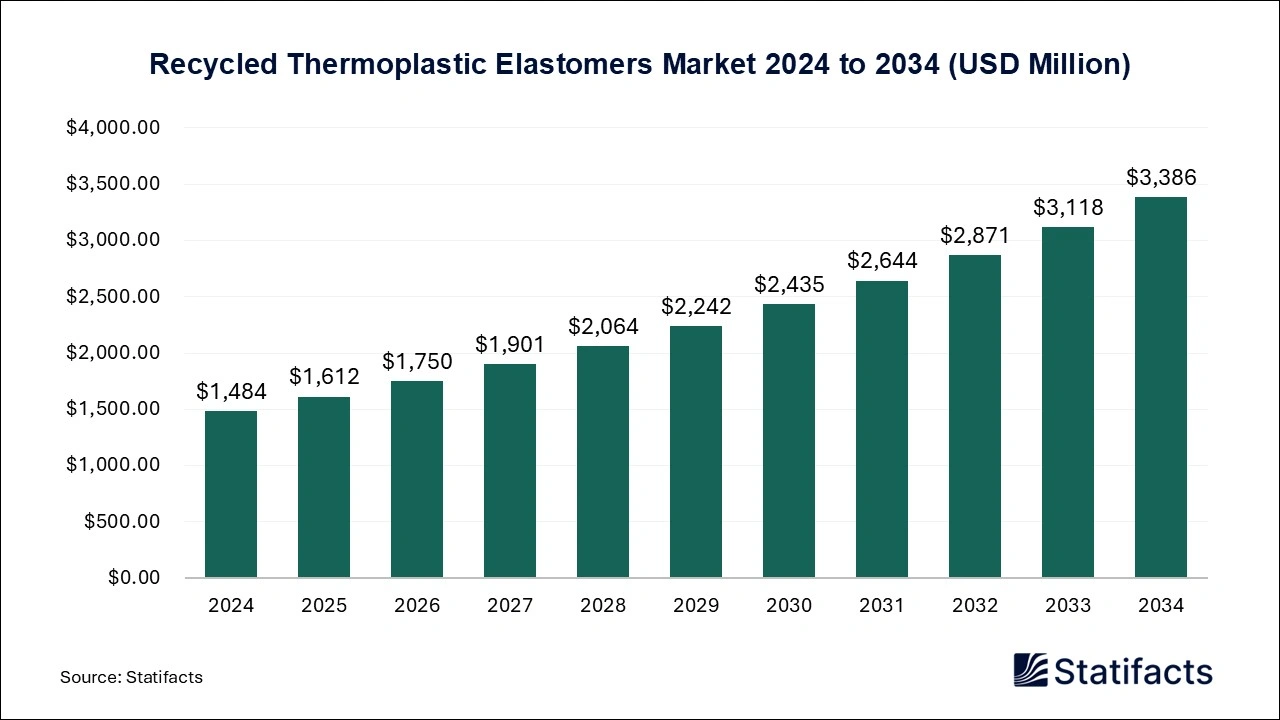
The global recycled thermoplastic elastomers market, valued at USD 1,612 million in 2025, is projected to reach approximately USD 3,640 million by 2035. This growth, driven by increasing adoption of sustainable materials in automotive and consumer goods, is expected at a CAGR of 8.49%.
| Reports Attributes | Statistics |
| Market Size in 2025 | USD 1,612 Million |
| Market Size in 2026 | USD 1,750 Million |
| Market Size in 2032 | USD 2,871 Million |
| Market Size by 2035 | USD 3,640 Million |
| CAGR 2026 to 2035 | 8.49% |
| Base Year | 2025 |
| Forecast Period | 2026 to 2035 |
The recycled thermoplastic elastomers market is developing faster due to the rising world attention to the so-called sustainability and circular economy. Recycled TPEs are also finding their way in sectors like healthcare equipment, automobile, consumer products, and electronics because of their flexibility, durability, and lower environmental impact than traditional plastics. These materials can also assist manufacturers in reducing carbon emissions and waste production without leaving an impact on the performance of the product. In addition, recycled TPEs are being utilized in the automotive interiors, medical tubing, and footwear, hence new opportunities are emerging. The issues like low feedstock quality, contamination in recycling, and high processing cost are some of the obstacles to large-scale deployment in the cost-sensitive and high-performance industries.
The recycled thermoplastic elastomers market incorporates artificial intelligence and automation of the digital process. The material quality can be enhanced through the use of artificial intelligence AI-based modeling and predictive analytics that will contribute to the optimization of compatibilizer selection, impurity, and recycling parameters. The technology change aids accelerated innovation, lifestyles, and cost-effectiveness, particularly in industries such as medical devices, wearable electronics, and automotive parts, where accuracy, efficiency, and endurance play a vital role.
| Regions | Shares (%) |
| North America | 27% |
| Asia Pacific | 33% |
| Europe | 25% |
| LAMEA | 15% |
| Segments | Shares (%) |
| <55% | 58% |
| ≥55% | 42% |
| Segments | Shares (%) |
| Automotive Interior & Exterior Trims | 28% |
| Consumer Goods | 22% |
| Construction Material | 18% |
| Wire & Cable | 16% |
| Others | 16% |
Published by Saurabh Bidwai





