




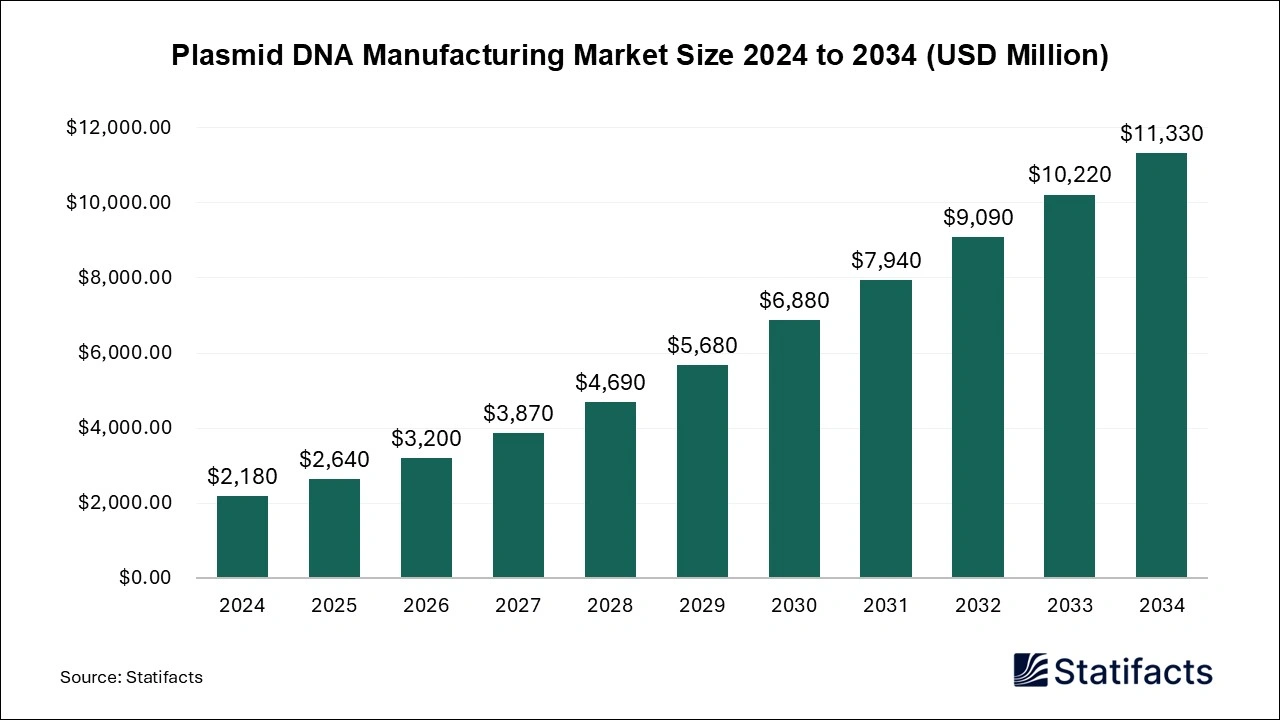
The global plasmid DNA manufacturing market size surpassed USD 2,180 million in 2024 and is predicted to reach around USD 11,330 million by 2034, registering a CAGR of 17.91% from 2025 to 2034.
| Industry Worth | Details |
| Market Size in 2025 | USD 2,640 Million |
| Market Size by 2034 | USD 11,330 Million |
| Market Growth Rate from 2025 to 2034 | CAGR of 17.91% |
The plasmid DNA manufacturing market is an effective and rapidly increasing sector that plays a crucial role in genetic research and biotechnology. Plasmid DNA is a circular, double-stranded DNA molecule that replicates independently of chromosomal DNA. With its capability to be genetically engineered, plasmid DNA serves as a vital element in the generation of advanced therapy medicinal products (ATMPs) like nucleic acid vaccines and cell and gene therapy.
Allen Guo, CEO of ProBio, said, “We understand pharmaceutical companies’ concerns about how many plasmid DNA manufacturers do not have predictable timelines, and we are committed to raising the bar for the industry, and we will deliver at the speed drug developers deserve.”
“Medical biotechnology is a key technology of the 21st century. The pandemic has proven Germany’s capability as a location for innovation and manufacturing of medicines. Germany and Europe are becoming more resilient by building local value chains. BioNTech’s investment is very good news,” said Olaf Scholz, Chancellor of the Federal Republic of Germany.
The plasmid DNA manufacturing market is experiencing significant growth, with North America maintaining its position as the dominant region while Europe emerges as the rapidly growing market. In the APAC region, China stands out as a driver of growth in the space.
North America
North America dominated the global market in 2024. It is the foundation of the recombinant DNA advisory committee by NIH to tailor scientific, legal, and ethical issues pertaining to the usage of rDNA techniques is taking part in a vital role in boosting the acceptance of these techniques. The significant role of the body is to analyze human gene transfer research.
Europe
Europe is experiencing rapid growth in the plasmid DNA manufacturing market during the forecast period. It is assigned to a rise in research support and the existence of major market players in this area. The number of biopharmaceutical firms is increasing in Europe, owing to growing investments.
China and APAC
Asia Pacific (APAC) is projected to be the fastest growing in the market during the forecast period. The existence of untapped opportunities, enhancing healthcare infrastructure, economic development, and favorable initiatives by the government and producers in the biotechnology field are some factors accounting for this fast growth. However, this region provides relatively low-cost operating and producing units for conducting research.
Charles River Laboratories International tackles fierce competition from both renowned players and emerging disruptions in the company. With a target on reliability, quality, and customer satisfaction, the firm constantly attempts to stay ahead of the curve and manage its position as a pacemaker in the sector of biopharmaceutical research and development.
Kaneka Corp is a chemical production firm. Its item offerings include caustic soda, polyvinyl chloride, hydrochloric acid, rigid PVC compounds, flexible polyvinyl chloride (PVC) compounds, paste PVC, chlorinated PVC, and flexible polyvinyl chloride (PVC) compounds. Its products include expandable plastics and products, functional plastics, foodstuffs products, electronic products, synthetic fibers, and life science products. Kaneka functions research laboratories including cell therapy laboratories and regenerative medicine, biotechnology research laboratories, material solutions new research engine, and others.
Danaher Corp designs, produces, and markets medical items and services. It provides a broader range of testing instruments, life science research apparatus, medical diagnostic solutions, professional microscopes, genomic consumables, reagents and mass spectrometry, filtration and flow cytometry, centrifugation, genomics, lab automation, particle counting, and characterization businesses.
Table: Annual Revenue: Charles River Laboratories vs Kaneka Corp. vs Danaher Corporation 2021-24 (Millions of US$)
| Year | Charles River Laboratories | Kaneka Corp | Danaher Corporation |
| 2024 | 40,49,989 | 76,23,02,000 | 2,38,75,000 |
| 2023 | 41,29,409 | 75,58,21,000 | 2,38,90,000 |
| 2022 | 39,76,060 | 69,15,30,000 | 2,66,43,000 |
| 2021 | 35,40,160 | 57,74,26,000 | 2,48,02,000 |
Published by Ajit Bansod





