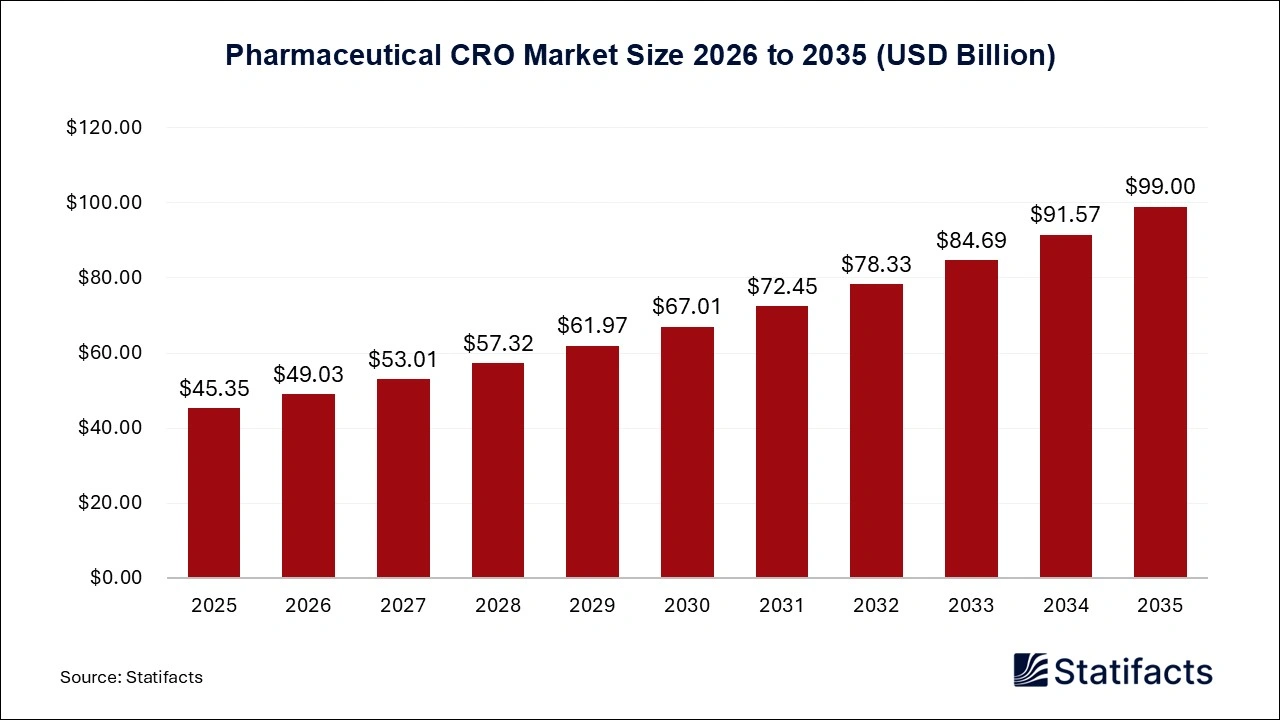
The global pharmaceutical CRO market, valued at USD 45.35 billion in 2025, is projected to reach nearly USD 99 billion by 2035, expanding at a CAGR of 8.12%, driven by rising clinical trial demand, outsourcing trends, and innovation in drug development.
Pharmaceutical CRO Market Statical Scope
| Reports Attributes |
Statistics |
| Market Size in 2025 |
USD 45.35 Billion |
| Market Size in 2026 |
USD 49.03 Billion |
| Market Size in 2032 |
USD 78.33 Billion |
| Market Size by 2035 |
USD 99 Billion |
| CAGR 2026 to 2035 |
8.12% |
| Base Year |
2025 |
| Forecast Period |
2026 to 2035 |
The market is at the forefront, with clear numbers on clinical trial complexity, access to brilliant expertise, support to advance trials, and ocean-deep knowledge. The rising advanced drug development seeks the best-in-class technology to elevate the market graph.
The pharmaceutical CRO is also called a clinical research organization, a well-recognised, specialized company that renders outsourced research services to medical device, biotechnology, and pharmaceutical companies. The sponsorship plays an important role as CROs operate on the sponsorship contracts to cover the whole drug development process, mainly clinical trials.
CROs act as a center stage for all clinical trial sites, regulatory bodies, and sponsors to communicate and encourage new talent and innovations. Most of the giant companies use CROs to join hands with niche expertise and leverage the market with their quick trials.
The business growth is expanding due to the complexity spotted in modern therapies requiring modern-minded modalities for approval. The emerging biopharma segment is engaging with the CROs' team, especially small and mid-sized biotech companies. These companies rely on external research infrastructure. The apt decision of outsourcing is a needed strategy as the growing R&D cost is at its peak. The new technology installation is another business bridging science and technology to reach the highest profit rate.
Pharmaceutical CRO Market Share, By Region, 2025 (%)
| Regions |
Shares (%) |
| North America |
42% |
| Europe |
28% |
| Asia-Pacific |
20% |
| Latin America |
6% |
| Middle East & Africa |
4% |
- North America – The North America regional segment dominated the market by 42% with the never-ending R&D investments and extraordinary efforts in specialized outsourcing. The tech integration to manage the complexity of advanced trails is stimulating the regional market growth.
- Europe – The Europe regional segment is expected to grow at a share of 28% with its constant regulatory support and harmonization featuring CTIS and EU-CTR. The keen focus on the specialized therapies is a boon to the regional market.
- Asia-Pacific – Asia Pacific acquires 20% of the market due to its infinite number of patients, which fastens the case registration process and cuts the trial duration. The supportive regulatory reforms in a few countries are streamlining the approval processes of valuable drugs.
- Latin America – Latin America is leading with 6% of market share, with its excellent segmental performance and biopharmaceutical rise. While the heterogeneous cohort helps to learn the diversified data, which is fundamental for international drug validation.
- Middle East & Africa – MEA successfully acquired 4% of the market with the rising number of microbiology CRO services and government initiatives. This marks more business for the regional market due to the diverse patient population.
Pharmaceutical CRO Market Share, By Type, 2025 (%)
| Segments |
Shares (%) |
| Clinical |
76% |
| Pre-clinical |
14% |
| Drug Discovery |
10% |
- Clinical – The clinical segment's dominance in this market has been 76%, highlighting the effective revenue generated from Phase 3 trial services. Tech integration remains the standard foundation for the segment's growth.
- Pre-clinical – The preclinical segment is expected to grow at a share of 14% as the strategic outsourcing is accelerating demand for CROs to balance the R&D cost escalating with the growing drug validation portfolio.
- Drug Discovery – Drug discovery is expanding with the rising prevalence of disease, capturing unusual conditions, while the tech support to the CRO builds more trust walls for effective space for drug discovery to develop and evaluate the performance. The segment covers 10% of its market profit.
Pharmaceutical CRO Market Share, By Molecule Type, 2025 (%)
| Segments |
Shares (%) |
| Small Molecules |
62% |
| Large Molecule |
38% |
- Small Molecules – The small molecule segment has dominated the market with 62%, as their oral bioavailability is an effective and operative factor in the constant drug discovery. It's capable of penetrating cell membranes to meet the intracellular needs.
- Large Molecules – The large molecules segment is expected to grow at a share of 38% due to the leveraging of the biologics portfolio and noteworthy results of the segment in all preclinical levels and the approval phase.
Pharmaceutical CRO Market Share, By Service, 2025 (%)
| Segments |
Shares (%) |
| Clinical Monitoring |
18% |
| Technology |
5% |
| Laboratory |
8% |
- Clinical Monitoring – The clinical monitoring segment smartly dominated 18% of the market, as the growing complexity volume in the clinical trial due to the evolution of modern therapies brings more responsibility to the data and patient safety.
- Technology – The technology segment is expected to grow at a rate of 5% with the lengthening alliances of tech expertise and solutions. The involvement of new technology like AI/ML for more efficiency is attracting more business from tech industries.
- Laboratory – The segment features 8% of the market as precision ends meet the drug validation point. The laboratory services have transformed into the central lab services as rare disease volume has increased, and so the pattern in clinical trial laboratory and central laboratory services.
Pharmaceutical CRO Market Share, By Therapeutic Area, 2025 (%)
| Segments |
Shares (%) |
| Oncology |
30% |
| Immunological Disorders |
10% |
| CNS Disorders |
12% |
- Oncology – The oncology segment had clear dominance, was 30% in the market, due to the growing statistics of oncology incidences. The popularity of novel modalities pumped radiopharmaceuticals, precision medicine, and immuno-oncology, pushing the market segment growth.
- Immunological Disorders – The immunological disorders segment is expected to grow at a rate of 10%, with the vast space of the immunology drug sector. The innovation flows in favor of the segment market growth.
- CNS Disorders – The CNS disorders segment leads with 12% of the market, as the number of neurological-based drug discoveries is increasing in number, learning about the CNS
disorder population. The critical modalities are fuelling more development with the support of skilled CROs.
Published by
Deepa Pandey