

Share


Magnetic Separation in Mining Market (By Material: Iron Ore & Magnetite Beneficiation, Base Metals, Coal Processing, Industrial Minerals, and Others; By End User: Fertility Clinics, Hospitals, and Clinical Research Institutes) Industry Size, Share, Growth, Trends 2026 to 2035

The global magnetic separation in mining market size was valued at USD 48.53 billion in 2025, is projected to reach approximately USD 84.08 billion by 2035. Growth is driven by rising demand for efficient mineral processing and advanced separation technologies, with a CAGR of 5.65%.
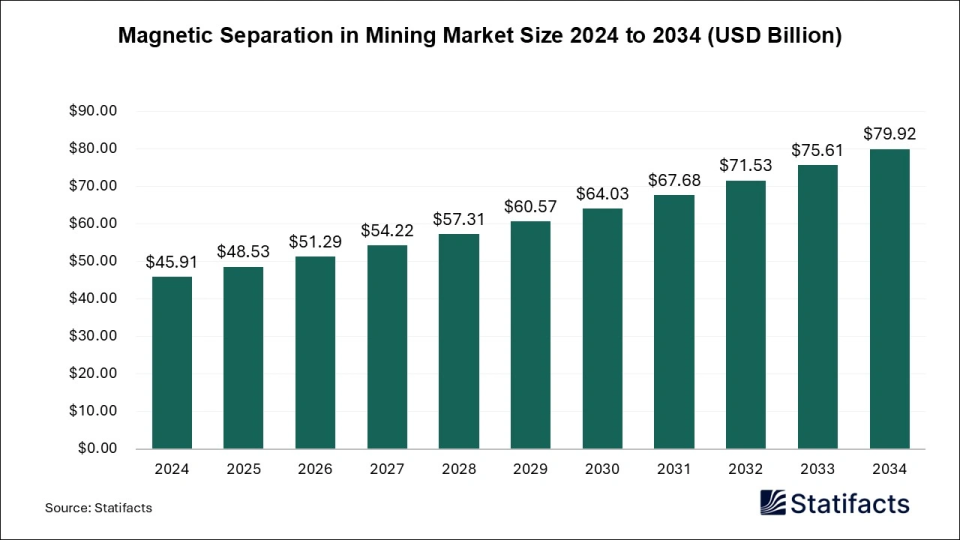
| Reports Attributes | Statistics |
| Market Size in 2025 | USD 48.53 Billion |
| Market Size in 2026 | USD 51.29 Billion |
| Market Size in 2032 | USD 71.53 Billion |
| Market Size by 2035 | USD 84.08 Billion |
| CAGR 2026 to 2035 | 5.65% |
| Base Year | 2025 |
| Forecast Period | 2026 to 2035 |
The magnetic separation in mining market is expanding rapidly due to increasing demand for minerals and metals used in modern infrastructure development. Magnetic separation is the process of isolating magnetic minerals from non-magnetic ones using magnetic fields, improving purity and operational efficiency. The method is gaining importance because it is non-chemical and eco-friendly, making it a sustainable alternative to chemical leaching. Rising demand for rare-earth element recovery, especially for neodymium and dysprosium used in electronics, is a major factor boosting adoption of magnetic separation technology.
Despite its advantages, the adoption of advanced magnetic systems can be difficult due to high initial investment costs for installation, calibration, and system integration. Small and medium-sized mining companies, particularly in developing economies, often face financial and technical barriers that limit their ability to adopt these solutions. The energy-intensive nature of magnetic separation equipment also increases operational costs and complexity, acting as another restraining factor for market growth.
The rising demand for rare-earth minerals used in wind turbines and electric vehicles is expected to accelerate investment in magnetic separation technologies. Government initiatives promoting sustainability are further supporting growth by encouraging cleaner mineral processing methods. Rapid advancements in ultra-fine particle recovery and magnetic particle technology are pushing the market forward. Investments in research and development are increasingly focused on nanomaterials and hybrid magnetic-fluid systems that aim to improve precision and recovery efficiency.
The Asia Pacific region holds a dominant position due to rapid expansion in construction and infrastructure projects in India, China, and Australia. China leads global production of magnetic separators and plays a major role in rare-earth mining through its strong network of local manufacturers. Australia is also expected to attract significant investment due to its emphasis on sustainable mining practices and large mineral reserves. Other regions are gradually adopting magnetic separation technology as awareness and availability of advanced systems increase.
Artificial intelligence AI and machine learning are improving the efficiency and reliability of magnetic separation systems by enabling real-time monitoring of operational parameters. These technologies help optimize energy usage and improve metal recovery rates. AI-enabled diagnostics allow early detection of mechanical faults in magnetic separator equipment, reducing downtime and maintenance costs. Automated ore classification systems are also emerging, using pattern recognition to enhance process efficiency and reduce waste, creating a more intelligent and sustainable mining workflow.
| Regions | Shares (%) |
| North America | 28% |
| Asia Pacific | 35% |
| Europe | 25% |
| LAMEA | 12% |
| Segments | Shares (%) |
| Iron Ore & Magnetite Beneficiation | 41% |
| Base Metals | 23% |
| Coal Processing | 15% |
| Industrial Minerals | 13 |
| Others | 8% |
| Segments | Shares (%) |
| Fertility Clinics | 24% |
| Hospitals | 58% |
| Clinical Research Institutes | 18% |
Published by Saurabh Bidwai





