



North America Digital Health Market (By Component: Software, Hardware, Services; By Technology: Telehealthcare, mHealth, Digital Health Systems, Health Analytics) Industry Size, Share, Growth, Trends 2026 to 2035.

The North America digital health market reached USD 105.75 Bn in 2025 and is projected to hit USD 748.18 Bn by 2035 at a 21.61% CAGR, driven by increasing adoption of telehealth, mHealth, and advanced digital health solutions across the region.
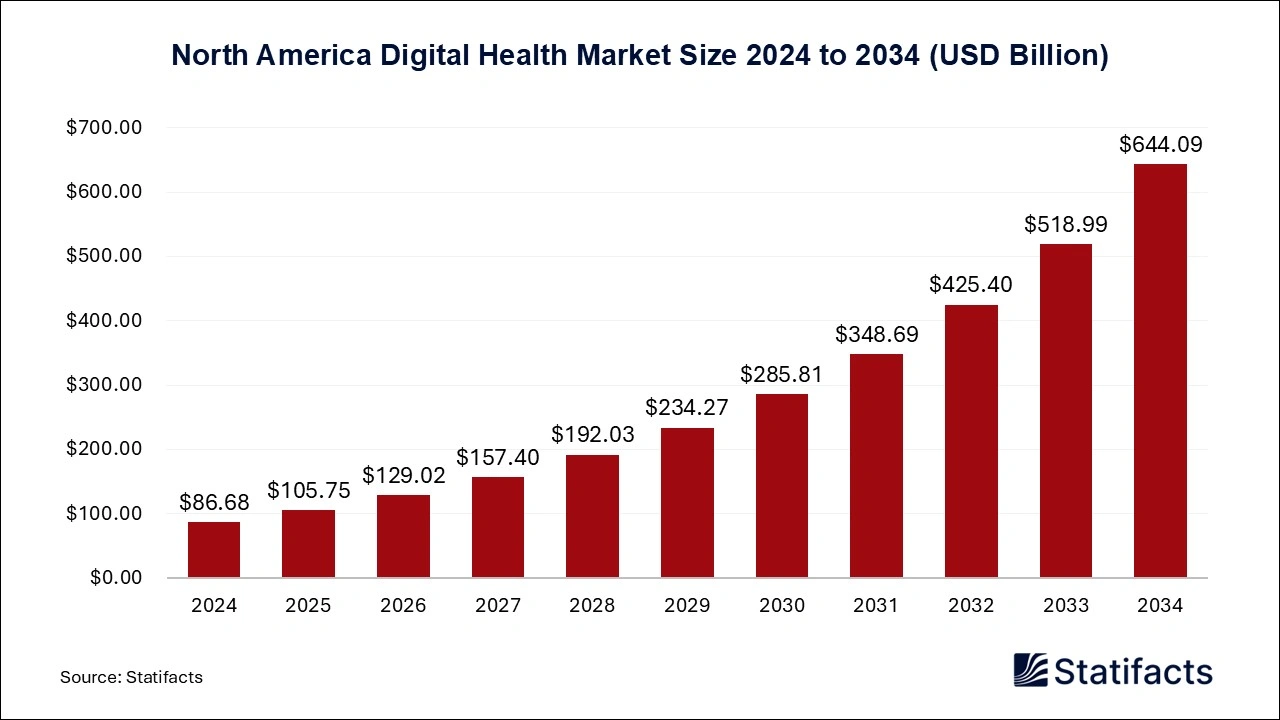
| Reports Attributes | Statistics |
| Market Size in 2025 | USD 105.75 Billion |
| Market Size in 2026 | USD 129.02 Billion |
| Market Size in 2032 | USD 425.4 Billion |
| Market Size by 2035 | USD 748.18 Billion |
| CAGR 2026 to 2035 | 21.61% |
| Base Year | 2025 |
| Forecast Period | 2026 to 2035 |
The North America digital health market is expanding rapidly, driven by increasing telehealth adoption, which enables services to reach a wider population without geographical boundaries. Digital health refers to the use of digital technologies to improve healthcare, promoting wellness and managing risks throughout all stages of care. These services mainly include telemedicine, mobile health apps, wearable devices, electronic health records, and many more. The changing pace of life in the region forces people with a chronic disease burden to use these services for better health management in a more accessible manner. The major driver of these solutions is the value-based healthcare model, which improves outcomes at lower total cost compared to traditional approaches.
North America, being a tech hub with advanced healthcare infrastructure, faces several challenges in the digital era, including data privacy and security. Additionally, the framework needs to be upgraded to attract more business through digital health solutions. Digital barriers among some rural populations are expected to hinder the growth of digital health.
The increasing technological advancements in remote patient monitoring and in-home services are expected to attract a higher demand in the coming years. The payer contract rate is also expected to increase, where evidence-based diseases will be more reliable in this healthcare model. The rise of the Internet of Medical Things (IoMT) is expected to enable monitoring of wearable technologies as part of continuous health tracking. The increasing popularity of digital therapeutics (DTx) will also drive greater demand for treating these conditions in combination with traditional therapies. More technological growth from Augmented Reality (AR) and Virtual Reality (VR) is expected to drive improvements in medical training, patient education, and other advancements in a creative and informative way.
The healthcare sector in the North American region has been rapidly integrating artificial intelligence (AI) and machine learning technologies to streamline clinical workflows, enhance diagnostic precision, and support data-driven decision-making across hospitals and outpatient facilities. AI algorithms are increasingly embedded into radiology, pathology, and cardiology workflows to analyze large volumes of imaging and clinical data, improving diagnostic accuracy, accelerating image interpretation, and reducing reporting backlogs for overstretched clinicians. ML models are being deployed to predict hospital readmission risk, early signs of patient deterioration, sepsis onset, and other adverse outcomes, enabling providers to intervene earlier and tailor treatment plans with greater specificity.
Demand is also rising for AI-enabled automation of routine administrative tasks such as appointment scheduling, billing, coding, prior authorization, and claims management, helping healthcare systems reduce operational bottlenecks and redirect staff time toward direct patient care. Personalized care tools powered by AI are gaining traction as well, with algorithms optimizing medication dosing schedules, monitoring patient adherence patterns, and analyzing behavior and lifestyle data to support chronic disease management. Together, these capabilities reinforce AI and ML as foundational technologies that drive efficiency, improve clinical outcomes, and strengthen the overall healthcare delivery ecosystem in North America.
The United States is one of the dominant countries in the North American digital health market due to the massive healthcare spending by leading organizations and startups to drive digital innovation. The country's IT hub is actively partnering with healthcare players to develop digital solutions that can reduce healthcare costs and improve outcomes. Additionally, increasing health awareness among the population is expected to drive greater focus on commercial insurers, Medicare, and other payers to attract more consumers. Regulatory support for telehealth reimbursements is expected to attract a wider population in the coming years.
Canada stands as one of the most opportunistic countries in the North American digital market, where remote patient monitoring and virtual care are rapidly increasing. Moreover, companies are investing in AI and automation for many tasks due to healthcare labor shortages, including those in rural areas. The increasing digital literacy and patient awareness is expected to drive more demand for wearables on daily basis for more accurate insights of their health data.
| Regions | Shares (%) |
| Software | 36.49% |
| Hardware | 30.22% |
| Services | 33.29% |
| Segments | Shares (%) |
| Digital Health Systems | 26.84% |
| mHealth | 29.13% |
| Telehealthcare | 21.77% |
| Health Analytics | 22.26% |
Published by Ajit Bansod





