



Mixed Reality Industrial Training Systems Market (By Type: Immersive Virtual Training Systems, Augmented Reality Operational Assistance Systems, Remote Collaboration and Guidance Platforms, Modular Customized Training Platforms, and Others; By Application: Equipment Operation Training, Maintenance and Repair Training, Industrial Safety Training, Production Process Optimization Training, and Others; By Region: North America, Europe, Asia Pacific, Latin America, and Middle East & Africa) Industry Size, Share, Growth, Trends 2026 to 2035.

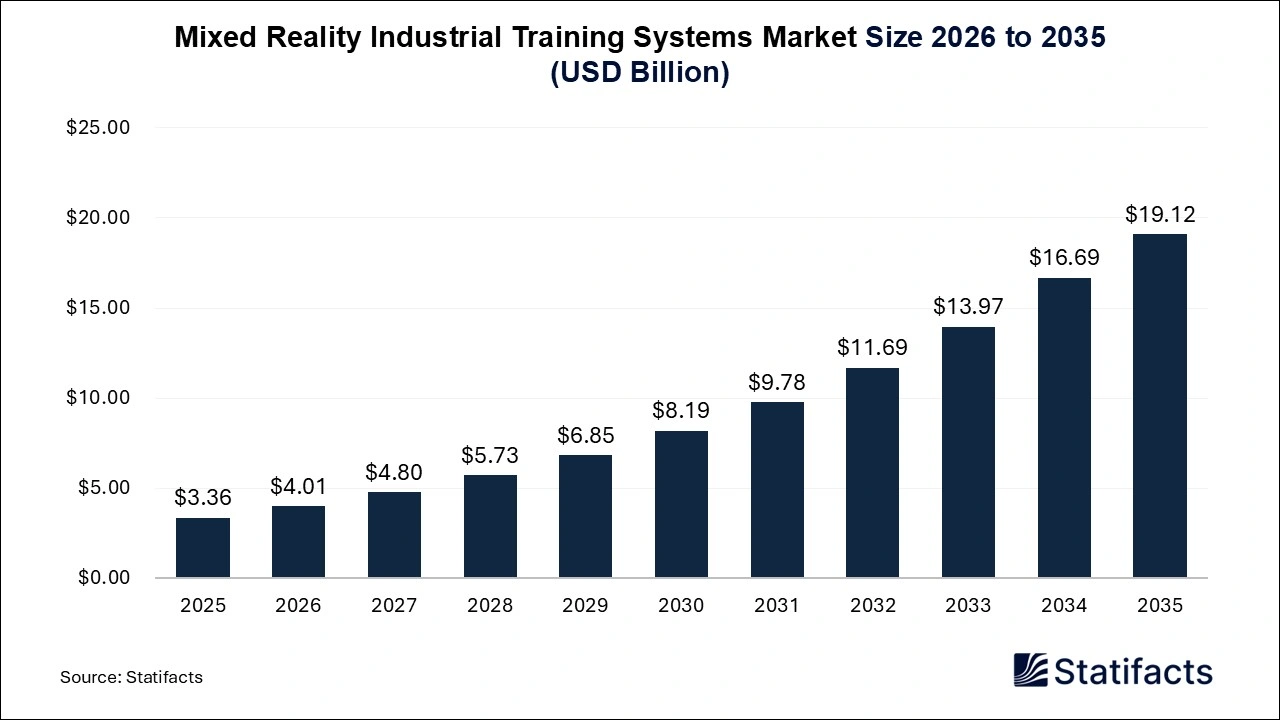
The global mixed reality industrial training systems market was valued at USD 2,811 billion in 2025 and is projected to reach approximately USD 16,693.21 billion by 2035, registering a CAGR of 19.50%. This rapid growth is driven by the increasing adoption of immersive training technologies in manufacturing, energy, and logistics sectors to enhance workforce efficiency, safety, and skill development.
| Reports Attributes | Statistics |
| Market Size in 2025 | USD 3.36 Billion |
| Market Size in 2026 | USD 4.01 Billion |
| Market Size in 2032 | USD 11.69 Billion |
| Market Size by 2035 | USD 19.12 Billion |
| CAGR 2026 to 2035 | 19.50% |
| Base Year | 2025 |
| Forecast Period | 2026 to 2035 |
The Mixed Reality Industrial Training Systems Market refers to the market for advanced training solutions that integrate mixed reality (MR) technologies, including virtual reality (VR), augmented reality (AR), and holographic simulations, to enhance workforce training in industrial settings. These systems enable employees to engage in immersive, interactive, and simulated environments for learning complex industrial processes, equipment operation, maintenance, safety procedures, and production optimization without the risks or costs associated with traditional on-site training.
MR industrial training systems combine real-world physical environments with digital overlays to provide hands-on experiential learning, real-time guidance, and remote collaboration capabilities. The market encompasses hardware (head-mounted displays, sensors, and controllers), software platforms (training modules, simulation engines, and analytics tools), and integrated services that facilitate deployment, customization, and content management.
| Segments | Shares (%) |
| North America | 40% |
| Europe | 25% |
| Asia Pacific | 20% |
| LAMEA | 15% |
| Segments | Shares (%) |
| Immersive Virtual Training Systems | 35% |
| Augmented Reality Operational Assistance Systems | 25% |
| Remote Collaboration and Guidance Platforms | 15% |
| Modular Customized Training Platforms | 10% |
| Others | 15% |
| Segments | Shares (%) |
| Equipment Operation Training | 30% |
| Maintenance and Repair Training | 25% |
| Industrial Safety Training | 20% |
| Production Process Optimization Training | 15% |
| Others | 10% |





