

Share



The global liquid packaging market size was evaluated at USD 501.66 billion in 2024 and is expected to grow around USD 815.6 billion by 2034, registering a CAGR of 4.98% from 2025 to 2034.
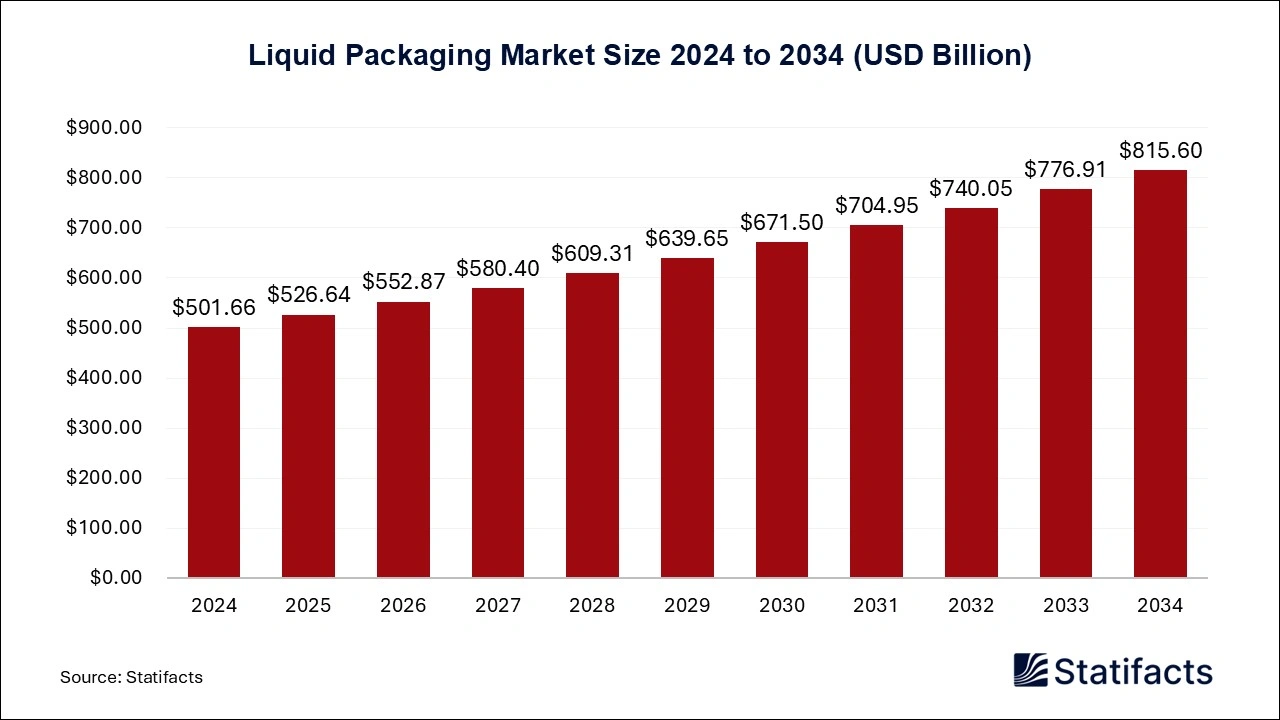
| Industry Worth | Details |
| Market Size in 2025 | USD 526.64 Billion |
| Market Size by 2034 | USD 815.6 Billion |
| Market Growth Rate from 2025 to 2034 | CAGR of 4.98% |
The steady growth of liquid packaging can be attributed to changing consumer trends, urbanization, and innovations in packaging materials. Traditional materials include glass, paper, metals, and plastics for packaging food and beverages. A significant impact on the market has arisen from the shift towards newer materials like aluminum films, which offer better barrier properties and are lightweight, providing enhanced protection and shelf life for liquid products.
With the increasing interest in maintaining the freshness and quality of products during storage and distribution, the market will demand more advanced solutions in liquid packaging. The cost-effectiveness of plastics and their functional versatility, such as microwavability, thermo-sealability, and adaptability to different shapes and sizes while maintaining transparency, outweighs the benefits of traditional materials. Once sealed, plastic packaging provides a barrier against moisture and microorganisms during long-distance travel, enabling longer product storage.
Accelerated urbanization drives the market, as more people migrate to urban centers, increasing the demand for packaged, ready-to-use liquid products. Urban lifestyles and better economic opportunities encourage greater consumption of convenient food and beverage formats. The liquid packaging sector continues to grow, supported by innovations in materials, changing consumption patterns, and rising demands for safe, durable, and effective packaging solutions that meet the needs of modern distribution and storage.
“We look forward to partnering closely with the team at SEE. This will be a new chapter for Liquibox – a chance to accelerate innovation and bring sustainable packaging solutions to more customers and geographies,”
"With the support of our talented team, Verso has successfully streamlined our operations and reduced costs while strategically investing in projects to enhance our ability to support our customers. This transaction builds upon our considerable progress and better positions the combined company to invest in our North American manufacturing capability, provide high-quality paper products to customers, and accelerate growth."
The global liquid packaging market is experiencing significant growth, with APAC maintaining its position as the dominant region while North America emerges as the fastest-growing market.
Asia-Pacific
APAC dominated the market. Very supportive government initiatives and robust industrial growth dominate the Asia Pacific liquid packaging market, especially in the pharmaceutical and food and beverage industries. Manufacturers looking for cost-optimized production would typically relocate their global production facilities to such a region, thus benefiting from its cost-effective labor and operational environment. More important now, however, is the regional economic viability of an enabling regulatory landscape that would encourage manufacturers to coax innovations and sustainability to diversify their offerings. Thus, the Asia Pacific remains the most prospective region for exploring long-term growth and investment in the liquid packaging market.
North America:
North America is expected to grow moderately due to the increasing consumer preference for sustainable and recyclable materials. Being the forerunner, the US market demand is primarily fueled by the food & beverage and healthcare sectors.
Growing environmental consciousness and regulatory support for eco-friendly alternatives encourage innovation in packaging technologies. By being an ardent crusader of quality and safety, North America is proudly emerging as one of the important regions contributing to the liquid packaging business on the global platform, though not on the manufacturing scale that compares with Asia Pacific.
Europe:
Europe is also emerging as an increasingly important region in the liquid packaging market, in line with the regional environmental sustainability movement. The strict regulation of eco and non-recyclable standard materials is forcing different manufacturers to invest heavily in alternative packaging formats to mitigate their carbon footprint. That is indeed raging hot, with a terrific increase expected in innovations about biodegradable and paper-based solutions as consumer awareness increases in environmental issues. A mature market with strong regulatory backing on demand for greener solutions makes Europe one of the key regions defining the future of sustainable liquid packaging.
The liquid packaging market is highly competitive, with leading pharmaceutical companies such as Nippon Paper Industries Co., Ltd., Klabin Paper, The DOW Chemical Company, Smurfit Kappa Group, and Mondi PLC. The global liquid packaging market faces intense competition due to evolving consumer preferences, innovation, and product development, with brand managers focusing on global market share and differentiation.
The market is dominated by several packaging companies renowned for their significant contributions to sustainable packaging solutions. Based on recent data, the top three companies are:
In the fiscal year ending March 31, 2024, Nippon Paper Industries Co., Ltd. reported a total net sales of ¥1,167.3 billion.
Klabin SA, a Brazilian paper producer, reported a 2022 revenue of $3.6 billion, a 10% decrease from the previous year. In 2024, their annual revenue was $3.34 billion. Klabin also experienced a net income decrease and a negative net profit margin in 2022. The company's net debt increased significantly in 2024.
In 2024, International Paper reported revenue of $18.6 billion. The company's fiscal year ends on December 31st, and its net income was $557 million
Published by Vidyesh Swar
Related Reports





