By clicking “Accept All Cookies” you agree to the storing of cookies on your device
to enhance site navigation, analyze site usage, and assist in our marketing efforts.
The U.S. polyethylene market size was estimated at USD 23.7 billion in 2024 and is projected to be worth around USD 34 billion by 2034, growing at a CAGR of 3.67% from 2025 to 2034.
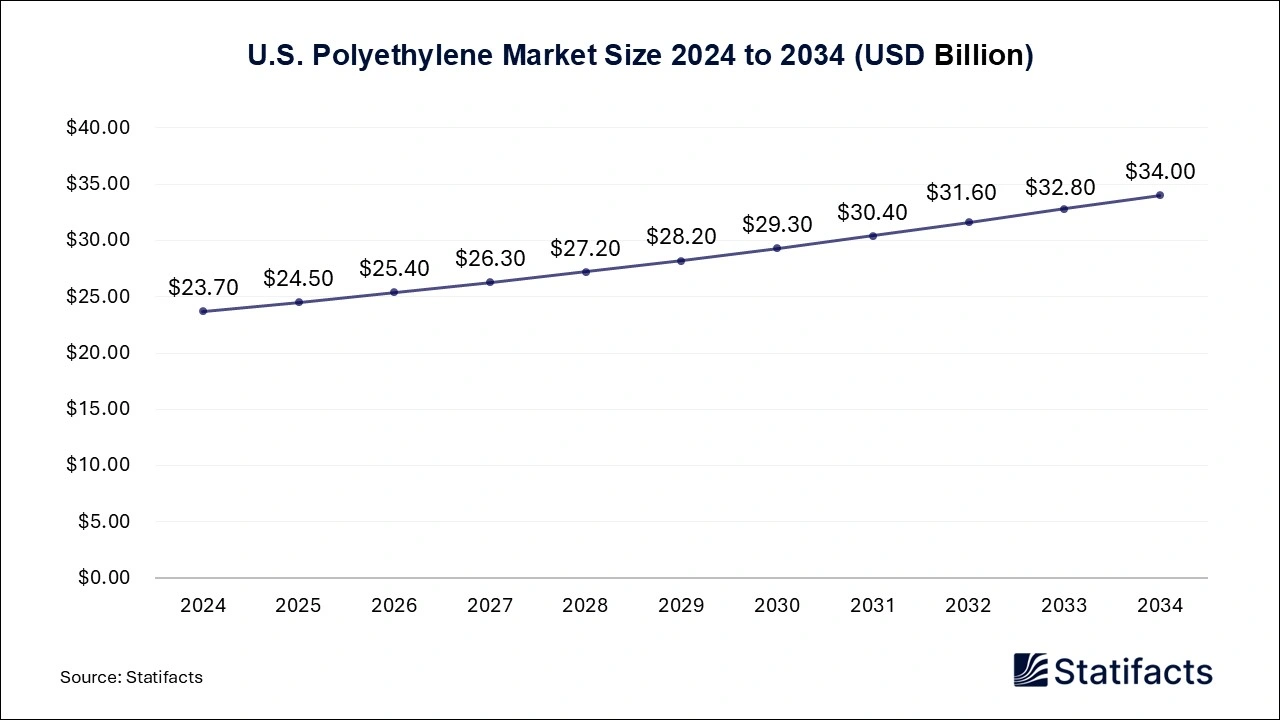
Highlights of the U.S. Polyethylene Market
By type insight, the HDPE segment underwent notable growth in the market during 2024.
By type insight, the LLDPE segment experienced significant expansion in the market.
By application insight, the packaging segment saw strong growth during the studied period.
By application insight, the construction segment showed substantial gains in the market.
Industry Valuation and Growth Rate Projection
Industry Worth
Details
Market Size in 2025
USD 24.5 Billion
Market Size by 2034
USD 34 Billion
Market Growth Rate from 2025 to 2034
CAGR of 3.67%
The U.S. polyethylene market is a growing sector in high demand, including packaging, construction, automotive, and healthcare. With the complement of all properties- larger use, more durable, and cost-efficient property- the material finds applications in industrial and consumer sectors alike. Demand is largely driven by packaging, which serves for protection, versatility, and lightness. Advancing technologies, including better catalyst systems and processing methods, are aiding a close chase after higher-quality polyethylene products that are tailored for specific applications. Flexible polyethylene is a major category, employed in food packaging, industrial wrapping, and consumer articles. Plastics such as HDPE are in great demand from all sectors. It is a highly diversified competitive setting where global, as well as regional players, are investing in expanding capacities, sustainability endeavours, and innovations. The U.S. polyethylene market is poised to strengthen its growth trajectory in the coming years.
Market Trends
Sustainability and circular economy initiative concerns over the environment are driving development in recycled and bio-based PE, backed by corporate and governmental commitments to sustainability.
Technological advancements developments in polymer processing and multilayer film technology enhance polyethylene's properties for barrier packaging.
Growth in emerging markets increasing income levels and industrialization in the Asia-Pacific, Africa, and Latin America are ushering in increased demand for polyethylene from various sectors.
Regulatory drive for recyclability regulations at a global level, calling for recyclability and banning single-use plastics, is forcing innovations in the recyclable PE solution.
Agricultural applications the plastic is cast widely in films for greenhouses, mulching, etc., given its UV resistance and sheer flexibility.
Restraint
Raw material price volatility is a significant threat to the polyethylene market. The price fluctuations greately dependent on varying factors like worldwide supply-demand interplay, geopolitical unrest, and other macroeconomic events, which introduce some form of uncertainty into the cost structure of PE production.
As these raw materials become costlier, profit margins shrink, and any disruption in the supply chains prevents the marketers or producers from receiving timely supplies of these crucial inputs.
Simultaneously, increasing environmental and regulatory concerns have propelled market preference towards bio-based alternatives and sustainable materials, further adding to cost pressure since often these alternatives need different, usually costlier feedstock.
As a result, the whole situation becomes quite complex for polyethylene producers, thereby restricting their flexibility and earnings-distribution capability.
Opportunity
As the focus of the industries is slowly drifting toward sustainability, the polyethylene (PE) market is undergoing scrutiny and perhaps change. Recycling today is looked upon as one of the brighter opportunities in the packaging, automotive, textile, and 3D printing fields.
Now, packaging stands as a major demand driver for recyclable polyethylene, with companies wishing to minimize their carbon footprint and offer cutting-edge green products. Technological debugging in recycling processes improves recyclable polyethylene production in terms of quality, efficiency, and possibilities, allowing for the processing of mixed and contaminated plastics.
Composite materials blended with recyclable polyethylene and natural fibers would be a great solution in terms of sustainability, with better properties.
Adoption of recycled content and circularity practices is expected to be a major driver of growth within the broader polyethylene market, posing opportunities for long-term innovations and differentiation.
Recent Developments in the U.S. Polyethylene Market:
In March 2025, Glenmark Pharmaceuticals launched 'Polyethylene Glycol 3350 Powder for Solution' as an OTC product in the US, a generic equivalent of Bayer HealthCare's MiraLAX Powder for Solution, which has achieved annual sales of $555.7 million.
In May 2024, Finnish compounder Premix Oy opened its first US plant in Charlotte, NC, to produce electrically conductive plastic compounds and masterbatches. The facility, which will begin production in early 2025, will produce 45 million pounds per year.





