



Lidar-Based Forest Fire Detection Systems Market (By Type: Ground-based Fixed Systems, Aerial Drone-mounted Systems, Satellite-integrated Systems, Portable Patrol Devices, and Others; By Application: Early Warning of Forest Fires, Monitoring of Nature Reserves, Protection of Mountain Infrastructure, Real-time Monitoring of Forestry Resources, and Others; By Region: North America, Europe, Asia Pacific, Latin America, and Middle East & Africa) Industry Size, Share, Growth, Trends 2026 to 2035.

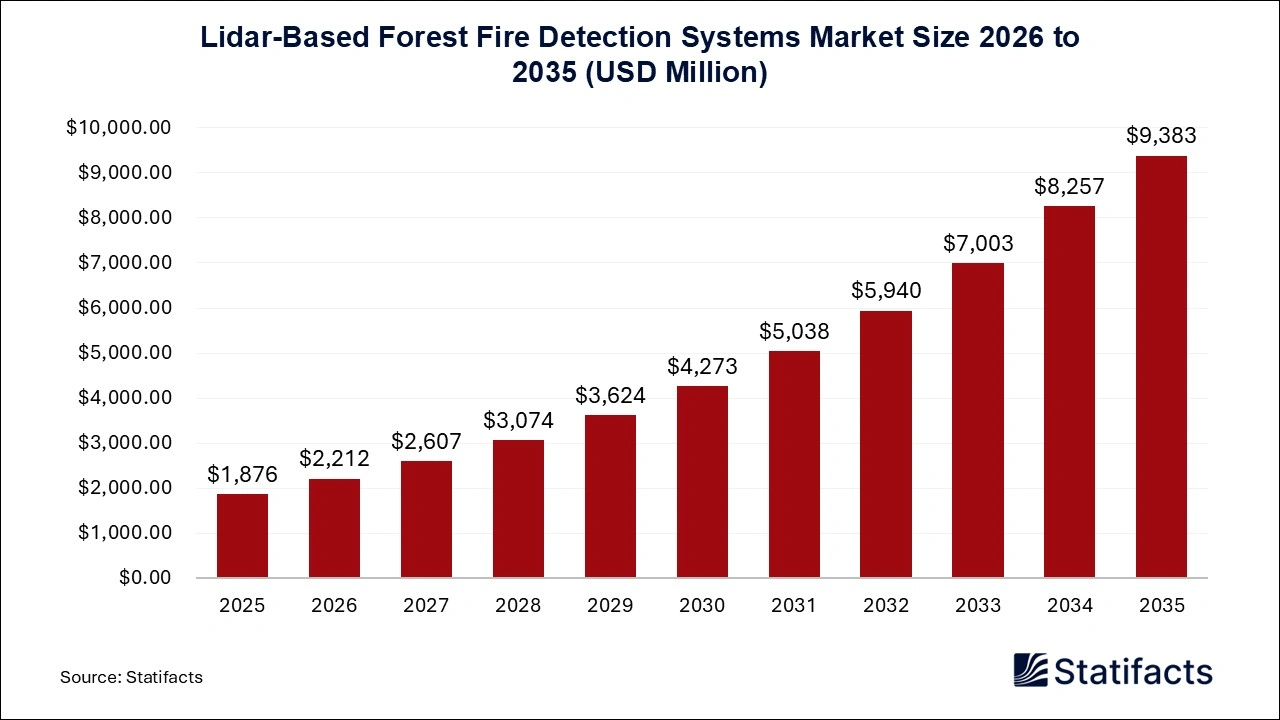
The global LiDAR-based forest fire detection systems market was valued at USD 1,876 million in 2025 and is projected to reach USD 9,383 million by 2035, growing at a CAGR of 17.47%. This surge is driven by the increasing adoption of advanced fire detection technologies, rising incidences of forest fires, and the need for real-time monitoring to mitigate environmental and economic losses.
| Reports Attributes | Statistics |
| Market Size in 2025 | USD 1,876 Million |
| Market Size in 2026 | USD 2,212 Million |
| Market Size in 2032 | USD 5,940 Million |
| Market Size by 2035 | USD 9,383 Million |
| CAGR 2026 to 2035 | 17.47% |
| Base Year | 2025 |
| Forecast Period | 2026 to 2035 |
The Lidar-Based Forest Fire Detection Systems Market refers to the global industry focused on the development, manufacturing, and deployment of advanced fire detection solutions that use Light Detection and Ranging (LiDAR) technology to identify, monitor, and predict forest fires in real-time. These systems leverage laser-based remote sensing to generate highly accurate, three-dimensional maps of forested areas, enabling early detection of fire outbreaks, rapid assessment of fire spread, and enhanced situational awareness for firefighting operations.
Lidar-based detection systems are often integrated with satellite imagery, thermal sensors, unmanned aerial vehicles (UAVs), and artificial intelligence (AI)-driven analytics to provide automated alerts and decision-making support. The market includes hardware components such as LiDAR sensors, scanning units, and detection devices, as well as software solutions for data processing, predictive modeling, and reporting.
| Segments | Shares (%) |
| North America | 45% |
| Europe | 30% |
| Asia Pacific | 15% |
| LAMEA | 10% |
| Segments | Shares (%) |
| Ground-based Fixed Systems | 30% |
| Aerial Drone-mounted Systems | 25% |
| Satellite-integrated Systems | 15% |
| Portable Patrol Devices | 10% |
| Others | 20% |
| Segments | Shares (%) |
| Early Warning of Forest Fires | 40% |
| Monitoring of Nature Reserves | 25% |
| Protection of Mountain Infrastructure | 20% |
| Real-time Monitoring of Forestry Resources | 10% |
| Others | 5% |





