



High-Precision Spatial Radar Positioning Chips Market (By Type: Millimeter-Wave Radar Chips, Ultra-Wideband Radar Chips, LiDAR-Assisted Positioning Chips, Sensor-Fusion Positioning Chips, and Others; By Application: Autonomous Driving & Smart Vehicles, Industrial Automation & Robotics, Drones & Aerospace, Smart Security & Smart Home, and Others; By Region: North America, Europe, Asia Pacific, Latin America, and Middle East & Africa) Industry Size, Share, Growth, Trends 2026 to 2035.

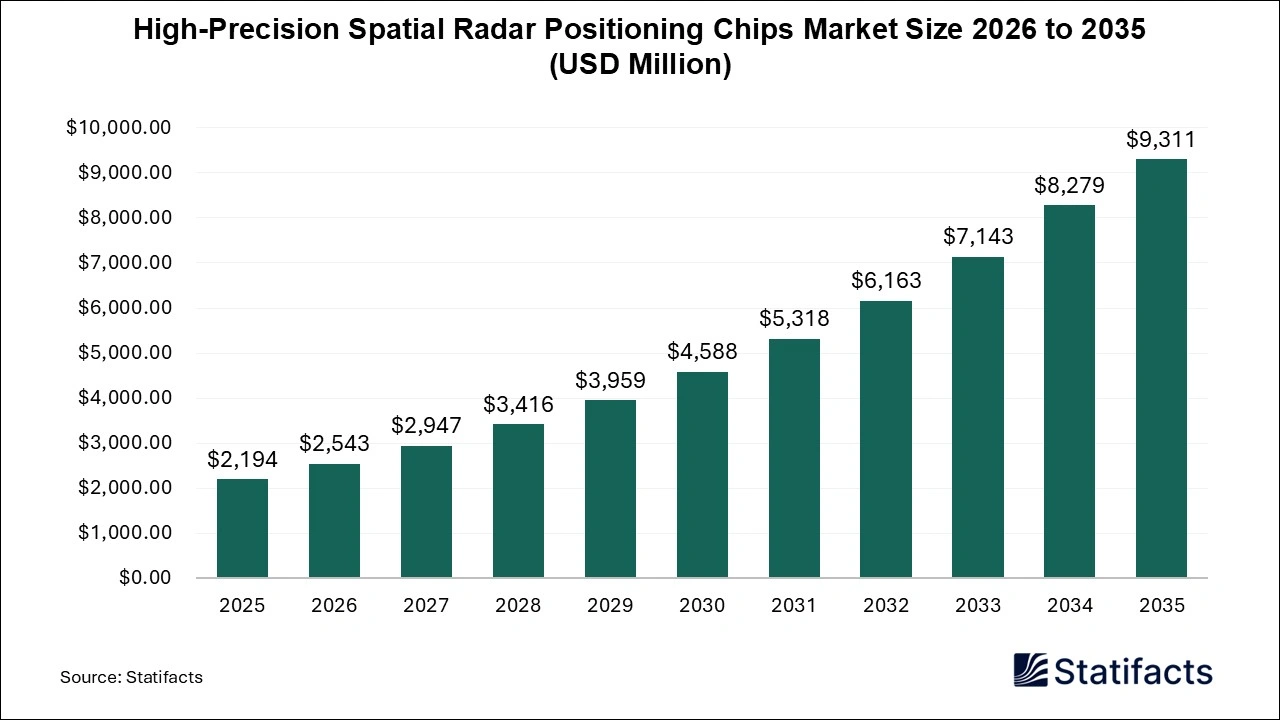
The global high-precision spatial radar positioning chips market was valued at USD 2,194 million in 2025 and is projected to reach USD 9,311 million by 2035, growing at a CAGR of 15.55%. This rapid growth is fueled by rising adoption of autonomous vehicles, smart transportation systems, and advanced navigation solutions, alongside increasing demand for precise spatial sensing in industrial, aerospace, and defense applications.
| Reports Attributes | Statistics |
| Market Size in 2025 | USD 2,194 Million |
| Market Size in 2026 | USD 2,543 Million |
| Market Size in 2032 | USD 6,163 Million |
| Market Size by 2035 | USD 9,311 Million |
| CAGR 2026 to 2035 | 15.55% |
| Base Year | 2025 |
| Forecast Period | 2026 to 2035 |
The high-precision spatial radar positioning chips market refers to the global industry involved in the design, development, and commercialization of advanced radar-based semiconductor chips that provide highly accurate spatial positioning, navigation, and detection capabilities. These chips leverage radar technology to detect objects, measure distances, and determine precise locations in real time, even under challenging environmental conditions such as low visibility, extreme weather, or complex urban settings.
High-precision spatial radar positioning chips are critical components in a range of applications including autonomous vehicles, advanced driver-assistance systems (ADAS), robotics, industrial automation, aerospace and defense, and smart infrastructure. The market encompasses various chip types differentiated by frequency bands, resolution, integration level, and functional capabilities. Growing demand for safety, efficiency, and automation in transportation and industrial sectors is driving the adoption of these chips, alongside advancements in radar sensor miniaturization, signal processing algorithms, and integration with other positioning technologies such as LiDAR and GPS.
| Segments | Shares (%) |
| North America | 35% |
| Europe | 30% |
| Asia Pacific | 25% |
| LAMEA | 10% |
| Segments | Shares (%) |
| Millimeter-Wave Radar Chips | 30% |
| Ultra-Wideband Radar Chips | 25% |
| LiDAR-Assisted Positioning Chips | 20% |
| Sensor-Fusion Positioning Chips | 15% |
| Others | 10% |
| Segments | Shares (%) |
| Autonomous Driving & Smart Vehicles | 40% |
| Industrial Automation & Robotics | 25% |
| Drones & Aerospace | 15% |
| Smart Security & Smart Home | 10% |
| Others | 10% |





