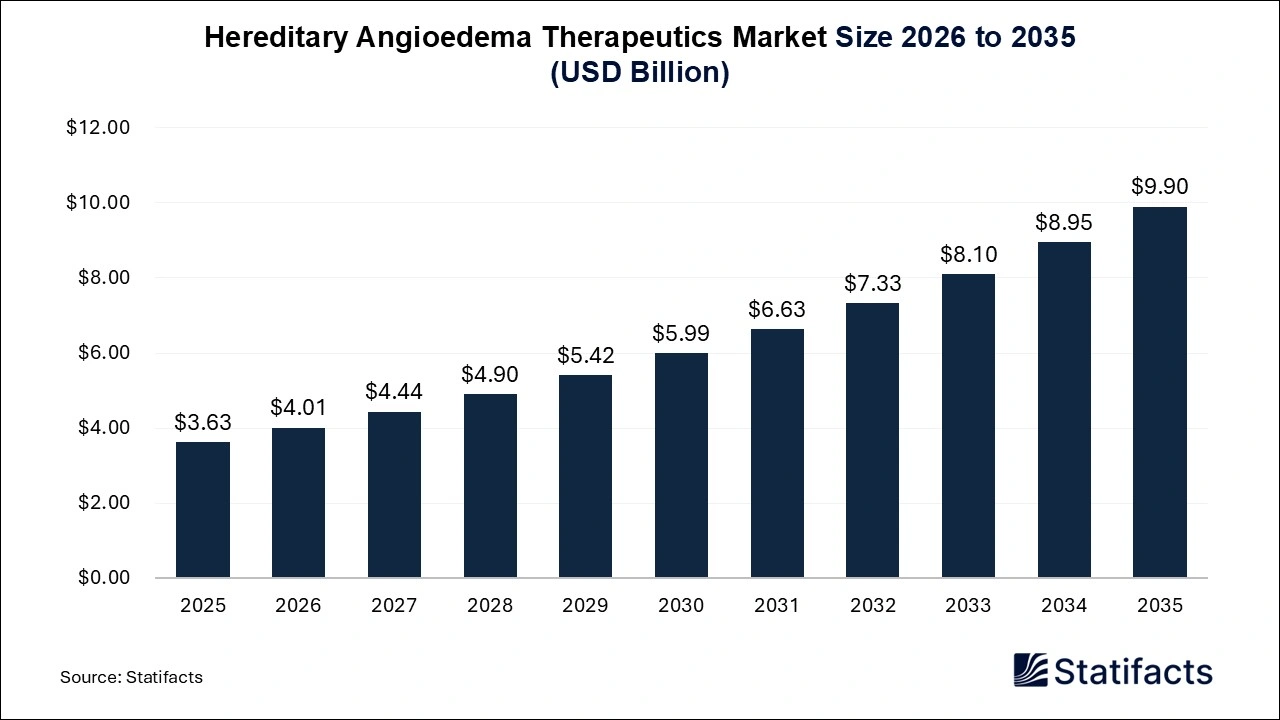
The global hereditary angioedema therapeutics market is anticipated to experience significant growth, expanding from USD 3.63 billion in 2025 to an estimated USD 9.9 billion by 2035, reflecting a robust compound annual growth rate (CAGR) of 10.55%.
Cell Identification Technology Market Statical Scope
| Reports Attributes |
Statistics |
| Market Size in 2025 |
USD 3.63 Billion |
| Market Size in 2026 |
USD 4.01 Billion |
| Market Size in 2032 |
USD 7.33 Billion |
| Market Size by 2035 |
USD 9.9 Billion |
| CAGR 2026 to 2035 |
10.55 |
| Base Year |
2025 |
| Forecast Period |
2026 to 2035 |
The growth and expansion of the market is influenced by the advanced treatment strategies to set the benchmark for standard care, with the targeted intervention to continue with the C1-INH replacement. The innovations like RNA-targeted therapies, oral small molecules, and monoclonal antibodies are sharing the required frame with this market to speculate growth with every possibility for encouraging the potential volume of the market.
The hereditary angioedema therapeutics are a unique smart medication and management plan popularly used to prevent unexpected extreme swelling injury caused by dysfunction or a rare genetic sign of the CI-INH protein. Various treatment options, depending on the severity, are proving the deserving existence of the market. The second line therapies evaluation is ongoing in research centers. It will definitely strengthen the market with the new development boost.
The business growth in the hereditary angioedema therapeutics sector revolves around the innovative portfolio supported by CRISPR technology, promising best-in-class proactive prevention from the extremity. The rising adoption graph of prophylaxis is bolstering the market segmental growth. The bulky profit share comes from the expansion of pediatric, as rapid approvals for pediatric-based therapies are seen, covering the best profit rate. Furthermore, modern genetic testing and clinical awareness are enhancing diagnosis and elevating patient engagement in the market.
Hereditary Angioedema Therapeutics Market Share, By Region, 2025 (%)
| Regions |
Shares (%) |
| North America |
40% |
| Europe |
20% |
| Asia-Pacific |
28% |
| Latin America |
7% |
| Middle East & Africa |
5% |
- North America – The North America regional segment dominated the market with 40%, ensuring the targeted therapies pool attracts more prophylactic therapies and access to quick oral treatments. The ease of administration via oral and subcutaneous injections is building patient trust in the regional market
- Asia-Pacific – Asia-Pacific regional segment is expected to grow of 20% share due to its enhanced diagnosis pattern with developed Patient Advocacy Groups (PAGs) and physician education. The leaders’ collaborations are taking a toll on the rise in the regional market.
- Europe – Europe confirms 28% of the market share with its sincere contribution of innovative oral therapies and supportive regulatory flexibilities. The EMA opened doors for orphan drug designations, which have sped up the approval volume of novel therapies.
- Latin America – Latin America is quickening its diagnostic potential to cross its recent 7% of market share. The sub-regions like Brazil, Mexico, and Argentina are doubling the investment amount in specialist clinics to pump the regional market growth.
- Middle East & Africa – MEA region held 5% of the market with the growing awareness of extreme disease, and so the clinical awareness is accelerating among patients and professionals to speed up the diagnosis of genetically based conditions.
Hereditary Angioedema Therapeutics Market Share, By Treatment, 2025 (%)
| Segments |
Shares (%) |
| Kallikrein Inhibitor |
47% |
| Bradykinin B2 Receptor Antagonist |
15% |
| C1-Inhibitor Concentrates |
28% |
| Others |
10% |
- Kallikrein Inhibitor – The kallikrein inhibitor segment dominated the market with 47% by shifting the preference to long-standing prophylaxis. The segment is fuelled by the qualification of oral berotralstat monoclonal antibodies.
- Bradykinin B2 Receptor Antagonist – The bradykinin B2 receptor antagonist segment is expected to grow at a share of 15%. The segment tends to grow with a solution to oral prophylaxis and extension of prophylaxis.
- C1-Inhibitor Concentrates – This segment held 28% of the market, with its core capacity in acute treatment, and self-administration comfort promotes home care with the safety remark signed by the FDA and a sense of trust in C1-INH concentrates.
- Others – The RNA-targeted therapies, LTP/STP prophylaxis, and plasma kallikrein inhibitors acquires 10% of the market with its growing alliance and suitability with new therapies aiming at RNA targeting and other oral options.
Hereditary Angioedema Therapeutics Market Share, By End use, 2025 (%)
| Segments |
Shares (%) |
| On-demand |
61% |
| Prophylaxis |
39% |
- On-demand – The on-demand segment dominance acquires 61% of the market share due to growing advanced therapeutic options, an increase in diagnosis rate, and guidelines for early treatment. The on-demand injectables tend to cover the best of the innovation space for the segmental growth.
- Prophylaxis – The prophylaxis segment is expected to grow at a rate of 39% with the rapid adoption rate of targeted therapies. The accelerating pediatric population and its availability of usage to the extended younger population confirm the expansion of the market's footprint.
Hereditary Angioedema Therapeutics Market Share, By Route of Administration, 2025 (%)
| Segments |
Shares (%) |
| Intravenous |
55% |
| Oral |
10% |
| Subcutaneous |
35% |
- Intravenous – The intravenous segment dominated the market with the highest of 55% as it’s a first-line administration process for decades, especially for on-demand treatments. Some of the scientific advancements, like IV infusions, strengthen the segmental growth.
- Oral – The oral route of administration segment is expected to rise at a share of 10% with the strong back of oral therapeutic developments. The commendable advantages, like on-demand flexibility, momentum, and patient choices, stimulate more growth in the market segment.
- Subcutaneous – This segment held 35% of the market with its stability to provide self-administration comfort with more efficacy and quality. The ALN-F12 and Navenibart (STAR – 0215) are the upcoming new popular subcutaneous therapies to mark exponential growth in the market segment.