

Share


Dural Repair Patch Market (By Type: Absorbable and Non-absorbable; By Application: Public Hospital and Private Hospital; By Region: North America, Europe, Asia Pacific, Latin America, and Middle East & Africa) Industry Size, Share, Growth, Trends 2026 to 2035

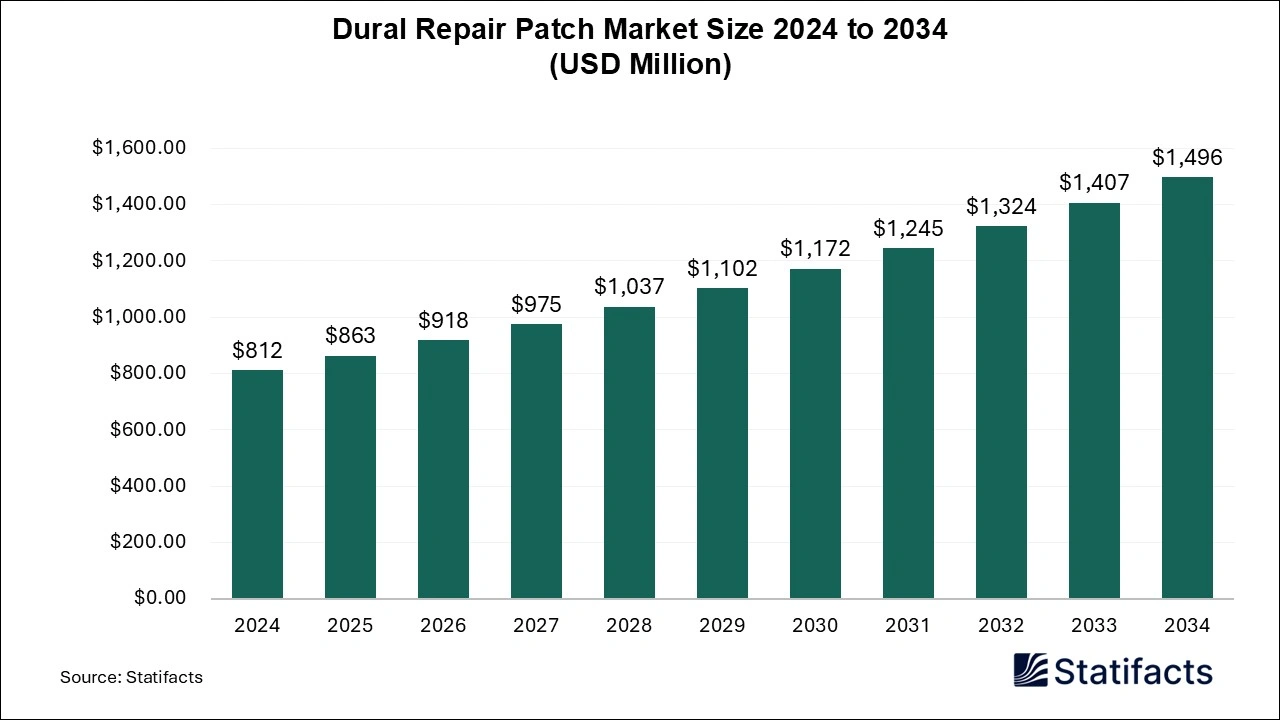
The global dural repair patch market size was valued at USD 863 million in 2025, is projected to reach approximately USD 1,581 million by 2035. This growth, fueled by rising neurosurgical procedures and advancements in biomaterial technologies, is expected at a CAGR of 6.24%.
| Reports Attributes | Statistics |
| Market Size in 2025 | USD 863 Million |
| Market Size in 2026 | USD 918 Million |
| Market Size in 2032 | USD 1,324 Million |
| Market Size by 2035 | USD 1,581 Million |
| CAGR 2026 to 2035 | 6.24% |
| Base Year | 2025 |
| Forecast Period | 2026 to 2035 |
The dural repair patch market is evolving at an accelerated pace, driven by technological progress in tissue engineering and regenerative medicine, which facilitate improvements in patch design and functionality. Surgical outcomes and reduction of the post-operative complications are being enhanced with the use of innovations like collagen-based, polyurethane, and bioresorbable dural substitutes. The increasing proportion of traumatic brain injuries, spinal cord operations, and tumor resections, in which an effective dural closure is necessary to avoid cerebrospinal fluid (CSF) leakage and infection, contributes to the growth, too. Synthetic and biological patches are being considered as a way of enhancing the biocompatibility, durability, and quick healing of patients in hospitals and neurosurgical centers.
Furthermore, the increased popularity of minimally invasive neurosurgical procedures and the ready-to-use and easy-to-manage availability of dural grafts are leading to their usage in developed healthcare systems. The expensive nature of sophisticated dural repair products, reimbursement policies in non-developed countries, and the possibility of immune reactions to certain types of grafts, however, serve as some of the most formidable inhibitors to the growth of the market.
The future perspective is also optimistic, as surgical planning, material optimization, and post-operative monitoring are integrated through the use of artificial intelligence. Image analysis and predictive modeling using artificial intelligence (AI) are assisting surgeons in determining the best type and size of patches for individual patients to increase precision and achieve better results. Moreover, AI-oriented lattices of the next generation of dural substitutes should catalyze the advancement of dural repair, improve biocompatibility, and decrease the rate of complications, significantly enhancing the efficiency and personalization of dural repair.
| Regions | Shares (%) |
| North America | 33.8% |
| Asia Pacific | 29.8% |
| Europe | 27.2% |
| LAMEA | 9.2% |
| Segments | Shares (%) |
| Absorbable | 54.5% |
| Non-absorbable | 45.5% |
| Segments | Shares (%) |
| Public Hospital | 53.2% |
| Private Hospital | 46.8% |
Published by Ajit Bansod





