



Diffraction Gratings Market (By Type: Ruled Gratings and Holographic Gratings; By Application: Monochromator and Spectrometer, Laser, Optical Telecom, Astronomy, and Others; By Region: North America, Europe, Asia Pacific, Latin America, and Middle East & Africa) Industry Size, Share, Growth, Trends 2023 to 2033

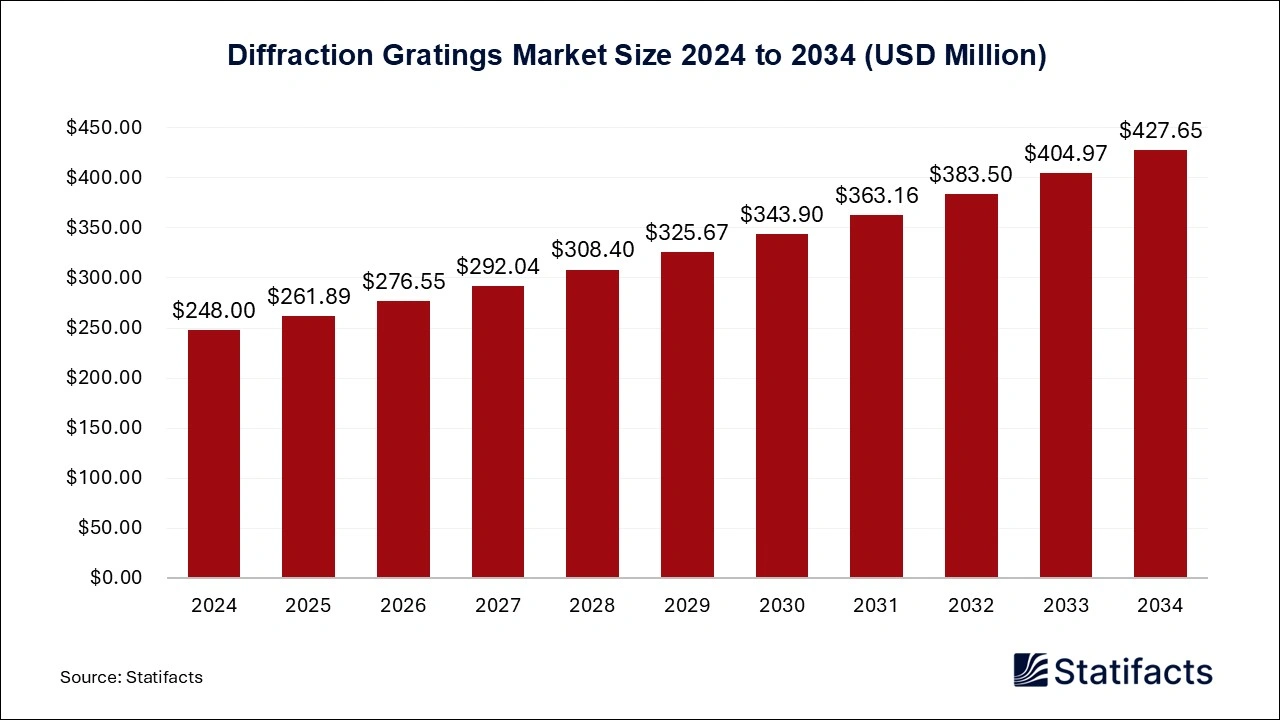
The global diffraction gratings market size was valued at USD 261.89 million in 2025, is projected to reach approximately USD 449.52 million by 2035. This growth, driven by increasing applications in spectroscopy and optical systems, is expected at a CAGR of 5.55%.
| Reports Attributes | Statistics |
| Market Size in 2025 | USD 261.89 Million |
| Market Size in 2026 | USD 276.55 Million |
| Market Size in 2032 | USD 383.5 Million |
| Market Size by 2035 | USD 449.52 Million |
| CAGR 2026 to 2035 | 5.55% |
| Base Year | 2025 |
| Forecast Period | 2026 to 2035 |
The diffraction gratings market is growing rapidly as more industries, like the medical industry, laser systems, and optical sensors, are using diffraction gratings in spectrometers, laser systems, and research laboratories. The spectral resolution, wavelength resolution, and optical measurement precision required with the increasing demand for high-resolution spectral analysis necessitate the performance and reliability of diffraction gratings. The expensive price of the higher-order gratings, the complexity of manufacturing, and being sensitive to the environmental conditions are some of the constraints that may hinder adoption, especially by smaller research institutions and start-ups.
With innovations in the artificial intelligence AI- and sensor-assisted technologies, the diffraction gratings market will increase at a faster rate. Real-time calibration, defect detection, and automated wavelength optimization AI-enabled systems enhance the accuracy of the measurements, decrease errors, and optimize operational efficiency. There are also opportunities in custom-designed, small, and robust gratings in portable spectroscopy, telecommunications, and laser. As more instruments become precise and as optical research and industrial automation develop, the market of diffraction gratings is likely to experience tremendous growth within the coming ten years.
| Regions | Shares (%) |
| North America | 20.13% |
| Asia Pacific | 12.04% |
| Europe | 58.11% |
| LAMEA | 9.73% |
| Segments | Shares (%) |
| Ruled Gratings | 33.69% |
| Holographic Gratings | 66.31% |
| Segments | Shares (%) |
| Monochromator and Spectrometer | 14.87% |
| Laser | 2.60% |
| Optical Telecom | 30.64% |
| Astronomy | 37.83% |
| Others | 14.07% |





