

Share


Civilian-drone Lithium Battery Market (By Type: Lithium Polymer, Lithium Metal Battery; By Application: Consumer Drone, Industrial Drone; By Region: North America, Europe, Asia-Pacific, Latin America, Middle East and Africa) Industry Size, Share, Growth, Trends 2025 to 2034.

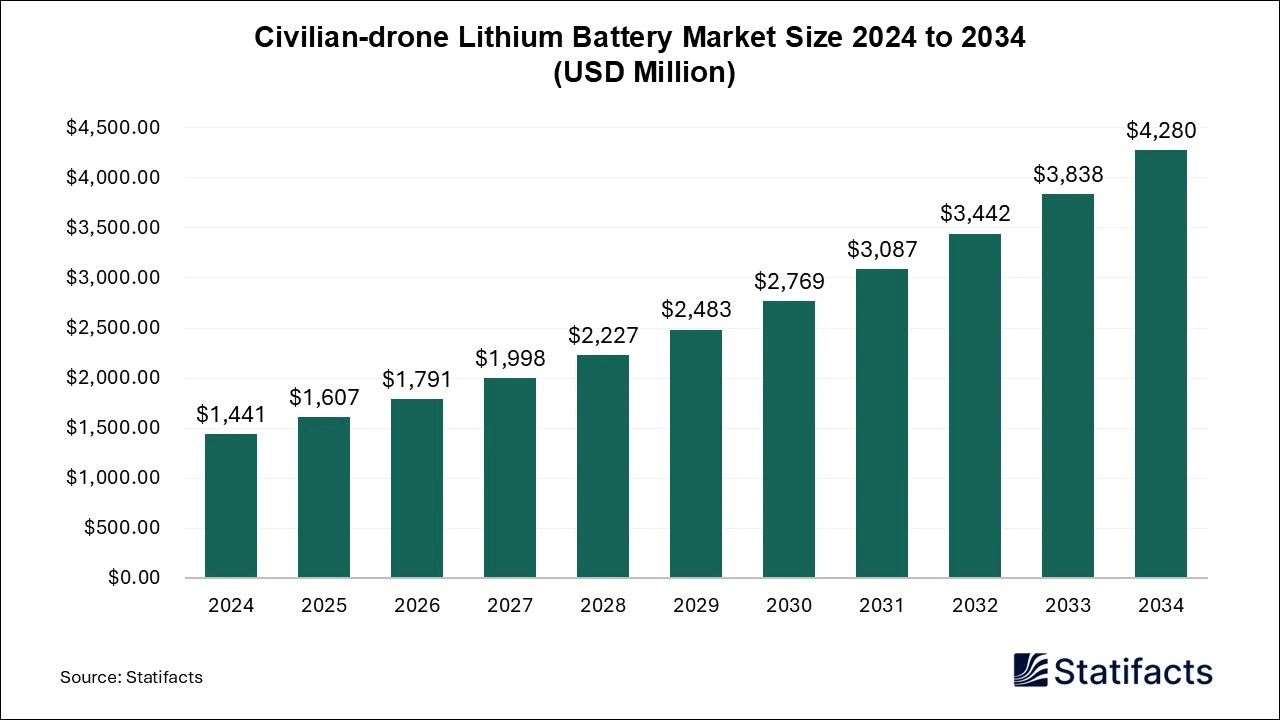
The global civilian-drone lithium battery market, valued at USD 1,607 million in 2025, is projected to reach USD 4,691 million by 2035, growing at a CAGR of 11.31% driven by the increasing use of drones in commercial applications and the demand for longer battery life.
| Reports Attributes | Statistics |
| Market Size in 2025 | USD 1,607 Million |
| Market Size in 2026 | USD 1,791 Million |
| Market Size in 2032 | USD 3,442 Million |
| Market Size by 2035 | USD 4,691 Million |
| CAGR 2026 to 2035 | 11.31% |
| Base Year | 2025 |
| Forecast Period | 2026 to 2035 |
Civilian drone lithium battery market growth is fueled by the rapid expansion of drone applications across logistics, smart agriculture, energy inspection, and cinematography, alongside declining lithium battery costs and advancements in energy density and battery management systems. The rise of delivery drones and urban air mobility initiatives further accelerates demand. Asia-Pacific, led by China, Japan, and India, is projected to exhibit the fastest growth owing to strong manufacturing capacity and drone adoption. North America and Europe maintain significant shares through technology innovation and regulatory support for commercial drone usage.
Key restraints include limited flight endurance, safety risks associated with overheating or short-circuiting, and supply-chain challenges in lithium and cobalt procurement. Environmental concerns around battery disposal and recycling also remain pressing. However, emerging opportunities exist in solid-state battery development, lithium-sulfur chemistries, modular battery swapping systems, and AI-integrated power optimization. Growing investments in sustainable energy storage and drone electrification policies are expected to further open the market.
Artificial intelligence AI is transforming the civilian drone lithium battery sector by enabling smarter battery management systems that predict energy needs and optimize charge-discharge cycles in real time. Machine learning models enhance safety by monitoring temperature, voltage, and degradation patterns, preventing failures mid-flight. In R&D, AI accelerates the discovery of new materials and chemistry formulations, while predictive analytics optimize logistics, recycling, and maintenance—improving battery efficiency and longevity across the civilian drone ecosystem.
| Regions | Shares (%) |
| North America | 25% |
| Asia Pacific | 40% |
| Europe | 20% |
| LAMEA | 15% |
| Segments | Shares (%) |
| Lithium Polymer | 60% |
| Lithium Metal Battery | 40% |
| Segments | Shares (%) |
| Consumer Drone | 70% |
| Industrial Drone | 30% |
Related Reports





