

Share


Chip-based Oligonucleotide Synthesis Market (By Type: Photochemical Method, Electrochemical Method, Inkjet Printing Method; By Application: Scientific Research, Others; By Region: North America, Europe, Asia-Pacific, Latin America, Middle East and Africa) Industry Size, Share, Growth, Trends 2025 to 2034.

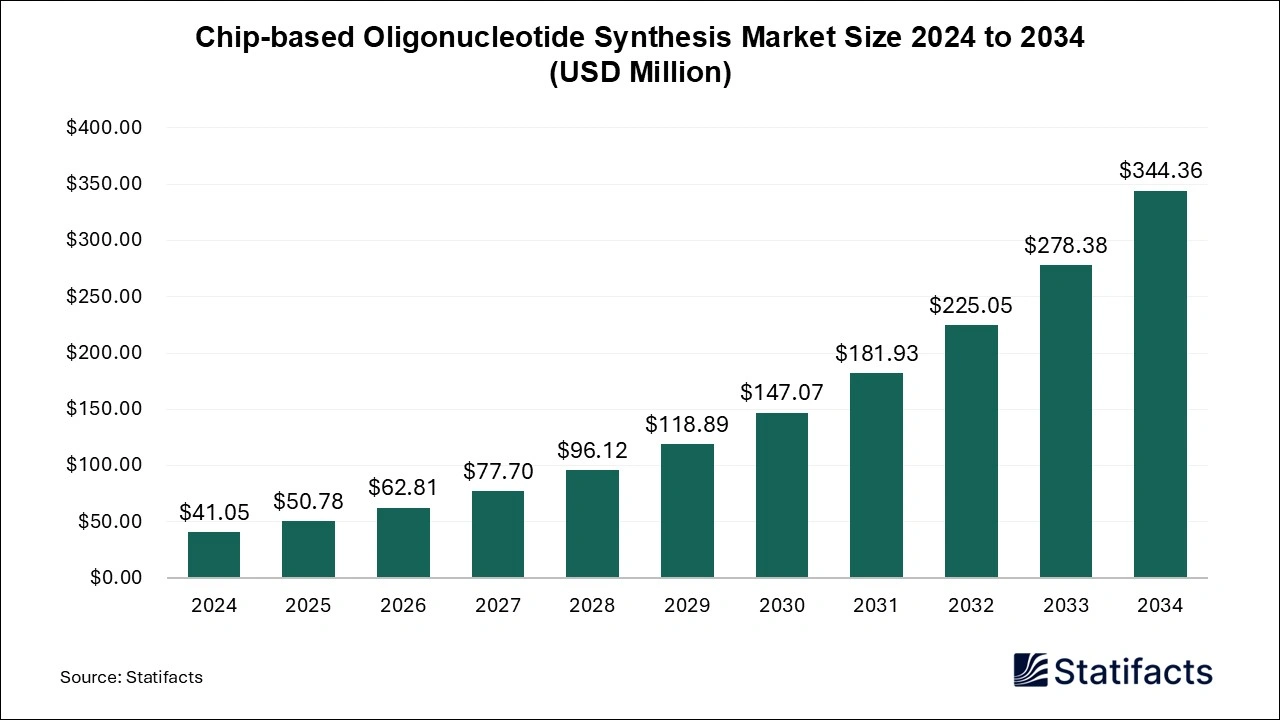
The global chip-based oligonucleotide synthesis market, valued at USD 50.78 million in 2025, is projected to reach USD 401.91 million by 2035, growing at a CAGR of 22.98% driven by advancements in genomics, biotechnology, and personalized medicine.
| Reports Attributes | Statistics |
| Market Size in 2025 | USD 50.78 Million |
| Market Size in 2026 | USD 62.81 Million |
| Market Size in 2032 | USD 225.05 Million |
| Market Size by 2035 | USD 401.91 Million |
| CAGR 2026 to 2035 | 22.98% |
| Base Year | 2025 |
| Forecast Period | 2026 to 2035 |
The chip-based oligonucleotide synthesis market growth is driven by diagnostics and personalized medicines, next-generation sequencing and gene editing, automation & artificial intelligence AI, and RNA-based therapeutics. However, the restraining factors of the market include use of hazardous reagents, waste generation, market uncertainties, market penetration, cost constraints, quality and consistency, synthesis complexity & errors, and maintaining speed & accuracy is difficult. Regional expansion, contract services, growing demand for modified oligonucleotides, high-throughput synthesis, and advances in gene editing technologies will help the growth of the market in the future.
The chip-based oligonucleotide synthesis market is expected to grow rapidly due to the integration of artificial intelligence (AI). AI applications in chemical reactions include condition recommendations, retrosynthetic planning, and forward reaction prediction. Additionally, AI allows the automation of compound synthesis and reduces the repetitive work of laboratory staff. AI models exhibit impressive accuracy when predicting molecular properties, including toxicity, stability, and solubility.
| Regions | Shares (%) |
| North America | 40% |
| Asia Pacific | 20% |
| Europe | 25% |
| LAMEA | 15% |
| Segments | Shares (%) |
| Photochemical Method | 35% |
| Electrochemical Method | 30% |
| Inkjet Printing Method | 35% |
| Segments | Shares (%) |
| Scientific Research | 60% |
| Others | 40% |
Published by Yogesh Kulkarni





