Last Updated: 15 May 2025
Source: Statifacts


Share



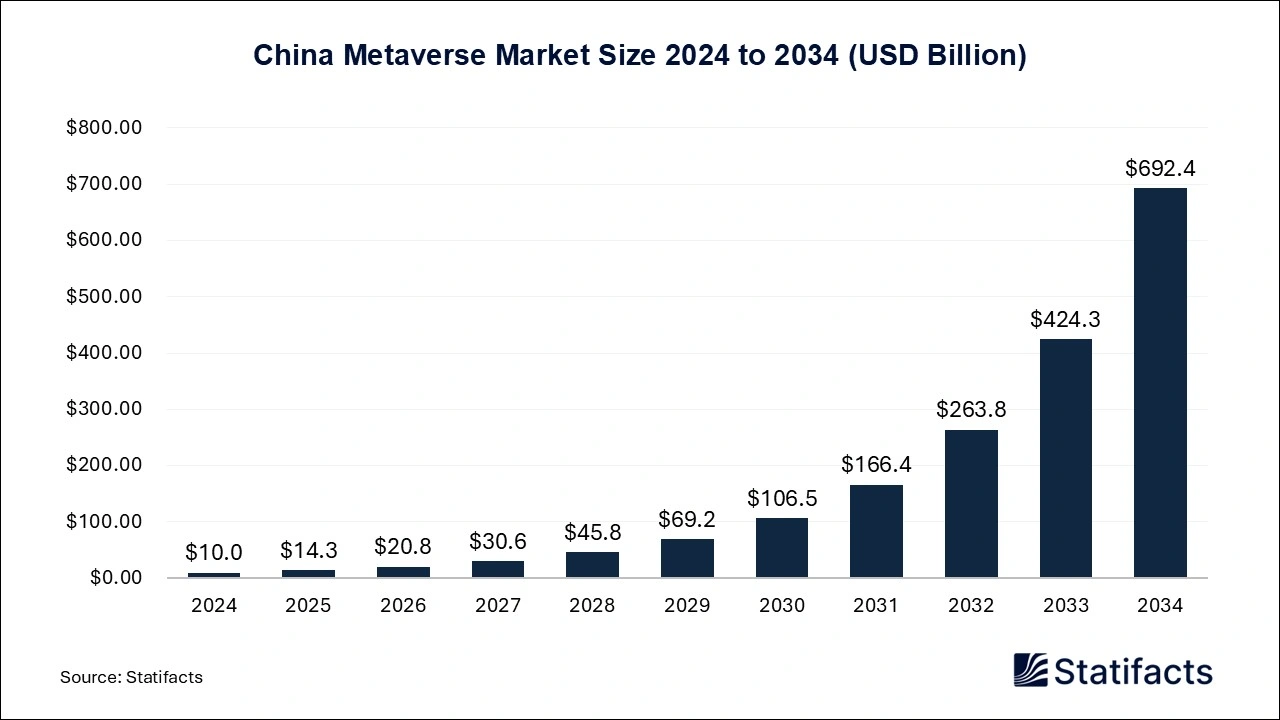
The China metaverse market size was calculated at USD 10 billion in 2024 and is predicted to attain around USD 692.4 billion by 2034, expanding at a CAGR of 52.84% from 2025 to 2034.
| Industry Worth | Details |
| Market Size in 2025 | USD 14.3 Billion |
| Market Size by 2034 | USD 692.4 Billion |
| Market Growth Rate from 2025 to 2034 | CAGR of 52.84% |
Metaverse is a collective virtual shared space, merging augmented and virtual reality, where users can interact with each other and digital objects in real time. It is the emerging 3D-enabled digital space that uses augmented reality, virtual reality, and other innovative internet and semiconductor technologies. Metaverse assets are sometimes traded as non-fungible tokens (NFTs) and track ownership using blockchain technology. In China, the metaverse market growth is driven by the adoption of digital solutions, significant investment & funding, increased consumer demand, and technological advancement.
The China metaverse market includes a wide range of applications, including real estate, healthcare, mass-audience interaction, e-commerce, interactive learning environments, and enhancing work productivity. Industrial metaverse uses include supply chain optimization, process optimization, global collaboration, remote management, risk reduction, business operations, e-commerce, and more.
Increased partnership across global supply chains: The benefits of the supply chain partnership for customer retention include a long-term relationship that ultimately leads to higher profits. It allows work together towards greater supply chain transparency, reducing costs, driving efficiency, and promoting higher ethical and environmental standards.
Investment and funding: Various companies are involved in the metaverse, giving you options between less costly up-and-comers or big brands. Investors can explore better investment opportunities in the metaverse with virtual real estate value. It will help advertising, communication, and product experiences.
High development costs: The metaverse is so expensive due to people expect to make money there. Development cost depends on the technologies required to develop metaverse games, such as 3D reconstruction, blockchain, VR, AR, powerful hardware, software, and more.
Regulatory and legal issues: The metaverse poses unique regulatory issues because of its lack of physical boundaries. Users in India, Japan, and the United States may all interact in a single virtual space, governed by the European Union. Legal issues in the metaverse include Jurisdiction, contracts, and property rights.
Growth of Virtual Economies: Metaverse virtual economies include more freedom and control for users, the ability to own and trade virtual assets, and a thriving marketplace for virtual goods and services. It allows users to make payments, borrow, lend, and invest using virtual currencies.
Integration of AI: Artificial intelligence is instrumental as a catalyst driving innovation, improving user experiences, and powering highly interactive and immersive environments within this virtual realm. AI allows interactive storytelling, enabling users to influence the narrative and participate actively in the virtual world.
Published by Yogesh Kulkarni





