



North America Fertility Market (By Offering: Assisted Reproductive Technology IVF, Artificial Insemination, Surrogacy, Others; Fertility Drugs Gonadotropin, Anti-estrogen, Others; By End User: Fertility Clinics, Hospitals, and Clinical Research Institutes) Industry Size, Share, Growth, Trends 2026 to 2035

The North America fertility market size was valued at USD 11.13 billion in 2025, is projected to reach USD 25.60 billion by 2035. Growing adoption of ART procedures, rising infertility rates, and expanding fertility clinic infrastructure are driving its strong 8.69% CAGR. Driven by rising demand for assisted reproductive technologies and increasing access to fertility preservation services. This growth is also supported by demographic trends such as delayed parenthood and widespread awareness of fertility health, supported by national public health agencies.
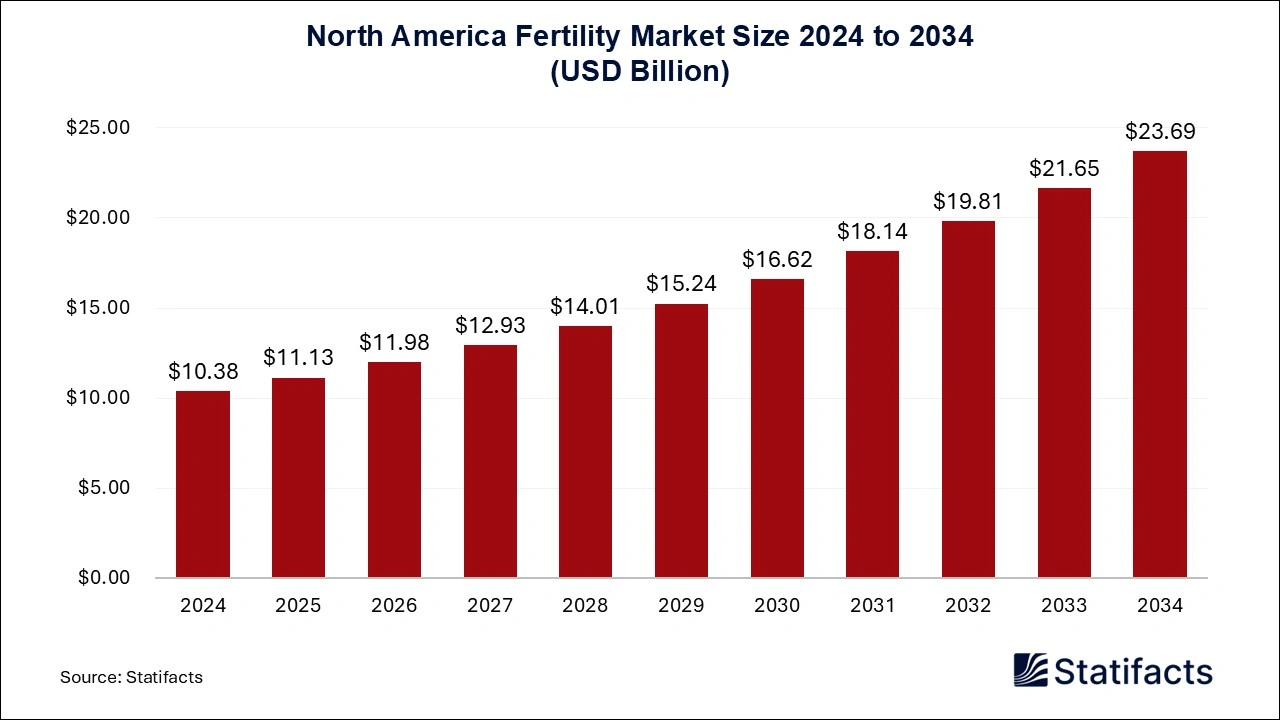
| Reports Attributes | Statistics |
| Market Size in 2025 | USD 11.13 Billion |
| Market Size in 2026 | USD 11.98 Billion |
| Market Size in 2032 | USD 19.81 Billion |
| Market Size by 2035 | USD 25.60 Billion |
| CAGR 2026 to 2035 | 8.69% |
| Base Year | 2025 |
| Forecast Period | 2026 to 2035 |
Demand for fertility services in North America is rising due to demographic and lifestyle shifts that influence reproductive timelines. According to the U.S. Centers for Disease Control and Prevention (2023), infertility affects millions of individuals in the region, creating sustained demand for diagnostic and treatment services. Maternal age at first birth continues to increase in both the United States and Canada, which raises the likelihood of fertility-related conditions and directly drives demand for assisted reproductive technologies. The World Health Organization (2023) further notes that infertility is a global public health issue affecting one in six individuals, supporting the broader need for accessible services.
Another strong driver is the increasing uptake of fertility preservation, especially egg-freezing, among individuals seeking to postpone childbearing for personal, professional, or medical reasons. Clinics across North America have reported year-over-year increases in cryopreservation cycles, supported by heightened awareness of reproductive aging. In addition, many large employers in the United States now include fertility benefits in their health plans, helping reduce financial barriers and expanding access to treatments. These employer-sponsored packages often cover services such as in vitro fertilization, cryopreservation, and hormonal testing, thereby strengthening overall market demand.
Despite rising demand, high treatment costs remain a major barrier. Fertility services in the United States often require significant out-of-pocket costs, and the CDC notes that affordability remains one of the most substantial obstacles to patient access. Medications, diagnostic procedures, and laboratory services all add to the financial burden, and coverage varies significantly across states. In Canada, where some provinces fund limited IVF cycles, disparities in public and private access persist due to long wait times and coverage limitations.
Geographic and social barriers also affect growth. Fertility clinics tend to be concentrated in urban centers, leaving rural and remote populations underserved. This is especially noted in Canadian health reports that highlight disparities between major provinces and northern or remote regions. Stigma and misinformation surrounding infertility can also limit individuals from seeking timely care, and policies governing donor gametes, embryo use, or cross-border services occasionally create regulatory uncertainty. Workforce shortages in specialized areas like embryology add to operational challenges for clinics across the region.
The United States accounts for the largest share of the North American fertility market due to its large population, high patient demand, and extensive private healthcare infrastructure. The CDC’s Assisted Reproductive Technology Surveillance Report highlights consistent year-over-year increases in ART cycles, driven by the growth of private clinics and the adoption of advanced laboratory technologies. These include time-lapse incubators, preimplantation genetic testing, and AI-assisted embryo assessment tools that aim to improve success rates. However, the regulatory landscape for insurance coverage varies by state, contributing to uneven access.
Canada, by contrast, offers a mixed public-private model shaped by provincial health policies. The Canadian Assisted Reproductive Technologies Register (CARTR Plus) compiles national data on ART cycles, showing steady use and growing demand for both IVF and fertility preservation. Provinces such as Ontario provide publicly funded IVF cycles, which influence utilization patterns and create more equitable access compared with a purely private system. Digital health tools, such as telemedicine-based fertility counselling and centralized patient portals, are being adopted widely in Canada to expand access across geographically dispersed regions.
The United States has a high volume of ART procedures driven by delayed childbearing, higher prevalence of infertility diagnoses, and broad availability of fertility clinics. Public health data from the CDC indicates substantial annual ART cycle activity, which reinforces the clinical base for market expansion. Employer-backed fertility benefits are increasing and play a critical role in improving financial access. U.S. clinics also lead in adopting AI-assisted embryo evaluation and digital lab management systems that improve workflow and efficiency. These innovations increase treatment capacity and enhance the patient experience.
Canada’s fertility market is strongly shaped by provincial policies that determine access to IVF funding and coverage for fertility preservation. Reports from Canadian health authorities and CARTR Plus indicate stable demand across both public and private sectors. Urban centers such as Toronto, Vancouver, and Montreal have high concentrations of clinics offering advanced ART services, while rural and remote regions continue to face access gaps. Growing interest in egg-freezing and increased social acceptance of fertility treatments contribute to the strengthening market. Canada is also adopting AI-based imaging tools and telehealth platforms, which help bridge geographic barriers and improve service delivery.
| Segments | Shares (%) |
| Assisted Reproductive Technology | 62% |
| Fertility Drugs | 38% |
| Segments | Shares (%) |
| Fertility Clinics | 56% |
| Hospitals | 29% |
| Clinical Research Institutes | 15% |
Published by Ajit Bansod





