

Share


Cellulose Nanocrystal Reinforced Biopolymers Market (By Product: PLA + CNC, PHA + CNC, Starch-Blends + CNC, and Other Product; By End-use: Packaging, Automotive, Biomedical & Healthcare, Consumer Goods, and Other End Uses; By Region: North America, Europe, Asia Pacific, Latin America, and Middle East & Africa) Industry Size, Share, Growth, Trends 2026 to 2035

The global cellulose nanocrystal reinforced biopolymers market, valued at USD 253.68 million in 2025, is projected to reach approximately USD 1024.11 million by 2035. This strong growth, driven by rising demand for sustainable, high-strength materials across packaging, automotive, and biomedical sectors, is expected at a CAGR of 14.98%.
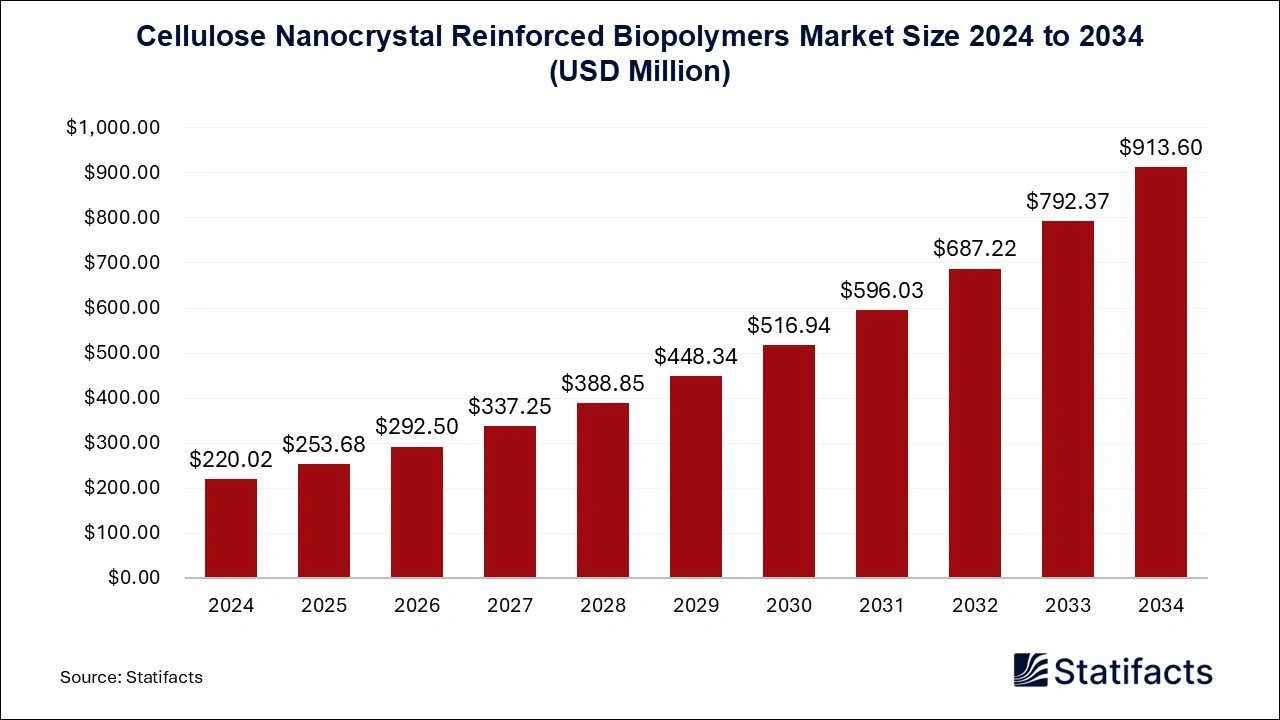
| Reports Attributes | Statistics |
| Market Size in 2025 | USD 253.68 Million |
| Market Size in 2026 | USD 292.5 Million |
| Market Size in 2032 | USD 687.22 Million |
| Market Size by 2035 | USD 1024.11 Million |
| CAGR 2026 to 2035 | 14.98% |
| Base Year | 2025 |
| Forecast Period | 2026 to 2035 |
The cellulose nanocrystal reinforced biopolymers market is expanding at a prominent pace due to the growing investments towards adopting eco-friendly biopolymers, which address the environmental concerns like plastic waste and pollution. Cellulose nanocrystals (CNCs) are renewable and biodegradable nanomaterials used to enhance mechanical, barrier, and optical properties.
The reinforcement of these materials makes them capable of use in packaging, automotive, biomedical, and construction sectors as a premium alternative to petroleum-based plastics. The regulatory bodies in North America, Europe, and the Asia Pacific region have largely adopted bans on single-use plastics, which are significantly contributing to the growth of sustainable alternatives. Moreover, the use of CNS is helping to improve enzymatic and mechanical extraction methods, thereby promoting its use in large-scale industries.
What Are the Obstacles Holding Back Growth in the Market for Cellulose Nanocrystal Reinforced Biopolymers?
However, processing these biopolymers is costlier due to higher energy use, which limits their use to large-scale industries and hinders their adoption by small manufacturers. It is a complex process due to polarity differences, which require chemical treatment, further increasing production costs. This creates challenges for companies in underdeveloped regions due to low awareness of alternatives to traditional materials.
The rapid development of packaging applications is expected to drive sustainable growth in food packaging applications from a business perspective. The packaging authorities are mandating companies to invest in bio-based alternatives, which will maintain demand in the long run. The cellulose nanocrystal-reinforced biopolymers market is expected to attract more businesses, such as the biomedical sector, where wound dressings and drug delivery systems are also undergoing a sustainable shift amid growing regulatory pressure. The automotive sector is also keen on investing in lightweight, sustainable alternatives, creating a new user base for CNC composites to expand their business.
North America holds a dominant position in the cellulose nanocrystal reinforced biopolymers market due to its stricter food regulations, which create several business opportunities for American brands in sustainable food packaging. Moreover, the region is highly focused on expanding its commercial sector through R&D in polymers and sustainable materials, which will help it generate more revenue in the future.
The expanding packaging sector in China is expected to create several opportunities due to its cost-effective procedures. The material design process is driven by the emergence of artificial intelligence, which is used to predict the thermal and mechanical behavior of these biopolymers in a shorter time with minimal error. The use of these technologies is also expected to reduce waste generation and improve energy use during the production process.
| Regions | Shares (%) |
| North America | 31% |
| Asia Pacific | 34% |
| Europe | 25% |
| LAMEA | 10% |
| Segments | Shares (%) |
| PLA + CNC | 38% |
| PHA + CNC | 24% |
| Starch-Blends + CNC | 21% |
| Other Product | 17% |
| Segments | Shares (%) |
| Packaging | 36% |
| Automotive | 20% |
| Biomedical & Healthcare | 18% |
| Consumer Goods | 16% |
| Other End Uses | 10% |
Published by Vidyesh Swar





