

Share


Calcium Ammonium Nitrate Market (By Type: Nitrogen Content 27% and Nitrogen Content 15.5%; By Application: Agriculture and Horticulture; By Region: North America, Europe, Asia Pacific, and LAMEA) Industry Size, Share, Growth, Trends 2026 to 2035

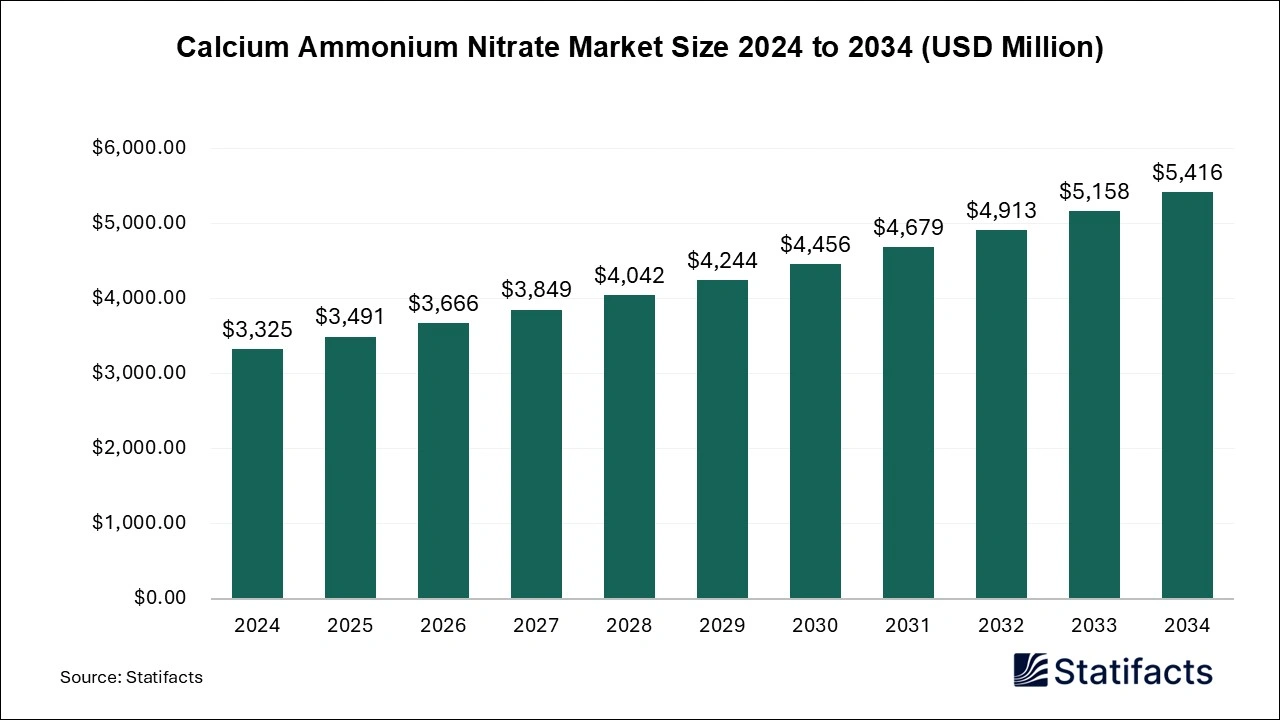
The global calcium ammonium nitrate market size was valued at USD 3,491 billion in 2025, is projected to reach about USD 5,665 billion by 2035. Steady growth at a 4.96% CAGR is driven by rising fertilizer use, improved crop yield needs, and expanding adoption in modern agriculture. Driven by rising global fertilizer demand for higher-yield agriculture, shifts toward balanced NPK fertilization, and expanding mechanized farming in emerging economies that increase the need for efficient nitrogen sources.
| Reports Attributes | Statistics |
| Market Size in 2025 | USD 3,491 Million |
| Market Size in 2026 | USD 3,666 Million |
| Market Size in 2032 | USD 4,913 Million |
| Market Size by 2035 | USD 5,665 Million |
| CAGR 2026 to 2035 | 4.96% |
| Base Year | 2025 |
| Forecast Period | 2026 to 2035 |
The growing emphasis on sustainable agriculture and precision nutrient application continues to shape global product demand.
Calcium ammonium nitrate is valued for delivering both ammonium and nitrate nitrogen in a relatively safe, water-soluble form that supports balanced crop nutrition. Farmers favor it for cereal crops, vegetables, and high-value cash crops because it offers quick availability and is easier to apply than some other nitrogen fertilizers. The balanced composition of CAN helps maintain soil pH and enhances fertilizer uptake, promoting healthier plant growth and improved yields. Increasing awareness about sustainable fertilizer practices and government initiatives for food security are further accelerating the market.
Regional fertilizer demand trends and seasonal planting cycles drive sales of calcium ammonium nitrate. Manufacturers are optimizing granule size, coating technologies, and blending compatibility to suit local application practices. In countries with rapidly expanding agricultural output, such as India and Brazil, CAN is being integrated into multi-nutrient blends to increase efficiency. The product is also seeing increasing use in precision farming and controlled-release systems. The fertilizer distribution network, including large distributors and agro-retail chains, plays a central role in market reach and pricing.
Volatility in feedstock and energy prices, trade policy shifts, and regulations on nitrogen application can restrain growth. In some regions, concerns about nitrate leaching and environmental impact prompt stricter application norms. Logistics and storage requirements for granular fertilizers add cost for suppliers and distributors. Limited farmer education in developing countries and poor rural infrastructure can also limit product reach and adoption.
Digital agronomy tools, precision application equipment, and data-driven fertilization plans are helping farmers apply calcium ammonium nitrate more efficiently. These tools reduce wastage and improve yield per unit of fertilizer, supporting long-term demand even as environmental controls tighten. The integration of IoT sensors and satellite-based farm management systems enables real-time monitoring of soil nitrogen levels, thereby promoting more efficient CAN use.
Beyond farm application, calcium ammonium nitrate’s role in compound fertilizer blending remains important. Blenders often use CAN to tailor nutrient profiles for specific crop cycles, and value-added offerings such as micronutrient-enriched CAN blends are emerging. Private sector partnerships with governments and NGOs to train farmers in best application practices are supporting adoption, particularly in regions where overuse of nitrogen previously led to soil and water issues.
With continued emphasis on food security and yield improvement, calcium ammonium nitrate should remain a staple nitrogen source in many cropping systems. Improvements in formulation, blended fertilizers, and precision application will support its steady adoption, though price and regulatory pressures will shape regional growth rates. Emerging economies are expected to drive most of the volume growth, supported by infrastructure upgrades and farmer education initiatives promoting efficient fertilizer practices. Over time, sustainability pressures will push manufacturers to innovate lower-loss formulations and better application guidance to maintain the product’s relevance.
| Regions | Shares (%) |
| North America | 32.28% |
| Asia Pacific | 34.72% |
| Europe | 15.62% |
| LAMEA | 17.38% |
| Segments | Shares (%) |
| Nitrogen Content 27% | 33.69% |
| Nitrogen Content 15.5% | 66.31% |
| Segments | Shares (%) |
| Agriculture | 24.82% |
| Horticulture | 75.18% |
Published by Saurabh Bidwai





