Last Updated: 01 Jul 2025
Source: Statifacts


Share



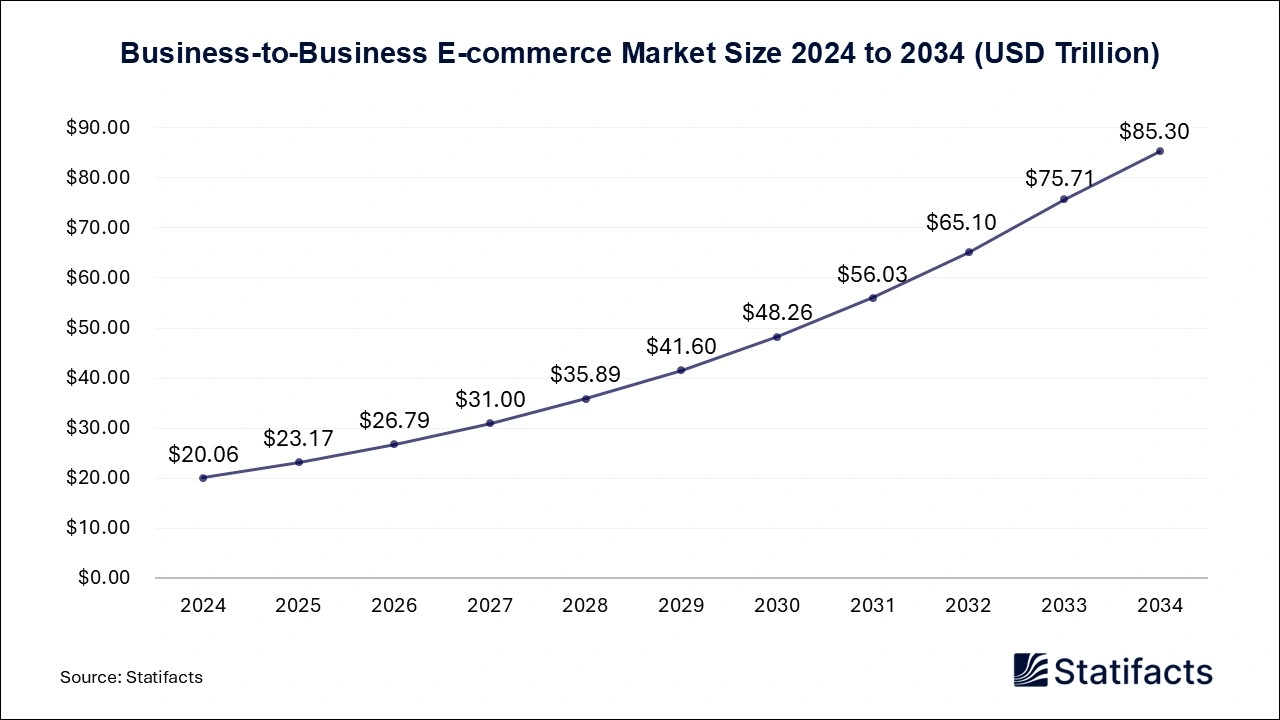
The global business-to-business e-commerce market size accounted for USD 20.06 trillion in 2024 and is predicted to touch around USD 85.3 trillion by 2034, growing at a CAGR of 15.57% from 2025 to 2034.
| Industry Worth | Details |
| Market Size in 2025 | USD 23.17 Trillion |
| Market Size by 2034 | USD 85.3 Trillion |
| Market Growth Rate from 2025 to 2034 | CAGR of 15.57% |
The business-to-business e-commerce market basically deals with taking the commercial transactions and processes classically held between businesses and performing them over online platforms. There exists automation of procurement and sales workflows, which cuts down on administrative costs and improves coordination. The platforms come with electronic data interchange, online catalogs, quote management, real-time updates for inventory, and a payment gateway, among numerous other features. The global digital transformation sweeping through industries necessitates faster procurement cycles, pricing on the fly, and enriched buyer-seller communication. AI and blockchain implementations enrich customer experience through personalization and buying-likelihood prediction. Growing international supply chain complexity and operational agility have made scalable e-commerce the top choice for any enterprise. B2B e-commerce is pushing the very foundation of inter-business trade in a digital-first economy.
“As operating costs keep rising, Amazon Business can help take some of that pressure off by offering meaningful savings on everyday goods and supplies, along with the convenience and simplicity of our delivery experience.”
“Our mission with Virtual Network is to provide a modern automated solution that creates value and revenue growth opportunities. This partnership makes that vision possible and fast.”
North America
North America's B2B e-commerce market has the presence of sound digital infrastructure and technology adoption. Through online platforms, companies procure goods and manage their supply chain activities, while their operations are made more efficient by AI and machine learning. The pace of change in the B2B e-commerce industry is driven by an innovation culture and tech-oriented companies of the region.
Asia-Pacific
Asia-Pacific is expected to grow at a significant CAGR during the forecast period. Asia-Pacific is booming rapidly with its busy business environment and a burgeoning digital ecosystem. Mobile-first approaches are being invoked for many mobile-centric users. Embracing the front-running technologies to modernize procurement, this region is positioned to shape the very future of B2B e-commerce.
Europe
Europe is expected to see notable growth in the market. The European B2B e-commerce market is caught between the old school business traditions and the new school of digital innovation, where organizations are migrating towards online procurement, keeping the user-centered experience and regulatory compliance in view. Sustainability and transparency will almost certainly become the cornerstone upon which businesses will weigh their decisions and digital strategies in the future.
The market is moderately fragmented with local players like Alibaba Group Holding Limited, eBay Inc., JD.com, Inc., Walmart Inc., IBM Corporation, SAP SE, Tencent Holdings Limited, Amazon.com, Inc., Rakuten, Inc., Oracle Corporation, ThomasNet, Mercateo AG, Global Sources Ltd., TradeIndia, ThomasNet etc. wishing to take the time to edge their presence through investments, partnerships, acquisitions, and mergers. They also invest in product development and competitive pricing. These strategies will promote market growth and lucrative opportunities for market players
Alibaba Group's annual revenue in 2025 reached $137.3 billion, a 5.33% increase from 2024.
Amazon's annual revenue for 2024 was $637.959 billion, a 10.99% increase from 2023. In 2023, the company generated $574.785 billion in revenue, a 11.83% increase from 2022
Oracle Corporation's annual revenue for 2024 was $52.96 billion, representing a 6.02% increase from 2023.
Published by Yogesh Kulkarni





