



Defence Cable Assemblies Market (By Type: PVC Sheath and PUR Sheath; By Application: Airborne Weapon Systems, Ground Weapon Systems, Naval Weapon Systems, and Others; By Region: North America, Europe, Asia Pacific, Latin America, and Middle East & Africa) Industry Size, Share, Growth, Trends 2026 to 2035

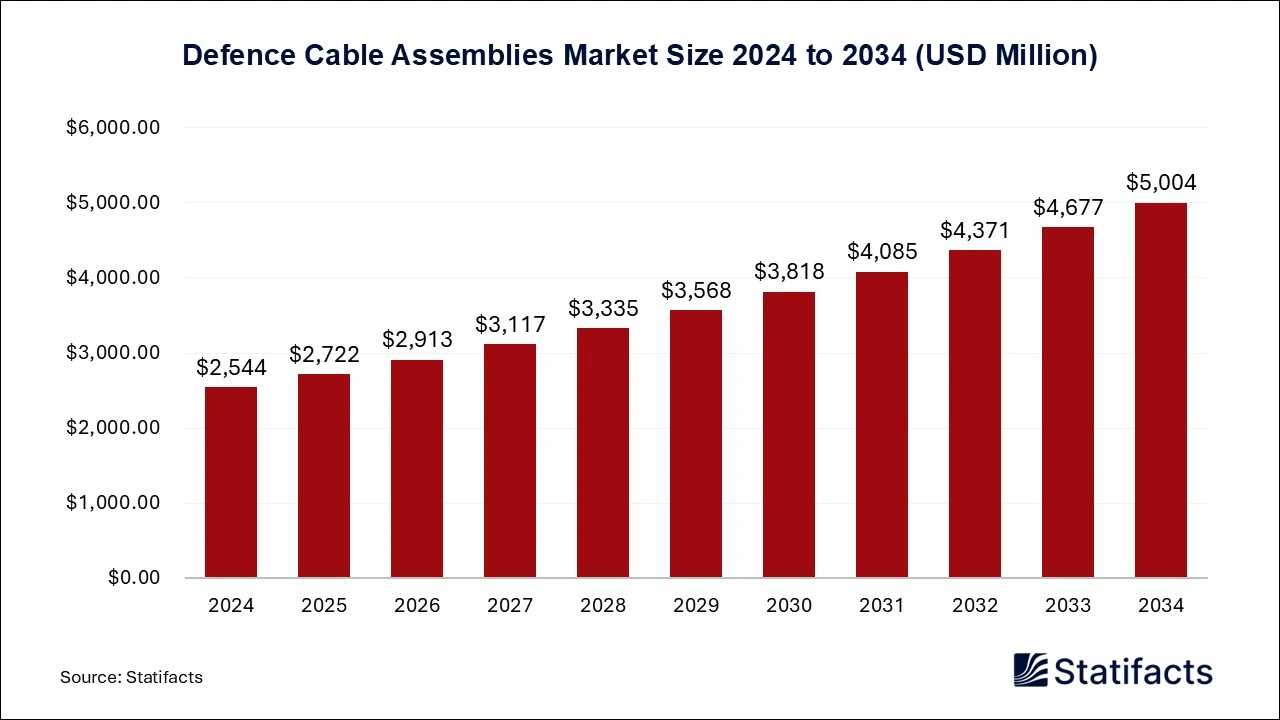
The global defence cable assemblies market size was valued at USD 2,722 million in 2025, is projected to reach approximately USD 5,317 million by 2035. This growth, fueled by increasing defense modernization and advanced communication systems, is expected at a CAGR of 6.92%.
| Reports Attributes | Statistics |
| Market Size in 2025 | USD 2,722 Million |
| Market Size in 2026 | USD 2,913 Million |
| Market Size in 2032 | USD 4,371 Million |
| Market Size by 2035 | USD 5,317 Million |
| CAGR 2026 to 2035 | 6.92% |
| Base Year | 2025 |
| Forecast Period | 2026 to 2035 |
The defence cable assemblies market is expanding steadily as armed forces worldwide continue to invest in advanced electronic systems, radar, avionics, and surveillance equipment that require durable and interference-free connectivity. Cable assemblies are integral to mission-critical defense platforms, including aircraft, naval vessels, ground vehicles, and command-and-control systems, where reliability under extreme environmental and electromagnetic conditions is paramount. The increasing integration of digital communication networks, unmanned aerial vehicles (UAVs), and battlefield automation technologies has heightened the need for specialized shielded and fiber optic cable assemblies.
However, the market faces restraints such as high production costs due to stringent military standards and complex testing requirements. Supply chain vulnerabilities, especially for rare materials and precision connectors, can disrupt production. Moreover, lengthy defense procurement cycles and budget constraints in certain regions may delay large-scale adoption.
The defence cable assemblies market is expected to grow more rapidly as AI and digital twin technologies become integral to cable system design, testing, and maintenance. Artificial intelligence enables predictive diagnostics, allowing early detection of signal loss, corrosion, or insulation failure before operational disruptions occur. AI-driven simulations optimize cable routing, electromagnetic compatibility, and performance under variable environmental conditions.
| Regions | Shares (%) |
| North America | 29.28% |
| Asia Pacific | 20.83% |
| Europe | 18.44% |
| LAMEA | 31.45% |
| Segments | Shares (%) |
| PVC Sheath | 40% |
| PUR Sheath | 60% |
| Segments | Shares (%) |
| Airborne Weapon Systems | 15.16% |
| Ground Weapon Systems | 22.12% |
| Naval Weapon Systems | 56.17% |
| Others | 6.56% |





