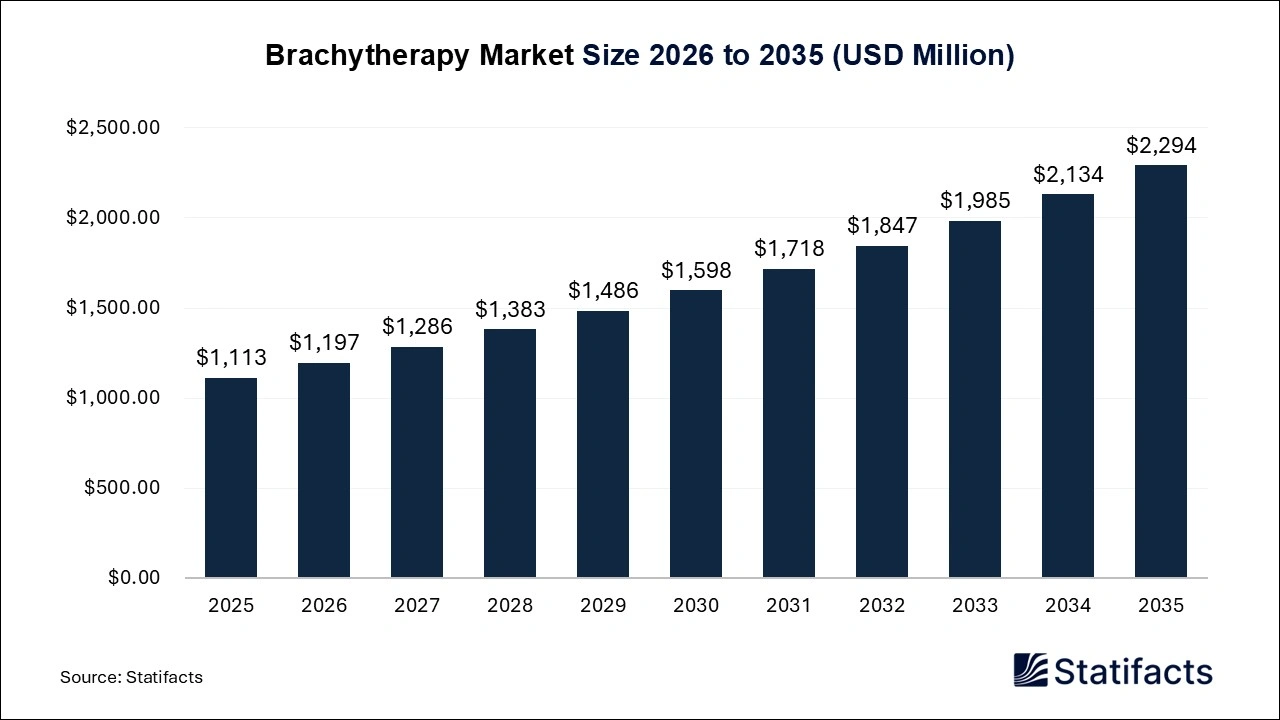
The global brachytherapy market, valued at over USD 1.11 billion in 2025, is poised to grow significantly, projected to reach approximately USD 2.29 billion by 2035. This represents a robust CAGR of 7.5%, driven by advancements in cancer treatment technologies and rising demand for targeted therapies.
Brachytherapy Market Statical Scope
| Reports Attributes |
Statistics |
| Market Size in 2025 |
USD 1,113 Million |
| Market Size in 2026 |
USD 1,197 Million |
| Market Size in 2032 |
USD 1,847 Million |
| Market Size by 2035 |
USD 2,294 Million |
| CAGR 2026 to 2035 |
7.50% |
| Base Year |
2025 |
| Forecast Period |
2026 to 2035 |
The growing cancer cases and the brachytherapy’s minimally invasive factor heads towards exponential market growth and expansion with the valuable government support and tech shifts. The advanced brachytherapy procedures, mainly HDR, are attracting outpatient convenience.
Brachytherapy is a form of internal radiation therapy known for its radioactive sources situated near the tumor for the dosages of radiation to flow directly towards the tumor, without harming the healthy tissues. It's popularly performed in skin, gynecological, breast, and prostate cancers. The temporary implants and permanent implants treatment strengthen the buildup of the market. The diversified potential of this market is also witnessed in eye, head/neck, and other non-cancer incidences.
The tech advancements, such as Artificial Intelligence-powered treatment planning and 3D imaging, are signalling tech proficiency, which encourages businesses with a layer of automated confidence in the market. This specialized therapy is in the growing oncology sector, bolstering the base of the other advanced therapies portfolio. The transition in outpatient care, electronic brachytherapy, and LDR seed is giving more recognition to the market. The regional champions and alliances are meeting the required ends of the innovations and investments to contribute to the market rate.
Brachytherapy Market Share, By Region, 2025 (%)
| Regions |
Shares (%) |
| North America |
45% |
| Europe |
25% |
| Asia-Pacific |
15% |
| Latin America |
10% |
| Middle East & Africa |
5% |
- North America – The North America regional segment dominated the market with 45% of strength in tech and healthcare infrastructure. The effective contribution of policies featuring the robust reimbursement frameworks from private insurers and the Medicare field. This stimulates the procedure growth with more space for financial support/access to uplift the regional market.
- Europe – Europe covers 25% of the market share due to the unification of AI-influenced treatment planning and 3D image-guidance. This unlocks accurate success for the producers, proving best in complicated cases. The smart regional policies elevate the market at the regulatory level.
- Asia-Pacific – Asia Pacific speeds with 15% of market share, with the rough and tough healthcare infrastructure contributing to the advanced AI-driven planning. The growing medical tourism is attracting more demand for modern brachytherapy devices and promoting minimally invasive procedures.
- Latin America – Latin America acquires 10% of the market as the efforts of the region successfully helped traditional LDR transform into HDR afterloaders. The heavy investment in the regional healthcare infrastructure is introducing advanced richness to the market.
- Middle East & Africa – MEA region leads with 5% of market share due to its HDR segmental power. The smart strategies of launching innovative treatment planning systems via collaborations are signalling more innovation in the regional market.
Brachytherapy Market Share, By Product, 2025 (%)
| Segments |
Shares (%) |
| Applicators & Afterloaders |
45% |
| Seeds |
20% |
| Electronic Brachytherapy |
35% |
- Applicators & Afterloaders – The applicators and afterloaders segment dominated the market by 45% with the rising number of HDR treatments. The demand for accurate oncology care and minimally invasive procedures drives segmental growth.
- Seeds – The seeds segment promotes 20% of market share due to the increasing breast and prostate cancer incidences. The seed-related treatments provide accurate radiation delivery with the favourable support of reimbursement policies.
- Electronic Brachytherapy – The segment rises by 35% of the market as the clinical efficacy, mainly for breast cancer and non-melanoma skin cancer, proves to unlock the key potential of the segment, while operational efficiency stays the core energy booster of the segment.
Brachytherapy Market Share, By Dosage type, 2025 (%)
| Segments |
Shares (%) |
| High-Dose Rate (HDR) |
72% |
| Low-Dose Rate (LDR) |
28% |
- High-Dose Rate (HDR) – The HDR segment dominated the market by 72% of profit with its booster effect on high-risk prostate cancer. The rise of HDR monotherapy, with the conviction of researchers and single fraction caution, drives responsible segmental growth.
- Low-Dose Rate (LDR) – The LDR segment held 28% of the market share, with its potential contribution to sublethal damage repair. Its single-handed capacity in treating low-risk cancers stimulates more segmental growth.
Brachytherapy Market Share, By Application, 2025 (%)
| Segments |
Shares (%) |
| Prostate Cancer |
34% |
| Gynecological Cancer |
25% |
| Breast cancer |
15% |
| Others |
26% |
- Prostate Cancer – The prostate cancer segment covers 34% of the market share, unveiling the best supportive tech advancements to the prostate cancer condition, like image-guided accuracy, stranded seeds, and real-time planning. The boost to salvage therapy is framing more scope for the segment to meet solutions.
- Gynecological Cancer – The segment acquires 25% of market share with the growing support of 3D IGABT. This helped medical professionals to serve accurate, higher radiation doses to protect the sensitive rectum and bladder organs. The hybrid applicators and eBT segment are the pillars of this segmental market.
- Breast cancer – The breast cancer segment covers 15% of the market due to the growing breast cancer cases. The treatment time, convenience, and access of brachytherapy therapy to patients over 50 promote the segmental growth to the larger patient population.
- Others – The skin cancer and other applications are experiencing exponential growth by 26%, enabling treatments to be streamlined in the healthcare sector with more focus on modern disease sites, with the market’s tech strength.