

Share


Blood Glucose Monitoring System Market (By Device Type: Continuous Glucose Monitoring Systems, Blood Glucose Meters; By Modality: Wearable, Non-wearable; By Type: Non-invasive, Invasive; By Patient Type: Type-1 Diabetes, Type-2 Diabetes; By Distribution Channel: Institutional Sales, Retail Sales; By Region: North America, Europe, Asia-Pacific, Latin America, and Middle East & Africa) Industry Size, Share, Growth, Trends 2026 to 2035

The blood glucose monitoring system market was valued at USD 18.32 billion in 2025 and is expected to reach USD 33.87 billion by 2035, growing at a CAGR of 6.34%. This growth is driven by the rising prevalence of diabetes and advancements in monitoring technology.
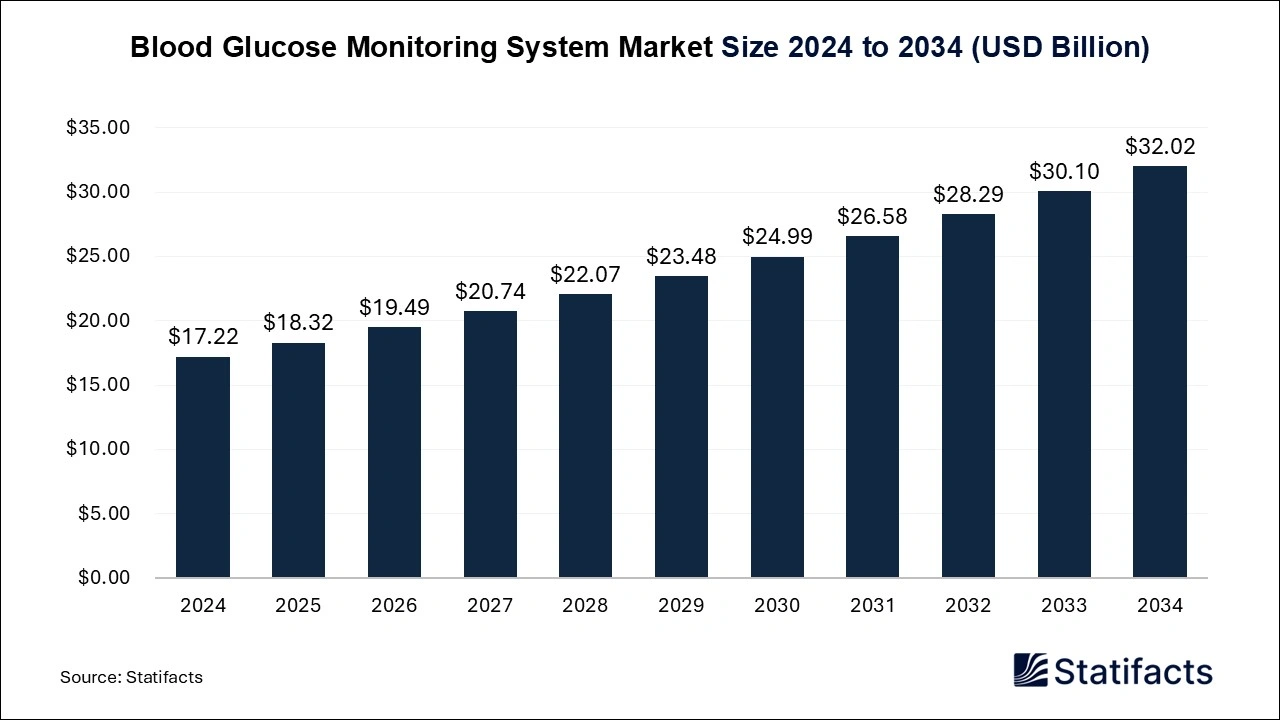
| Reports Attributes | Statistics |
| Market Size in 2025 | USD 18.32 Billion |
| Market Size in 2026 | USD 19.49 Billion |
| Market Size in 2032 | USD 28.29 Billion |
| Market Size by 2035 | USD 33.87 Billion |
| CAGR 2026 to 2035 | 6.34% |
| Base Year | 2025 |
| Forecast Period | 2026 to 2035 |
The blood glucose monitoring system market is gaining strong momentum as awareness about home-based healthcare increases in both developed and developing economies. More people are now taking responsibility for their own health, and managing blood sugar levels at home has become a regular part of diabetes care. The growing prevalence of diabetes, especially in regions with high obesity rates and aging populations, is fueling the need for accurate, convenient, and easy-to-use monitoring systems. Governments and healthcare organizations are also running awareness programs that encourage early diagnosis and self-monitoring, which is creating new opportunities for device manufacturers.
In developed markets such as North America and Europe, technology adoption is high, and continuous monitoring devices are gaining popularity among both patients and healthcare providers. In emerging markets such as India, China, and Brazil, demand is growing rapidly as healthcare infrastructure improves and consumer awareness of diabetes prevention increases. However, rural regions in many developing countries still face challenges. Limited access to healthcare facilities, high device costs, and a lack of understanding of how to use medical devices properly continue to slow adoption in these areas. Manufacturers are working to make devices more affordable and user-friendly to bridge this gap.
Recent technological advancements have completely transformed the market. The emergence of continuous glucose monitoring (CGM) systems that transmit real-time data directly to smartphones has made diabetes management more precise and convenient. These devices allow users to continuously track blood glucose trends rather than relying solely on periodic finger-prick tests. They provide more detailed insights into blood sugar fluctuations, helping doctors and patients make faster and more informed treatment decisions. The growing use of wearable technology and smart medical devices is also making glucose tracking more comfortable and accessible for people of all ages.
Artificial intelligence is playing a key role in the next phase of this market's growth. AI algorithms can analyze large amounts of data collected by glucose monitors to predict potential insulin spikes and suggest personalized treatment recommendations. Machine learning tools can recognize patterns in glucose levels, diet, and physical activity to provide early warnings and lifestyle advice. For healthcare professionals, AI-based analytics simplify patient monitoring by providing predictive insights and automated reporting, improving both care quality and efficiency.
As awareness about preventive healthcare and remote monitoring continues to rise, the blood glucose monitoring system market is expected to expand rapidly. The combination of user-friendly devices, smartphone integration, and AI-powered insights will make diabetes management smarter and more proactive. With growing innovation and global accessibility, these technologies are set to play a major role in improving patient outcomes and reducing the long-term impact of diabetes worldwide.
| Regions | Shares (%) |
| North America | 28.45% |
| Asia Pacific | 31.62% |
| Europe | 24.18% |
| LAMEA | 15.75% |
| Segments | Shares (%) |
| Continuous Glucose Monitoring Systems | 42.78% |
| Blood Glucose Meters | 57.22% |
| Segments | Shares (%) |
| Wearable | 46.31% |
| Non-wearable | 53.69% |
| Segments | Shares (%) |
| Non-invasive | 38.94% |
| Invasive | 61.06% |
| Segments | Shares (%) |
| Type-1 Diabetes | 34.57% |
| Type-2 Diabetes | 65.43% |
| Segments | Shares (%) |
| Institutional Sales | 41.12% |
| Retail Sales | 58.88% |
Published by Ajit Bansod





