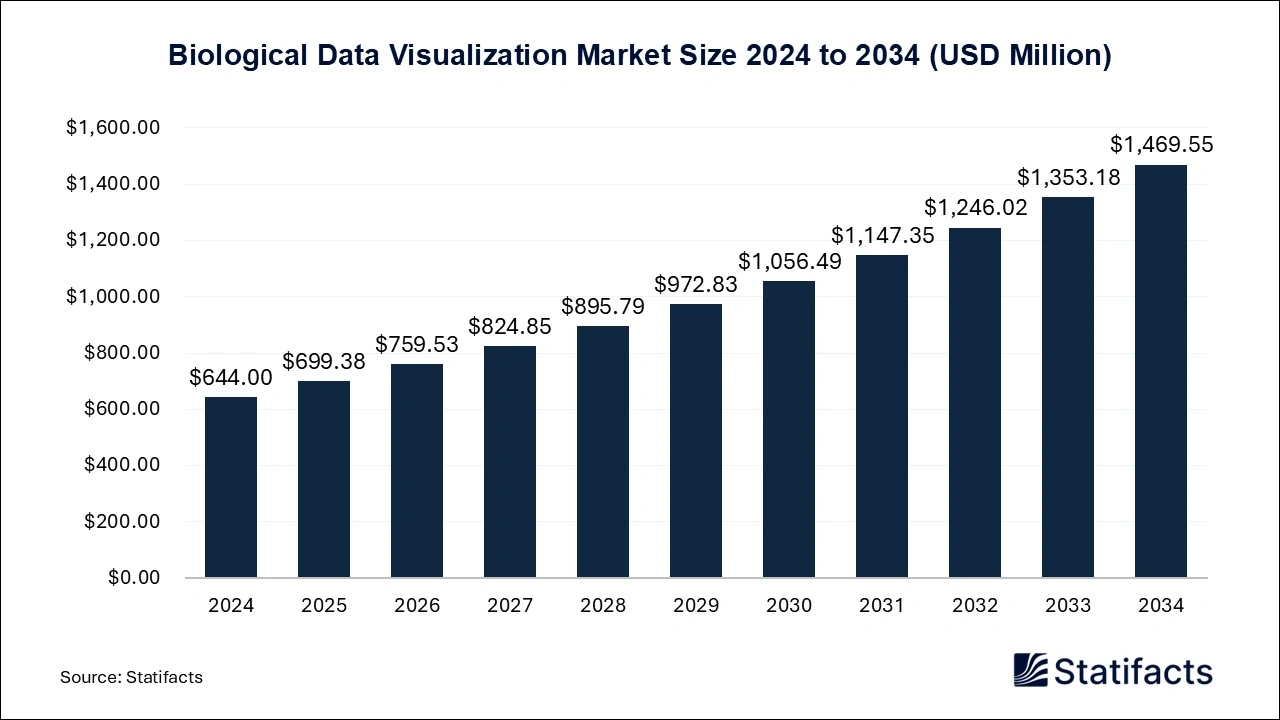
The global biological data visualization market size was estimated at USD 644 million in 2024 and is projected to be worth around USD 1,469.55 million by 2034, growing at a CAGR of 8.6% from 2025 to 2034.
Highlights of the Biological Data Visualization Market
- North America led the global market.
- Europe is projected to expand rapidly in the market in the coming years.
- By technique, the sequencing technique segment accounted for a considerable share of the market in 2024.
- By technique, the magnetic resonance imaging (MRI) segment is expected to grow at the fastest rate in the market during the forecast period of 2025 to 2034.
- By application, the cell & organism imaging segment registered its dominance over the global market in 2024.
- By application, the genomic analysis segment will gain a significant share of the market over the studied period of 2025 to 2034.
- By platform, the Windows segment held a dominant presence in the market in 2024.
- By platform, the Mac OS segment is set to experience the fastest rate of market growth from 2025 to 2034.
- By end-use, the academic research segment dominated the global market in 2024.
- By end-use, the pharmaceutical & biotechnology segment is predicted to witness significant growth in the market over the forecast period.
Industry Valuation and Growth Rate Projection
| Industry Worth |
Details |
| Market Size in 2025 |
USD 699.38 Million |
| Market Size by 2034 |
USD 1,469.55 Million |
| Market Growth Rate from 2025 to 2034 |
CAGR of 8.6% |
The biological data visualization market encompasses biological data visualization, an area of bioinformatics that deals with the application of computer graphics and the visualization of information akin to life sciences. Using graphical representations to transfer complicated biological facts from several data types like genomic, proteomic, and metabolomic data is what biological data visualization does.
Biological information can be obtained via data visualization tools like IGV, UCSC Genome Browser, and DNAPlotter, which help generate visual illustrations of the sequencing data. Data visualization in life science and biology has various major applications, including genomic analysis, systems biology, and experimental trial data analysis.
Biological Data Visualization Market: Stats and Figures
- Although NGS can be used to detect Parkinson's disease earlier, it affects a projected 7–13 million people globally..
- PD is a rare phenomenon before 50 years of age, with more than 1% of the people above 60 years and 4% over 80 years affected by PD.
Industry Leader Announcements
- Mr. Jacob Thaysen, CEO and Director at Illumina, Inc.
Providing insights on NGS, Thaysen said,” NGS will be deeply embedded in health care and will provide the highest quality of insight to ensure patients are given the most effective personalized care. In addition, sovereign nations will embrace whole genome sequencing, moving truly from sick care into health care. The power of NGS will unlock deeper insights in multiomics by multiomics.”
How AI Has Benefitted the Market
Thanks to Artificial Intelligence (AI), the biological data visualization market has shown tremendous potential in the field of research and data analysis. AI-powered tools are reshuffling complex procedures. The analysis of genetic sequences, phylogeny construction, and drug discovery is where AI is proving to be valuable for biological data visualization.
- BLAST (Basic Local Alignment Search Tool): It is an AI tool that can identify and compare genetic sequences like DNA or proteins.
- Drug Finding: By studying the data related to chemical compounds, AI and ML algorithms can support improvements in existing drugs, enabling cost-friendly and prompt treatments.
- Genomic Sequence Analysis: The immense data can be examined by AI algorithms, and using machine learning and deep learning, genetic variations and functions can be visualized, and the diseases linked to genes can be discovered.
- Protein Structure Estimate: The accuracy in predicting and evaluating the protein structures can be achieved by utilizing AI algorithms.
Recent Developments:
- Illumina’s CEO Jacob Thaysen shared the primacies of the company at the 42nd Annual J.P. Morgan Healthcare Conference 2024, and the investors were gratified after listening to him and sent the company enough shares to increase them from $133.66 to $139.74.
- It was announced that Evo 2, an AI model that understands genetic code created using the NVIDIA DGX Cloud platform with the collaboration of Arc Institute and Stanford University, is now available explicitly to global developers and scientists.
Geographical Insights
The global biological data visualization market is experiencing significant growth, with North America maintaining its position as the dominant region while Europe emerges as the fastest-growing market. In the APAC region, China stands out as a driver of growth in the space.
North America
- In 2024, North America held a major share of the global market. This dominance is attributed to several key factors, such as the rising adoption of advanced visualization tools in the healthcare and biotechnology sectors in the region.
As the U.S. healthcare sector is noted to be a prominent one globally, hefty investment in bioinformatics, including data visualization tools, is persistent. Innovations in the biological data visualization market can bud at a quicker pace due to initiatives such as the ONC’s interoperability standards by the government.
Europe
The region of Europe can be seen growing substantially as a consequence of soaring demand for research and development in data visualization.
- Corresponding to the International Trade Administration, Belgium’s pharmaceutical industry invests $1.64 billion in research and development every year, accounting for 40% of all the private investments in the country. A huge amount of complicated biological as well as clinical data processing can become more trouble-free and accurate.
India and APAC
The Asia Pacific biological data visualization market is projected to grow precipitously over the forecast period.
- In 2024, the bioeconomy sector of India earned approximately $130 billion, thus showing a positive impact on the biotechnology sector economy-wise. More importantly, technological advancements in the bioinformatics field have contributed to this colossal growth. The need for data visualization solutions rises in the country as a result of robust economic participation in the healthcare sector.
Competitive Landscape
The biological data visualization market is favorably competitive, with leading pharmaceutical companies such as Thermo Fisher Scientific, Agilent Technologies, QIAGEN, Illumina, ZEISS, Oxford Instruments, and Olympus Corporation holding most of the market share. Evolving biotech firms also play a crucial role by introducing innovative medicines and treatments, leading to a dynamic and progressing competitive landscape.
The market is dominated by several biotechnological companies well-known for their weighty contributions to the biological data visualization market. Based on current data, the top three leading companies are:
- Company Name: Thermo Fisher Scientific
- Year of Incorporation: 2006
- Headquarters: Waltham, United States
The total revenue of Thermo Fisher Scientific grew steadily from $42,857,000 in 2023 to $42,879,000 in 2024.
- Company Name: Agilent Technologies, Inc.
- Year of Incorporation: 1999
- Headquarters: Santa Clara, United States.
The gross profit of Agilent Technologies, Inc. was $3,535,000 in 2024.
- Company Name: Illumina, Inc.
- Year of Incorporation: 1998
- Headquarters: San Diego, United States.
The gross profit of Illumina, Inc. was $2,861,000 in 2024