



BESS Power Conversion System (PCS) Market (By Type: Centralised, String-based, Other; By Application: New Energy and Energy Storage Sector, Electricity and Grid Sector, Transport and Industrial Sector, Others; By Region: North America, Europe, Asia-Pacific, Latin America, Middle East and Africa) Industry Size, Share, Growth, Trends 2026 to 2035.

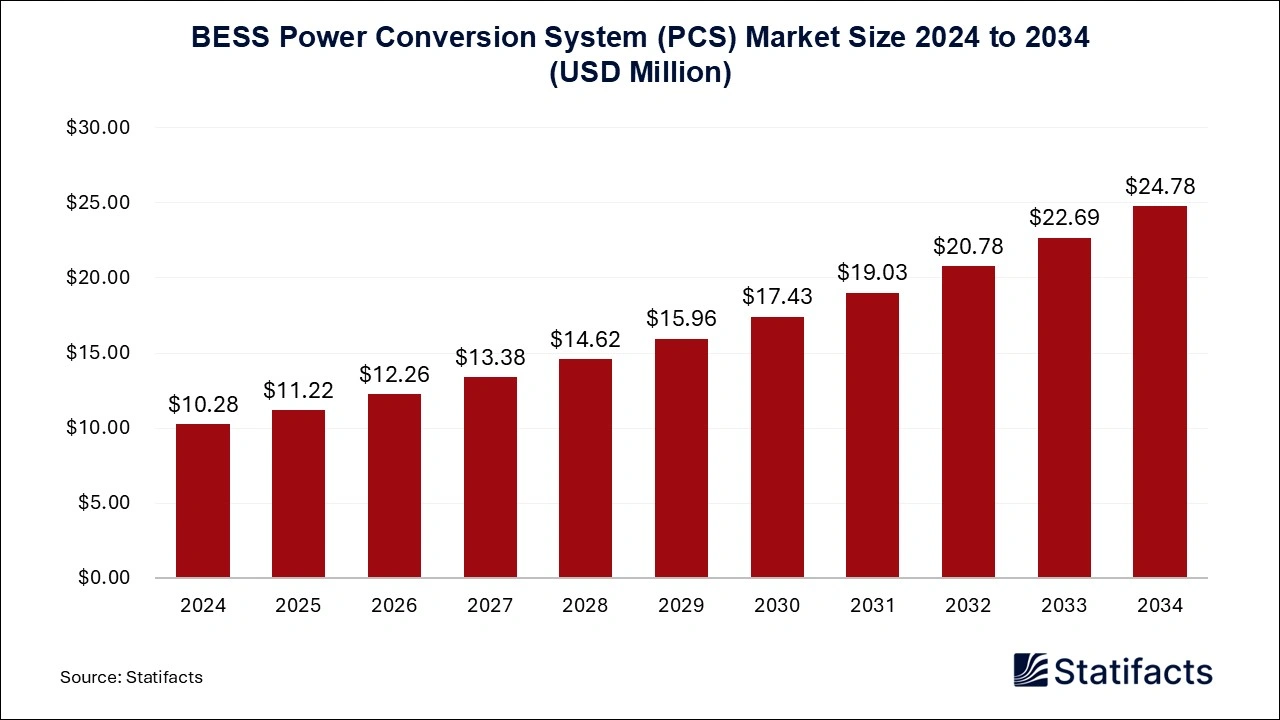
The global BESS power conversion system (PCS) market, valued at USD 11.22 billion in 2025, is projected to reach USD 26.75 billion by 2035, growing at a CAGR of 9.08% driven by the increasing demand for energy storage solutions and grid optimization technologies.
| Reports Attributes | Statistics |
| Market Size in 2025 | USD 11.22 Billion |
| Market Size in 2026 | USD 12.26 Billion |
| Market Size in 2032 | USD 20.78 Billion |
| Market Size by 2035 | USD 26.75 Billion |
| CAGR 2026 to 2035 | 9.08% |
| Base Year | 2025 |
| Forecast Period | 2026 to 2036 |
The greater adoption of renewable energy and smart electrification has actively accelerated digital transformation and sector evolution in recent years. With the rapid expansion of renewable energy and electrification, which is reflected in the need for grid flexibility and fast-response storage, the industry is pushing the boundaries of what it has achieved in recent years. Additionally, by converting battery DC to grid AC while providing critical frequency responses, battery energy storage systems have a significant market share in the current period. Projects like behind-the-meter and front-of-meter BESS projects globally have led to the emergence of high-impact solutions in the industry nowadays.
The industry opportunity has arisen from the development of software-defined PCS platforms in recent years. Moreover, by enabling value stacking where the single PCS can switch between wholesale arbitrage and frequency regulations, the manufacturer is likely to gain immense industry attention in the coming years. Additionally, manufacturers can maintain their growth by offering innovative packages, such as PCS hardware with subscription-based optimizations and cyber-secure cloud control, which is likely to create competitive advantages in the production space in the years to come.
The thermal management and safety for large power stacks are projected to obstruct innovation and development efforts in the coming years. Moreover, these high-power densities often require advanced cooling and fire mitigation systems, which create cost barriers in the BESS power conversion system (PCS) market and pose hurdles in the years to come. However, technological shifts, such as the adoption of wide-bandgap semiconductors and modular multilevel converter topologies, are likely to drive the industry during the forecast period.
| Regions | Shares (%) |
| North America | 26.30% |
| Asia Pacific | 34.20% |
| Europe | 24.80% |
| LAMEA | 14.70% |
| Segments | Shares (%) |
| Centralised | 48.20% |
| String-based | 41.30% |
| Other | 10.50% |
| Segments | Shares (%) |
| New Energy and Energy Storage Sector | 37.20% |
| Electricity and Grid Sector | 31.10% |
| Transport and Industrial Sector | 21.70% |
| Others | 10% |





