



Automotive Low-Voltage Cable Market (By Type: Power Cables, Signal Cables, Communication Cables, and Others; By Application: Passenger Vehicle and Commercial Vehicle; By Region: North America, Europe, Asia Pacific, Latin America, and Middle East & Africa) Industry Size, Share, Growth, Trends 2026 to 2035.

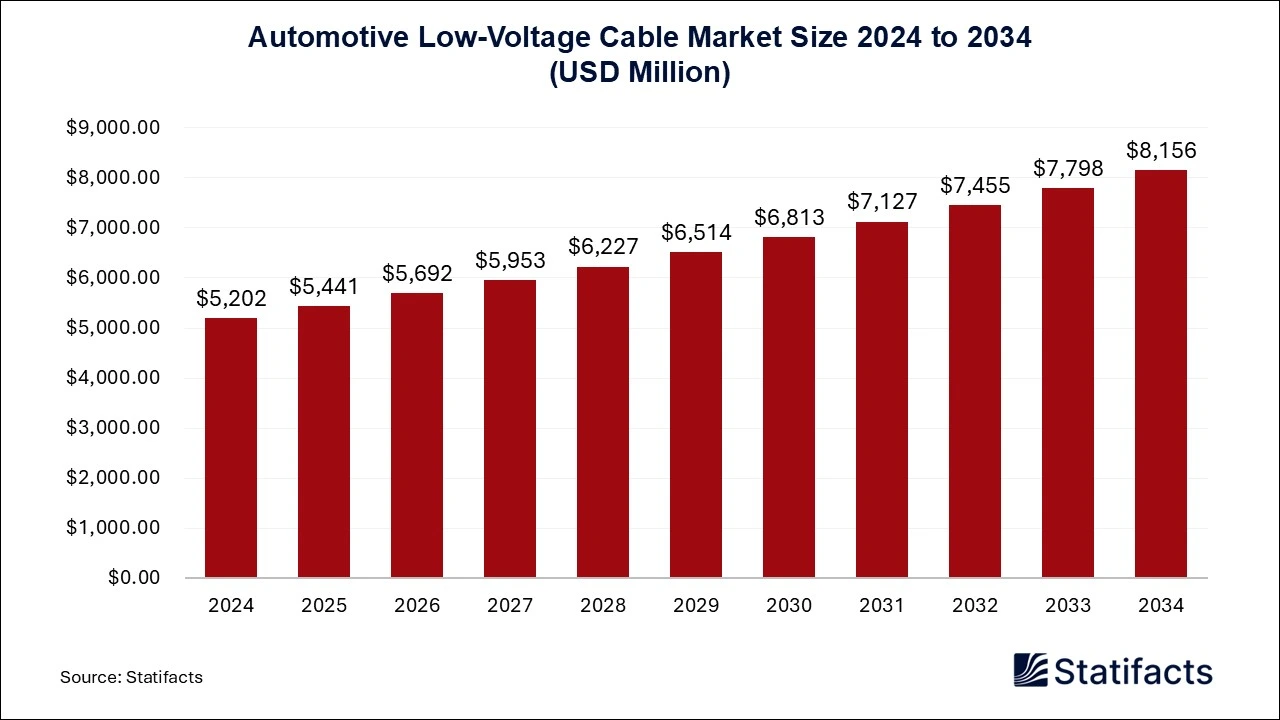
The global automotive low-voltage cable market size was valued at USD 5,441 million in 2025, is projected to reach approximately USD 8,504 million by 2035. This growth, driven by increasing vehicle electrification and advanced in-car electronics, is expected at a CAGR of 4.57%.
| Reports Attributes | Statistics |
| Market Size in 2025 | USD 5,441 Million |
| Market Size in 2026 | USD 5,692 Million |
| Market Size in 2032 | USD 7,455 Million |
| Market Size by 2035 | USD 8,504 Million |
| CAGR 2026 to 2035 | 4.57% |
| Base Year | 2025 |
| Forecast Period | 2026 to 2035 |
The automotive low-voltage cable market is emerging rapidly, driven by the increasing consumer demand for smart features such as infotainment, communication systems, and ADAS in vehicles. As a result, the demand for low-voltage wiring becomes crucial in such systems for better power management. The majority of the new vehicles are incorporating cameras, sensors, and control systems as an initiative to improve vehicle safety. However, budget vehicles may face difficulties in adopting these wiring systems due to fluctuating raw material prices, which increase overall costs and reduce profit margins.
The rising demand for EV and hybrid vehicles has led to a significant need for lightweight solutions, which is helping the automotive low-voltage cable market to expand rapidly. The automotive sector is using artificial intelligence AI and machine learning ML to optimize the design and improve the energy efficiency of these vehicles. Additionally, the use of AI is expected to aid in predictive maintenance of vehicles, preventing wiring defects before any major loss.
| Regions | Shares (%) |
| North America | 25% |
| Asia Pacific | 40% |
| Europe | 20% |
| LAMEA | 15% |
| Segments | Shares (%) |
| Power Cables | 40% |
| Signal Cables | 25% |
| Communication Cables | 15% |
| Other | 20% |
| Segments | Shares (%) |
| Passenger Vehicle | 60% |
| Commercial Vehicle | 40% |
Published by Ajit Bansod





