



Asia Pacific Generic Drugs Market (By Drug Type: Simple Generics, Super Generics; By Brand: Pure Generic Drugs, Branded Generic Drugs; By Route of Drug Administration: Oral, Injection, Cutaneous, Others; By Therapeutic Application: Central Nervous System (CNS), Cardiovascular, Infectious Diseases, Musculoskeletal Diseases, Respiratory, Oncology, Others; By Distribution Channel: Retail Pharmacy, Hospital Pharmacy, Online and Others) Industry Size, Share, Growth, Trends 2026 to 2035

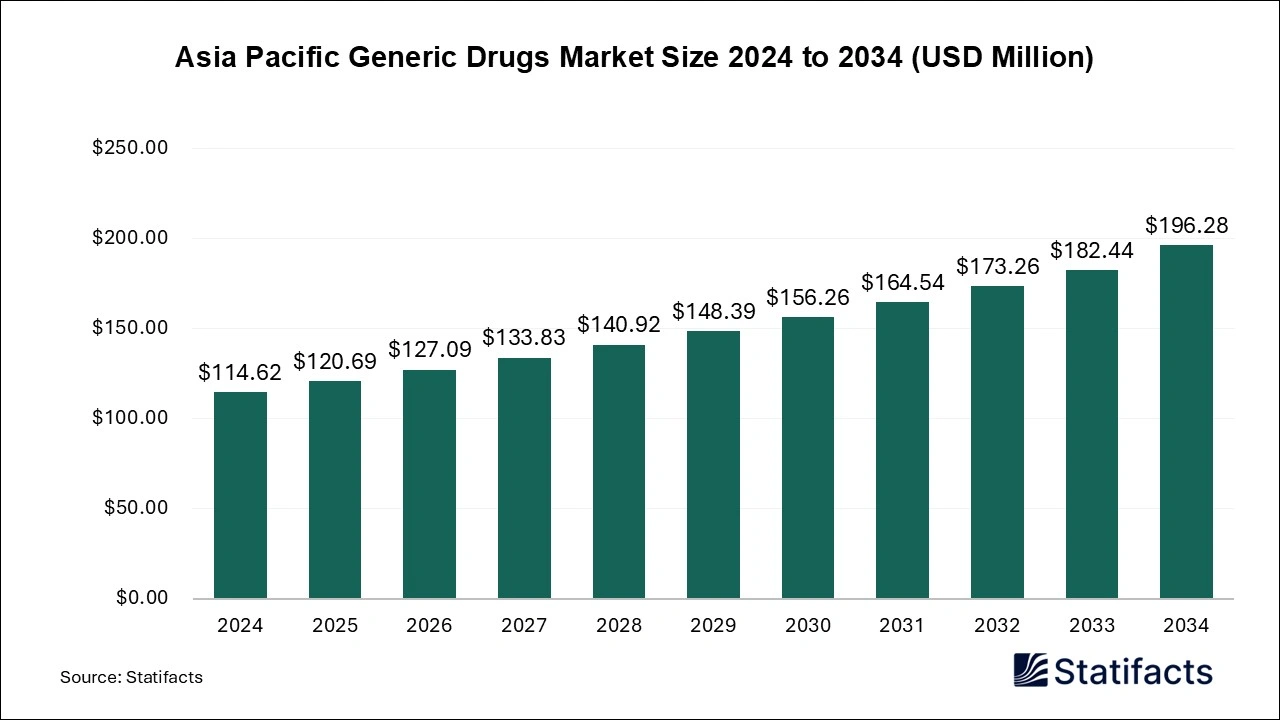
The Asia Pacific generic drugs market exceeded USD 120.69 million in 2025 and is forecast to reach approximately USD 207.01 million by 2035, growing at a 5.54% CAGR, supported by rising healthcare access, patent expirations, and cost-efficient treatment demand.
| Reports Attributes | Statistics |
| Market Size in 2025 | USD 120.69 Million |
| Market Size in 2026 | USD 127.09 Million |
| Market Size in 2032 | USD 173.26 Million |
| Market Size by 2035 | USD 207.01 Million |
| CAGR 2026 to 2035 | 5.54% |
| Base Year | 2025 |
| Forecast Period | 2026 to 2035 |
The Asia Pacific generic drugs market is expanding at a significant pace due to the increasing chronic disease burden, such as diabetes, cancer, and cardiovascular and respiratory conditions, which are significantly increasing the requirement for long-term medication. The region's large population base also often struggles to sustain itself financially for long-term use, creating strong demand for generic medicines. The large number of expiring patents is also helping in the rising adoption of equivalent medications that can meet the demand in the region. The rise of generic drug manufacturing is also witnessing growth, as it reduces development costs and the selling price for local users.
The emergence of generic medicines can be hampered for companies that fail to meet regulatory standards set by the FDA, EMA, and WHO. As a result, the government in the region does not allow them to circulate these medicines due to safety concerns. The rural areas in the region are also a major factor: they lack pharmacy chains despite a huge consumer base, which can hamper the supply and demand for these companies.
The future of the generic drugs market in Asia is highly driven by the growing government focus on expanding the use of generics in public healthcare settings. The growing number of approval pathways and domestic manufacturing also supports the increasing adoption of these generic drugs. Additionally, domestic manufacturing expansion is expected to help companies increase export rates to other developing nations. The rising digitization and improvements in accessibility are also likely to attract a huge consumer base from 24/7 offline and online services. The government is expected to select cost-effective tenders, which are generic drugs, to improve the penetration in the rural and semi-urban areas.
The integration of technologies such as Artificial Intelligence (AI) and Machine Learning (ML) is playing a significant role in reducing regulatory submission time and eliminating trial failures by simulating dissolution behavior, predicting excipient interactions, and more. Human error and requirements are also decreasing as these technologies are used for quality monitoring during the manufacturing process, including tablet thickness, coating, and more. These models simulate how a drug will behave in a virtual patient population and can be used to predict the bioequivalence rate.
India is a major player in the Asia-Pacific generic drugs market, with increasing acceptance from authorities such as the FDA, which is helping manufacturers expand their businesses. A report by the Economic Times stated that in 2023, India’s pharmaceutical industry was the third-largest by volume, producing 60,000 generic drugs across 60 therapeutic categories. The government's PLI scheme is still helping domestic manufacturers expand their businesses in the country at a rapid pace. The country is expected to invest more in rural areas, which will increase drug production in the future.
China is the leading country in global generic drug manufacturing, and the government has been helping it grow through higher approval rates. The NIH data indicate that more than 95% of China’s 1,70,000 drugs are generic. The country's low-cost manufacturing rate has helped it become a global leader, with most of its business coming from supplying these drugs to other leading countries. Constant advancements, such as automated manufacturing and biotech investments, are expected to help them maintain a major share in the Asia Pacific generic drugs market.
| Segments | Shares (%) |
| Simple Generics | 33.57% |
| Super Generics | 66.43% |
| Segments | Shares (%) |
| Pure generic drugs | 55.31% |
| Branded generic drugs | 44.69% |
| Segments | Shares (%) |
| Oral | 38.14% |
| Injection | 21.47% |
| Cutaneous | 24.93% |
| Others | 15.46% |
| Segments | Shares (%) |
| Central Nervous System (CNS) | 13.94% |
| Cardiovascular | 14.98% |
| Infectious Diseases | 17.42% |
| Musculoskeletal Diseases | 15.07% |
| Respiratory | 13.61% |
| Oncology | 13.61% |
| Others | 11.60% |
| Segments | Shares (%) |
| Retail Pharmacy | 47.35% |
| Hospital Pharmacy | 39.21% |
| Online and Others | 13.44% |
Published by Deepa Pandey





