



Asia Pacific Asthma Treatment Market (By Component Type: Smart Meters, Electric Vehicle Supply Equipment (EVSE), Software, Home Energy Management (HEM); By Application Type: Battery Electric Vehicles (BEVs), Fuel Cell Vehicles (FCVs), Plug-in Hybrid Electric Vehicles (PHEVs)) Industry Size, Share, Growth, Trends 2026 to 2035

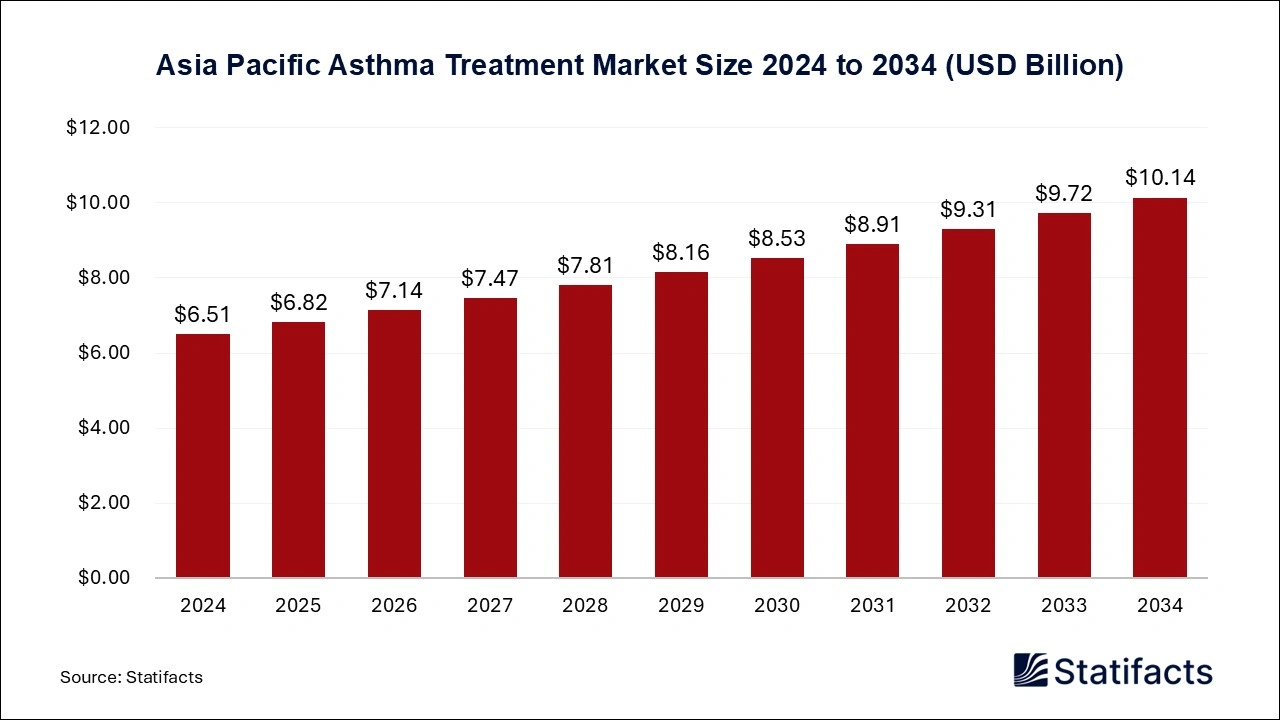
The Asia Pacific asthma treatment market reached USD 6.82 billion in 2025 and is expected to grow to nearly USD 10.55 billion by 2035, propelled by rising asthma prevalence and expanding access to advanced respiratory therapies, at a 4.46% CAGR.
| Reports Attributes | Statistics |
| Market Size in 2025 | USD 6.82 Billion |
| Market Size in 2026 | USD 7.14 Billion |
| Market Size in 2032 | USD 9.31 Billion |
| Market Size by 2035 | USD 10.55 Billion |
| CAGR 2026 to 2035 | 4.46% |
| Base Year | 2025 |
| Forecast Period | 2026 to 2035 |
Demand is increasing because asthma remains a major chronic respiratory disease across the Asia Pacific and because environmental and lifestyle factors are worsening control in many areas. According to the World Health Organization, asthma affected an estimated 262 million people in 2019, and effective inhaled medication remains the cornerstone of long-term control.
National- and region-level data show notable burdens that feed demand for treatment. India carries a large share of cases, with the Global Burden of Disease estimating tens of millions affected, which drives the need for primary care diagnosis and medications. China has seen a rising prevalence in urban areas, especially among children, prompting higher use of inhaled corticosteroids and combination therapies. These epidemiologic trends are increasing demand for both basic inhaler delivery devices and newer targeted medicines.
Underdiagnosis and under-treatment remain large barriers. Many people with asthma lack formal diagnosis or access to regular follow-up, so they rely on episodic care and over-the-counter remedies rather than controller therapy. Health-system gaps, limited specialist coverage outside major cities, and stigma or low disease awareness reduce consistent use of inhaled corticosteroids and guideline-directed care. The Global Asthma Report 2022 stresses that gaps in diagnosis and access limit control in low- and middle-income settings.
Cost and access to advanced therapies are also limiting factors. Biologic agents that transform care for severe eosinophilic asthma are expensive and are not reimbursed in many Asia-Pacific countries. Supply-chain issues, variable regulatory pathways, and local affordability constraints slow uptake of these therapies even where clinical need is high. At the same time, poor air quality and seasonal exposures increase the risk of exacerbations, counteracting gains from improved treatments.
Asia Pacific is diverse: high-income economies such as Japan, South Korea, and Australia show near-universal access to guideline-based inhaled therapies, growing use of smart inhalers, and an earlier adoption curve for biologics and digital therapeutics. Middle-income markets such as China and Thailand are rapidly expanding inhaler penetration and specialty clinic networks, driven by public investment in respiratory care and urbanization. Low- and middle-income parts of the region face slower scale-up of controller therapy and limited specialist access, which concentrates severe-case management in urban centers.
Policy and guideline moves are reshaping the market. The Global Initiative for Asthma updates and national programs have promoted earlier use of inhaled corticosteroid-formoterol regimens, and countries that adopt these protocols see faster uptake of combination inhalers. Telehealth and digital adherence tools are emerging across the region, improving follow-up and medication adherence where primary care capacity is limited.
China is a core growth engine because of its population size, urbanization, and rising diagnosed prevalence in children and adults. Recent national surveys and public health analyses report rising urban asthma rates, prompting greater demand for inhaled corticosteroids, combination inhalers, and specialty referrals. Government investment in respiratory infrastructure and the expansion of private clinic networks are improving access to diagnostics and inhaler therapies, while e-health platforms are accelerating patient education and remote monitoring.
India has a major unmet need and high case volume, with GBD estimates indicating a very large national asthma burden that drives both public health attention and market demand. Key constraints include underdiagnosis, rural access gaps, and cost barriers to newer biologics. However, urban centers and private respiratory clinics are modernizing care with guideline-based inhaler use, and ongoing public programs aim to raise awareness and reduce emergency presentations. Expansion of affordable combination inhalers, broader primary-care training, and investments in air-quality interventions will be central to market growth.
| Regions | Shares (%) |
| Long-Term Control Medications | 52.11% |
| Quick-Relief Medications | 47.89% |
| Segments | Shares (%) |
| Injectable | 21.37% |
| Oral | 38.92% |
| Inhaled | 39.71% |
| Segments | Shares (%) |
| Hospital Pharmacies | 29.18% |
| Retail Pharmacies & Drug Stores | 48.03% |
| Online Pharmacies | 22.79% |
Published by Ajit Bansod





