

Share


Telemedicine Information System Market (By Type: Hardware, Software, and Services; By Application: Hospitals & Clinics, Diagnostic Centers, Research & Academic Institutions, Pharmacies, and Others; By Region: North America, Europe, Asia Pacific, and LAMEA) Industry Size, Share, Growth, Trends 2026 to 2035

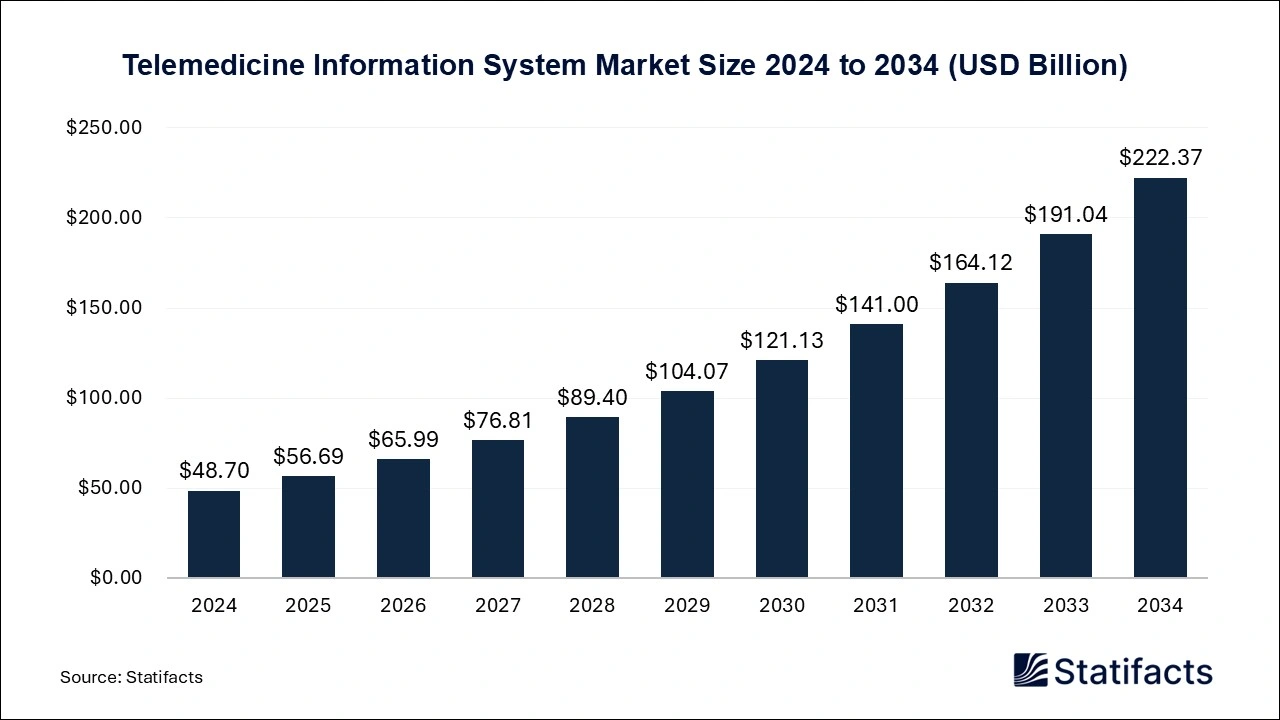
The global telemedicine information system market size was valued at USD 56.69 billion in 2025, is projected to reach approximately USD 250.76 billion by 2035. This strong growth, fueled by digital healthcare adoption and remote patient monitoring demand, is expected at a CAGR of 16.03%.
| Reports Attributes | Statistics |
| Market Size in 2025 | USD 56.69 Billion |
| Market Size in 2026 | USD 65.99 Billion |
| Market Size in 2032 | USD 164.12 Billion |
| Market Size by 2035 | USD 250.76 Billion |
| CAGR 2026 to 2035 | 16.03% |
| Base Year | 2025 |
| Forecast Period | 2026 to 2035 |
The telemedicine information system market is witnessing rapid growth as healthcare providers and governments invest in digital platforms to improve healthcare accessibility, reduce patient waiting times, and optimize resource utilization. Telemedicine information systems integrate video consultations, electronic health records (EHR), diagnostic data, and remote monitoring tools into a unified digital ecosystem, enabling real-time interaction between patients and clinicians. The rise in telehealth adoption during and after the COVID-19 pandemic, coupled with growing awareness of digital healthcare’s convenience and cost-efficiency, has significantly boosted market demand.
However, challenges such as data privacy concerns, limited interoperability among telemedicine platforms, and unequal access to digital infrastructure in rural regions act as key restraints. Regulatory variations across countries and cybersecurity threats also pose risks to long-term adoption.
The telemedicine information system market is expected to grow more rapidly as artificial intelligence AI and data analytics become integral to telehealth platforms. Artificial intelligence enables automated triage, symptom assessment, and predictive diagnosis, allowing clinicians to prioritize cases more effectively. Machine learning algorithms can analyze patient data to deliver personalized treatment recommendations and remotely monitor chronic conditions. AI-driven cybersecurity tools enhance patient data protection, while natural language processing (NLP) improves medical documentation and virtual assistant capabilities.
| Regions | Shares (%) |
| North America | 36.02% |
| Asia Pacific | 28.39% |
| Europe | 24.25% |
| LAMEA | 10.81% |
| Segments | Shares (%) |
| Hardware | 41.18% |
| Software | 30.25% |
| Services | 28.57% |
| Segments | Shares (%) |
| Hospitals & Clinics | 41.64% |
| Diagnostic Centers | 16.89% |
| Research & Academic Institutions | 13.56% |
| Pharmacies | 12.79% |
| Others | 15.13% |
Published by Yogesh Kulkarni





