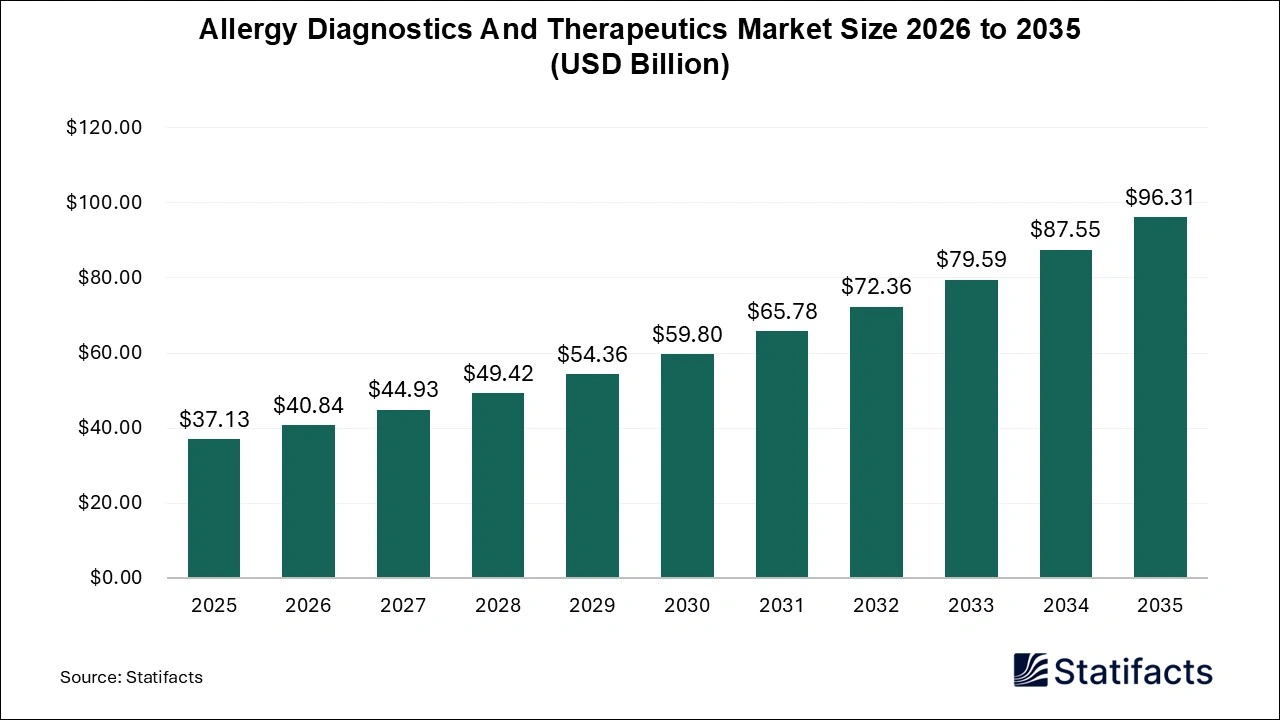
The global allergy diagnostics and therapeutics market is poised for significant growth, expected to expand from over USD 37.13 billion in 2025 to approximately USD 96.31 billion by 2035, reflecting a robust CAGR of 10%.
Allergy Diagnostics And Therapeutics Market Statical Scope
| Reports Attributes |
Statistics |
| Market Size in 2025 |
USD 37.13 Billion |
| Market Size in 2026 |
USD 40.84 Billion |
| Market Size in 2032 |
USD 72.36 Billion |
| Market Size by 2035 |
USD 96.31 Billion |
| CAGR 2026 to 2035 |
10% |
| Base Year |
2025 |
| Forecast Period |
2026 to 2035 |
The allergy diagnostics and therapeutics market retains its position as the highest-share segment with the highest CAGR in the healthcare sector. The lifestyle fluctuation and at-home testing services reserve massive profit for the labs and this market. The growing conditions of food allergies, allergic rhinitis, and asthma are paving more demand for precision care and accurate diagnostics to prevent any severity.
The sole purpose of allergy diagnostics and therapeutics is to diagnose skin irritation/condition and provide effective medication for the same. The specialized treatments, tests, and robust medical tools encompass the advanced innovations and biologics to prove the market potential in the healthcare spectrum. The main base for the specialized treatment is the awareness of the allergy type. While the diversified tests, like in vitro and in vivo, introduce the specification of blood and skin tests, which are popular in this market.
The cure depends on the condition and symptoms to further modify it into a particular timeframe and medication. The business perspective in this market focuses on the wider segments, ranging from type, unification of digital health technologies, and rapid advancement in precision medicine. Each of the segments and involvement of robust technologies aligns with the profit and improvement in the market strategy and growth.
Allergy Diagnostics And Therapeutics Market Share, By Region, 2025 (%)
| Regions |
Shares (%) |
| North America |
16.34% |
| Europe |
14.07% |
| Asia-Pacific |
25.63% |
| Latin America |
22.33% |
| Middle East & Africa |
21.63% |
- North America – North America is popular for its modern healthcare infrastructure, which strongly supports new innovation and manages complex demonstrations to promote the market strength. Alongside, the rapid adoption of biologics paves the way for the market to excel in its potency.
- Europe – Europe is leading with its innovation and sincere improvement in the personalized medicine and molecular diagnostics area. This calls for the expansion of allergy diagnostics to the modernized area.
- Asia-Pacific – The region is experiencing a massive expansion of allergy-based cases due to the high prevalence of allergic conditions. The regional market for in vitro diagnostics, mainly in India, Japan, and China, is bolstering the market growth.
- Latin America – Latin America’s allergy diagnostics and therapeutics sector is strategically enhancing the facilities and doubling the laboratory potential volume to suit the market's advanced scope, including a best-in-class infrastructure ecosystem for the market to rise.
- Middle East & Africa – MEA’s advanced diagnostics strategy focusing on molecular diagnostics, and therapeutic improvement initiative by extending immunotherapy alternatives is bringing more profit to the regional industry.
Allergy Diagnostics And Therapeutics Market Share, By Type, 2025 (%)
| Segments |
Shares (%) |
| Diagnostics |
33.69% |
| Therapeutics |
66.31% |
- Diagnostics – The diagnostics segment gains promising profit with the suitable drug delivery options like consumables and support of instruments to render best-in-class services during the diagnostics procedure.
- Therapeutics – The numerous therapeutics, like epinephrine, immunotherapy, decongestants, immune-modulators, corticosteroids, etc., are unlocking the potential of the market with each of the precision therapeutics supporting the diversified approaches.
Allergy Diagnostics And Therapeutics Market Share, By Allergen Type, 2025 (%)
| Segments |
Shares (%) |
| Food |
15.16% |
| Inhaled |
22.12% |
| Drug |
56.17% |
| Other allergen types |
6.56% |
- Food – The popular food segment involves the allergy possibilities through various foods like peanuts, wheat, soy, tree nuts, poultry products, dairy products, etc. They act as an awareness alarm, triggering allergies due to allergic food intake.
- Inhaled – The bad air pollution involving any harmful gases/chemical in the air can cause asthma and any respiratory allergy. The growing rate of asthma cases is high in the U.S., with the same number of regional respiratory allergic cases; molecular diagnostics is in high demand.
- Drug – Most of the patients with vulnerable and unknown health conditions are prone to drug allergy. Learning the same, the aim of monoclonal antibodies targeting IgE is strengthened, enhancing ASIT and rechecking with the drug volume.
- Other allergen types – The various other allergens, like contact allergens and venom allergens, are some of the common types, and the solutions for the same are available at the chemist stores, depending on the severity of the condition.
Allergy Diagnostics And Therapeutics Market Share, By Test Type, 2025 (%)
| Segments |
Shares (%) |
| In Vivo Tests |
65.06% |
| In Vitro Tests |
34.94% |
- In Vivo Tests – The in vivo tests include skin prick, intradermal, and patch tests, providing the best results and precision accordingly. The skin prick test is one of the quickest and most highly sensitive tests. The growing enhancement to safety and standardization promotes quality in vivo testing materials.
- In Vitro Tests – The in vitro tests consist of BAT and component-resolved diagnostics, which are apt to treat food and drug allergies. The precision nature fits in POC testing with automation, and AI boosts meeting greater efficiency in testing.